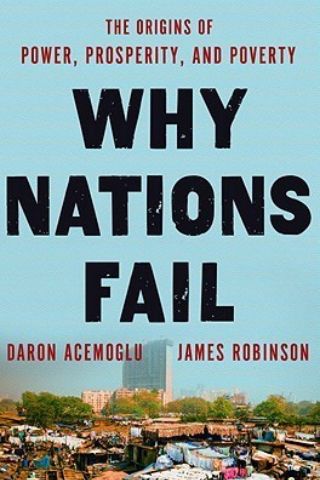
Why Nations Fail
| Book Author | |
|---|---|
| Published | March 1, 2012 |
| Pages | 529 |
| Greek Publisher | Λιβάνης |
The Origins of Power, Prosperity, and Poverty
What’s it about?
Why Nations Fail revolves around the question as to why even today some nations are trapped in a cycle of poverty while others prosper, or at least while others appear to be on their way to prosperity. The book focuses largely on political and economic institutions, as the authors believe these are key to long-term prosperity.
About the author
Daron Acemoglu (b. 1967) is a professor of economics at MIT and ranks among the most highly respected economists in the world. He received the John Bates Clark Medal, which is regarded as the precursor to the Nobel Prize.
James A. Robinson (b. 1932)is a political scientist, an economist and a professor at Harvard. He has done research in Latin America and Africa, and is widely considered an expert in foreign aid.
What’s it about?
Why Nations Fail revolves around the question as to why even today some nations are trapped in a cycle of poverty while others prosper, or at least while others appear to be on their way to prosperity. The book focuses largely on political and economic institutions, as the authors believe these are key to long-term prosperity.
About the author
Daron Acemoglu (b. 1967) is a professor of economics at MIT and ranks among the most highly respected economists in the world. He received the John Bates Clark Medal, which is regarded as the precursor to the Nobel Prize.
James A. Robinson (b. 1932)is a political scientist, an economist and a professor at Harvard. He has done research in Latin America and Africa, and is widely considered an expert in foreign aid.
Basic Key Ideas
It doesn’t take more than a few minutes of flicking through the news before some pretty basic questions start kicking in. Why are some nations rich and others poor? And how do some nations end up prosperous and tolerant, while others sink into elite despotism and self-interested greed?
It’s been common over the centuries to explain away such historical trends through a nation’s culture or location. But in truth, it’s the development of a country’s institutions that matter. In the course of history, all nations are faced with forks in the road, which lead them to building and sustaining institutions that are either inclusive or exclusive. It’s the fallout and landscapes built from such institution-building that is explored here. And it’s this that explains how nations can either prosper or fail.
In these blinks you’ll learn
- why it took centuries for the printing press to catch on in the Ottoman Empire;
- how the power of unions faced down the military dictatorship in Brazil; and
- how Western Europe benefited from the destructive Black Death.
On the border shared by Mexico and the United States there lies a town that’s divided in half between the two nations. The residents of Nogales, Arizona have a much higher standard of living than those living south of the border in Nogales, Sonora. They have better access to healthcare and education, their crime rates are lower, and the average household income is three times higher.
What causes such differences? The geography hypothesis has been the most influential theory designed to explain such inequality – but that theory falls short here.
It was most famously espoused by the eighteenth-century French philosopher Montesquieu. He maintained that inhabitants of warmer, more tropical climates were lazier than the harder working, more resourceful types who lived in more temperate climes.
In modern times, the theory has morphed to emphasize the presence of diseases in warmer regions such as Africa, South Asia and Central America, as well as the supposed poor soil quality of those regions, which allegedly inhibits economic growth.
But it isn’t just Nogales that disproves such ideas. Just look at differences between South and North Korea, the former countries of East and West Germany, and the massive economic leaps made by Botswana, Malaysia and Singapore.
Two other classically cited theories don’t stand up either.
The first is the cultural hypothesis. In the early twentieth century, German sociologist Max Weber claimed that Western Europe’s high rate of industrialization, in contrast to the rest of the world, had been caused by its “Protestant work ethic.”
But just look at Korea, a peninsula that was culturally homogenous until the split between communist North and capitalist South. The cultural hypothesis simply cannot explain the differences in inequality between the two. It’s the existence of the border that has caused such disparities, rather than deep and significant cultural differences.
The ignorance hypothesis operates in a similar field as the cultural hypothesis. It suggests that poverty results from a dearth of knowledge regarding policies that might encourage economic growth.
The counter example here is obvious: foreign aid and expert advice brought to countries in Africa have largely failed to make a lasting difference.
However, there is a more compelling theory that explains international inequality. Let’s look at it now.
Forget grand theories that try to explain away variations in prosperity between countries. The truth is far simpler. What really matters are economic and political institutions.
A given country’s prosperity is determined by its economic institutional landscape – the systems and regulations that direct economic behavior within its borders. That landscape includes property laws, the strength of public services and access to finance.
These economic institutions fall into one of two categories: extractive or inclusive.
Inclusive economic institutions stimulate economic success and are designed to encourage participation in economic activities. They also nurture economic freedom.
In countries like South Korea and the USA, for instance, market rules derive from private property laws, as well as from developed banking sectors and strong public education systems.
These rules enable people to know they can work hard and be innovative, certain that their efforts will be remunerated and their wealth will be preserved.
In contrast, extractive institutions derive incomes from groups within society for the benefit of other groups. In colonial Latin America, for example, a system built on duress and the expropriation of indigenous populations was designed to benefit the colonizers. In North Korea, the Kim family founded a regime that repressed the populace, outlawed private property and concentrated all power within a select elite.
Much like economic institutions, political institutions can also be inclusive or extractive.
The main characteristic of inclusive political institutions is pluralism. This means that various groups in a given society are politically represented, therefore power is shared between them. For institutions to be truly inclusive, it’s also essential that they are centralized. Centralization of power results in the rule of law being upheld; there is no need for these different groups to fight each other for superiority.
If political institutions lack pluralism or centralization, then they can generally be spoken of as being extractive.
The benefit of inclusive political institutions is that they result in power-sharing between groups. This leads to the erasure of extractive economic policies and, consequently, in mutual economic benefits for all members of society.
One event more than any other shaped the medieval and early modern periods in Europe. In the mid-fourteenth century, the Black Death traveled along established trading routes from the Far East to the European continent. Almost half its population died in the plague’s devastation.
Alongside the human devastation, the ensuing economic fallout shaped Europe for centuries to come.
The Black Death is therefore an example of what is known as a critical juncture – that is, an event capable of overturning the sociopolitical balance of a nation, a continent or even the entire world.
Prior to the arrival of the Black Death in Europe, the continent’s social and economic systems were shaped by a highly extractive form of governance and control called feudalism.
A country’s monarch owned land that he allotted among his lords, who, in turn, were obliged to provide military capabilities when needed. This land was then tended to by the lord’s peasants, who had to pay most of their harvest back to their lord in taxes. Peasants were not permitted to migrate without their lord’s permission. To top it off, the lord also held judicial power over them.
However, the Black Death caused massive labor shortages. In Western Europe, this meant that peasants finally felt they had the capacity to demand lower taxes and more rights.
But the same cannot be said of Eastern Europe. There, the peasants were less well-organized. Landowners managed to bring peasants under the yoke by taking advantage of their lack of organization. In contrast to their Western European counterparts, Eastern European institutions became increasingly extractive, as higher and higher taxes were extracted from the peasants.
It can therefore be said that the Black Death formed a critical juncture. It resulted in both the eventual dissolution of feudalism and, somewhat more swiftly, in less extractive institutions in Western Europe. But the opposite was true just a little further east.
There is a name for the phenomenon by which critical junctures lead to divergent paths. It’s known as institutional drift. This means that regions that are otherwise quite similar bifurcate in different directions.
Something similar happened just a few centuries later. This time the critical juncture was the expansion of global trade and the colonization of the Americas. These advents accelerated the path of institutional drift, as not all countries in Europe profited economically from them.
It may take centuries, but all it takes is a few critical junctures and the resulting institutional drift to result in huge differences between the institutional landscapes of countries that were once alike.
In the modern period, one country in particular was quick off the blocks to industrialize. England had begun the process of industrialization in the seventeenth century – and by the nineteenth, it was a global superpower.
This begs the question, why England? Well, it all came down to the country’s already existing political institutions, which gave rise to inclusive economic institutions.
The initial foundation for success had been laid long before. The signing of Magna Carta in 1215 had established an embryonic English Parliament. More critical still, however, was the Glorious Revolution of 1688. This enabled William III, who was supported by Parliament, to oust James II. In return for its support, the now British Parliament was given more power, while that of the monarchy was reduced.
Unlike monarchs, members of Parliament were elected, albeit only by landowners. As a result, the elected Parliament served the interests of this minority and, in so doing, created inclusive economic institutions that encouraged active participation in the economy.
Consequently, legally enforceable property rights were enshrined in law, and stronger protection laws served to incentivize investment and innovation.
Parliament also reformed the banking system. The Bank of England was established in 1694. One of its primary purposes was to provide credit to enable British subjects to invest.
The tax system also underwent reform. To encourage manufacturing, taxes on manufactured goods, such as stoves, were abolished. They were replaced by land taxes. An expanding state bureaucracy also allowed for the more efficient collection of excise taxes. The idea was to reinvest taxes and thereby stimulate the economy.
So it was that during the eighteenth and nineteenth centuries, the country’s infrastructure improved radically. First, the canals were built, and later railways too. Both these transport systems enabled the easy flow of goods and raw materials.
All of these factors together facilitated England’s rapid industrialization. Manufacturers now had the means and the methods to mass produce goods. These were shipped around the globe, and the resulting profits were taxed and fed back into England’s economy.
Capitalism is all good and well, but how did this economic boom and its supporting infrastructure allow for England’s institutions to become increasingly inclusive? Let’s look at that in the next blink.
Let’s continue with England as our case study. It’s no fluke that when fundamental inclusive institutions are put in place, the result is inclusive economic reform.
That’s because inclusive institutions not only stimulate economic growth; they also effectively reinforce themselves over time.
As England’s political institutions became more pluralistic, it was in the interest of each powerful faction to ensure that every other faction’s power was circumscribed by law.
Step by step, during the nineteenth and twentieth centuries, these institutions became increasingly inclusive. The right to vote was extended beyond the landed elite, until suffrage was eventually universal for men and women, regardless of wealth.
It was thanks to the concerted efforts of the disenfranchised that universal suffrage was achieved. Workers’ strikes, social unrest, petitioning and campaigning all played their part.
However, the success of the disenfranchised did not exist in a vacuum. In part, institutions already established in England were geared toward compromise. It was in the interests of the elite that stability and governance be maintained and orderly. There was no reason to allow the collapse of a system that had proved so financially successful. Better to heed demands, rather than let revolution stalk the land.
This increasing suffrage marked a shift toward more pluralistic political institutions which were now equipped to represent the economic interests of a greater share of people. Economic institutions, in turn, also became more inclusive.
While the mills of justice and suffrage turned slowly, the oil that kept things turning was the media.
It monitored the actions of the powerful and kept voters informed of political events. In short, it ensured the self-fulfilling process of institutional political inclusivity kept running.
We need only look across the pond for an example.
In the US, at the turn of the twentieth century, “robber barons” created powerful monopolies, such as Standard Oil and the US Steel Company. Between 1901 and 1921, however, presidents Theodore Roosevelt, William Taft and Woodrow Wilson enacted anti-monopoly laws that shut down the barons’ attempts to procure more economic power.
It was due to the efforts of the press that abuses of power by these monopolies became a national issue. Soon, people across the country were demanding reform.
It would be quite natural to presume that intelligent leaders would always choose prosperity over poverty for their countries.
Unfortunately, political elites are actually a self-interested bunch, and this has adverse effects on development.
The printing press is a prime example. Invented in Mainz in 1445, it had spread to Strasbourg, Rome, Florence, London, Budapest and Krakow by the end of the fifteenth century.
The rulers of the Ottoman Empire were having none of it though. For them, the printing press represented a threat to their power, and so Muslims were forbidden to print in Arabic. It was only in 1727 that printing was permitted, but even then, religious and legal scholars were there on hand as part of the vetting process. The impact on education was significant. It is estimated that only about 2 to 3 percent of citizens in the Ottoman Empire were literate, compared to 40 to 60 percent in England.
Another factor in the inhibition of economic growth is the fear of creative destruction among political elites.
Creative destruction is the process that results from innovations improving efficiency and obliterating certain economic sectors. For instance, the development of the sewing machine led to the downfall of the traditional textile industry.
In the early nineteenth century, Emperor Francis I of Austria famously resisted industrialization. Until 1811, all new machinery was prohibited, and even railways were opposed. His great fear was that new technologies would enable revolution, practically speaking. Additionally, there was the likelihood that industries controlled by elites that favored the emperor would be compromised, resulting in the elites’ political collapse.
Due to this fear of the industrial revolution and associated creative destruction, Austria’s development floundered.
In 1883, when 90 percent of the world’s iron production relied on coal, Austria was still dependent on far less efficient charcoal. It was as if the Industrial Revolution had never happened. In fact, when the Austro-Hungarian Empire collapsed after the First World War, its textile and weaving industries were still not fully mechanized.
We’ve seen how inclusive institutions develop over time. Extractive institutions the world over are similar; historical forces not only fashion them, but effectively prolong and perpetuate them.
This can be most clearly seen in the institution of slavery and its persistent historical influence.
Slavery had existed in Africa prior to the arrival of European colonizers in the seventeenth century. They were on the hunt for forced labor to toil in sugar plantations in the New World.
Once slavers started arriving in Africa, local rulers realized they could make a fortune selling slaves to them. Consequently, enslavement massively increased. War captives and criminals found themselves enslaved en masse. In some communities, slavery also became the only form of punishment.
In return for these slaves, as well for valued items such as cotton, traders imported weapons to Africa from Europe. Of course, all this did was further incite violent tendencies among African tribes.
Even though the global slave trade technically ended in 1807, slavery continued in Africa. It’s just that slaves were now commodities forced to work in the continent of Africa, producing for both internal and export markets.
Nor was that the end. Even though African independence movements were met with great success in the second half of the twentieth century, extractive institutions established by colonizers persisted.
Take Sierra Leone. It was a British colony from the early nineteenth century to 1961. The British appointed local Paramount Chiefs to rule on the British monarchy’s behalf.
Nowadays, Paramount Chiefs are elected for life by the Tribal Authority, a tiny unelected political body. Only members of a few aristocratic families – as originally prescribed by the British – are themselves eligible to become Paramount Chiefs.
That is to say, the political system is as highly extractive as it ever was.
The same is true of the economic system. In 1949, the British established the Sierra Leone Produce Marketing Board. This promised to protect farmers from price fluctuations. The catch? Just a “small” fee. Of course, this ballooned to around half a farmer’s income by the mid-1960s.
Independence failed to bring this practice to an end. In fact, under Siaka Stevens, who became the prime minister in 1967, the farmers were forced to hand over 90 percent of their income in tax!
The logical question is: Why didn’t these institutions just collapse after independence? Let’s investigate in the next blink.
Generally speaking, extractive institutions emerge when leaders resist development and attempt to consolidate power instead.
But that’s just the start, since extractive political institutions are self-perpetuating.
The purpose of extractive structures is to maintain an elite’s grip on power, so it’s fairly understandable that this elite will want to perpetuate these structures.
Just look at the slave states of the US in the nineteenth century. There, a white landowning elite profited from the labor of black slaves who had no political or economic rights.
After the American Civil War and the North’s victory in 1865, slavery was abolished, and black men gained the right to vote.
But the Southern landholding elite was still there, ready to extract and exploit ex-slaves as a source of cheap labor.
In an effort to consolidate power, they introduced the poll tax and literacy tests for potential voters. Of course, the intention was to disenfranchise new black voters who had been prevented from receiving the requisite education.
The dynamics of this power imbalance were formalized in the Jim Crow laws of the late nineteenth and early twentieth centuries. Segregation was officially sanctioned.
The continued existence of such extractive institutions, even after regime change, has been well studied.
The early twentieth-century German sociologist Robert Michels labeled this tendency “the iron law of oligarchy.” This refers to the penchant for oligarchic institutions to persist, irrespective of whether the same elite maintains its grip on power.
That’s exactly what happened in post-independence Africa. The extractive institutions established by Europeans effectively remain there today.
Needless to say, those gifted power by such institutions are almost duty-bound to consolidate their own power even further.
Take Siaka Stevens, Sierra Leone’s first president. He set about actively discriminating against the Mende, an ethnic group that supported his political opponents. He debilitated economic growth in the region where the Mende lived by destroying the railway used for exports – all to crush his opponents.
Consequently, he assumed more power, but the nation’s institutions could hardly be said to have represented its people anymore.
Whichever way you square it, the Soviet Union can by no definition said to have been a country that fostered inclusive political or economic institutions.
That said, from its genesis right through to the 1970s, its success in certain spheres was unquestionable. Its society was innovative, and it sent the first cosmonaut into space. Its economy also boomed; the annual average growth rate was 6 percent between 1928 and 1960.
One reason behind such growth was that the Soviets had taken over countries that had remained massively underdeveloped for centuries. In the Soviet Republics, the feudal order had only recently been jettisoned. Consequently, the re-allocation of resources from the agricultural sector to the more productive industrial sector made a lot of sense.
The result was massive economic growth – surprising on closer inspection, as you might not expect such growth to happen within extractive economic institutions. Property rights were few, and workers risked incarceration if found slacking. These conditions were coupled with an extractive political institution, namely a ruthless and murderous single-party dictatorship.
Needless to say, economic success built on such extractive institutions isn’t sustainable.
Once resources had been allocated to more efficient use, opportunities for growth were few. Additionally, the economic system wasn’t geared toward genuinely engendering innovation and, with it, growth.
The reasons for this are clear: extractive economic systems don’t incentivize work in the right way. Governing elites find themselves attempting to continuously “correct” accompanying forces in their nation’s economy. And along the way, mistakes are sure to be made.
In 1956, for instance, the Soviets introduced innovation bonuses, which were linked to a given invention’s productivity. However, they calculated productivity against a firm’s total wage bill. That meant that labor-saving innovations could actually lose you money, since innovation reduced the wage bill!
Another feature of extractive systems is that leaders discourage creative destruction. That’s because innovation – of whatever sort, and no matter how much it fosters growth – is a direct threat to an elite’s position.
Finally, countries with extractive political systems are prone to elite infighting, which causes instability and limited growth. That’s because everyone can see the massive rewards and riches that can be harvested once absolute power is achieved. Everyone wants a bite at that cherry.
So far we’ve seen that sustainable growth in a society’s living standard is possible. It just needs economic and political institutions that are inclusive and pluralistic in nature.
But what does that mean for future prosperity? What can countries do if they have extractive political and economic institutions today but want to buck the trends of history?
First off, it’s important to realize that history isn’t deterministic. That’s just a fancy way of saying that the future isn’t always shaped by the past.
As we’ve observed, extractive and inclusive institutions blossom and grow thanks to shifts in institutional landscapes after critical junctures. But it’s not a predetermined route; virtuous cycles can be broken, as can vicious ones.
Just look at Britain and the rest of Western Europe. Truth be told, right up to until very recently, their institutions were highly extractive. However, critical junctures slowly guided these countries to more inclusive institutions – even if it took the Black Death and an awful lot of capitalism to get there!
More recently, the US South’s exclusive institutions have been slowly becoming more inclusive after centuries of unequal rights for whites and blacks. There’s still much work to be done but the civil rights movement of the 1950s and 1960s signaled that a change was “gonna come.”
So what now? Well, we need to ensure that inclusive institutions are encouraged so that economic prosperity the world over can be fostered.
For instance, foreign aid has very little effect in challenging extractive institutions that extort communities across Africa and central Asia.
If positive change is to be promoted, then foreign aid needs to be directed more meaningfully. Groups currently excluded from decision-making processes need to be equipped so they can defy their countries’ extractive institutions.
Brazil is a prime example. There it was an enfranchised and empowered people, rather than economists or politicians, who instigated change. It was due to a mobilized grassroots movement that the country’s military dictatorship was expelled in 1985. Social movements such as those led by trade unions had laid the foundations for a strong anti-dictatorship coalition.
And with that breaking of the cycle, Brazil prospered. Between 2000 and 2012, its economy was one of fastest growing in the world.
The chain can always be shattered.
The key message in these blinks:
Prosperity and poverty among nations aren’t preordained fates, stemming from culture or geography. Instead, the main reason why some countries do better than others is their institutional landscape. This is shaped over the course of history, often over many centuries. The nature of a nation’s institutions – namely, whether they are inclusive or extractive – is what determines prosperity. These trends can be bucked by targeting troubled countries’ institutions. It will take effort, but vicious cycles of poverty the world over can be reversed.
What to read next: The Great Degeneration, by Niall Ferguson
In these blinks, we’ve seen how a society’s power and prosperity lies in the strength of its institutions. Its message is essentially a positive one: nations can change, and cycles of poverty can be broken if institutions are reassessed and overhauled.
However, it may seem to sidestep what many readers think is a self-evident truth. To many, the West’s century-long domination is waning, and its institutions are declining. The West has huge levels of public and private debt, while the economies in the rest of the world are quickly catching up.
The Great Degeneration aims to explain what’s going on and how this issue might be resolved. It too looks to institutions and suggests that the only way the West can recover is by radically reforming its wheezing institutions.
SECOND REVIEW FROM SHORTFORM
About Book
In Why Nations Fail, economist Daron Acemoglu and political scientist James A. Robinson try to answer one question: Why do some nations have wealth and high standards of living while others struggle with poverty and instability? They argue that the answer to this question has to do with freedom and fairness in a nation’s economy and government: Open nations—those with free and fair economies and governments—succeed. Exclusive nations—those with restricted and unfair economies and governments—fail.
In our guide, we’ll fully define what it means for a nation to be “open” or “exclusive” and how these qualities determine a nation’s success or failure. We’ll also examine how nations might change over time to become open or exclusive—or how they might resist such change. Through our commentary, we’ll provide alternative perspectives on what causes a nation to fail or succeed. We’ll also explore different interpretations of the historical examples that Acemoglu and Robinson discuss.
Published in 2012, Why Nations Fail by economist Daron Acemoglu and political scientist James A. Robinson creates a theory to explain international inequality: why some nations “fail” and are poor, unstable, and have low standards of living, while others “succeed” and are wealthy, stable, and have high standards of living. The authors argue that successful nations have political and economic institutions that are “open,” or free, fair, and accessible to society at large. On the other hand, failing nations have political and economic institutions that are “exclusive,” or that exploit average citizens to benefit a few powerful elites.
In our guide, we’ll explore their theory of international inequality in four parts:
- Part 1: Flawed Theories of International Inequality explains existing theories on international inequality and why they don’t work.
- Part 2: Why Nations Succeed defines open institutions and explains how they help nations succeed.
- Part 3: Why Nations Fail defines exclusive institutions and explains how they cause nations to fail.
- Part 4: Why Nations Change (Or Stay the Same) outlines how exclusive institutions can become open and vice versa.
Through our commentary, we’ll provide alternative perspectives on what causes a nation to fail or succeed. We’ll also explore different interpretations of the historical examples that Acemoglu and Robinson discuss.
The Context of Why Nations Fail
Acemoglu and Robinson published Why Nations Fail in 2012, when the global political landscape looked much different than it did just a few years later. The book was published in the middle of the Arab Spring, a series of pro-democracy protests in Middle Eastern and North African nations like Tunisia, Libya, and Egypt. In its 2012 report, nonprofit Freedom House classified 87 nations as “free,” 60 nations as “partly free,” and 48 nations as “not free.” This is the context in which Acemoglu and Robinson wrote Why Nations Fail—a book that argues that liberal democracy is the most stable and economically viable form of government.
In the years since the book’s release, there’s been a trend of authoritarian nations growing more powerful and democracies becoming partially, or entirely, authoritarian. In its 2022 report, Freedom House classified 83 nations as “free,” 56 nations as “partially free,” and 56 nations as “not free.” At the same time, there is increasing interest in the subject of why nations fail. Unlike Acemoglu and Robinson’s book, though, more recent works exploring this subject—such as How Democracies Die—tend to focus on the instability of liberal democracy and how nations become authoritarian.
Part 1: Flawed Theories of International Inequality
Acemoglu and Robinson begin by exploring discussions of international inequality, which aim to explain why some nations succeed while others fail. They use the following standards for success and failure:
- Successful nations are wealthy with high standards of living and relative economic and political stability.
- Failing nations are poor with low standards of living and a great deal of economic and political instability. A nation doesn’t have to collapse entirely to count as failing, but many failing nations do end up descending into chaos and anarchy.
(Shortform note: Some economists and activists argue for a definition of success that focuses less on wealth and more on health and happiness. They note that wealth and happiness don’t always correlate—nations like Bhutan and Costa Rica rank highly in terms of well-being and happiness despite not being exceptionally wealthy. As you read through the guide, consider how Acemoglu and Robinson’s definition of success influences their theory.)
In this first part of our guide, we’ll explore Acemoglu and Robinson’s argument that existing theories of international inequality don’t completely explain why it occurs—and are therefore flawed.
Flawed Theories of International Inequality
The authors briefly discuss the three leading theories about why some nations fail while others succeed—theories that they say can’t fully explain international inequality.
Theory #1: Geography
These theories suggest that geography determines which nations succeed or fail. Climate and availability of natural resources, both components of geography, have a significant effect on agricultural productivity. Geography theories suggest that nations with good climate, nutrient-rich soil, and many domesticable species got a head start on agricultural development. Meanwhile, nations with bad climate, poor soil, and few domesticable species lagged behind in agricultural development. These initial differences then eventually snowballed into present-day international inequality.
(Shortform note: Geography theory, also known as environmental determinism, has a long and varied history. Historically, scholars argue, environmental determinism was part of a broader theory of European supremacy. This theory claimed that the environment, culture, and racial background of Europe proved that Europeans were superior and that God had made them that way. Over time, scholars began to separate environmental arguments from racial and cultural ones; modern versions of environmental determinism from scholars like Jared Diamond (Guns, Germs, and Steel) deemphasize culture and especially race. However, some critics suggest that environmental determinism is inherently Eurocentric in its worldview nonetheless.)
Theory #2: Culture
Culture theories argue that a nation’s cultural attitudes determine how successful it will become. They suggest that wealthy nations have cultures that highly value hard work, productivity, and technological development. On the other hand, according to these theories, poor nations have cultures that don’t encourage—and may even discourage—hard work and technological development.
(Shortform note: Many early culture theories of inequality evolved out of a belief that European culture was superior, and that non-Europeans were lazy and inferior. Classic works that developed these theories include Montesquieu’s The Spirit of Laws and Marx’s The Poverty of Philosophy As these ideas fell out of favor (to some extent), culture theories became less popular. However, the last few decades have seen a return of culture theories that try to avoid Eurocentrism. A work that explores modern culture theory is Robert Putnam’s Making Democracy Work, a study of inequality between northern and southern Italy. Putnam argues that northern Italy is more successful than southern Italy because of its bottom-up culture of community organization, trust, and cooperation.)
Theory #3: Competence
Competence theories argue that the skill of political leaders determines which nations succeed and which nations fail. These theories suggest that skilled political leaders who understand economics make better decisions that create more wealth for their nations. On the other hand, unskilled leaders make more mistakes or bad economic choices that drive their nations into poverty.
(Shortform note: While competence theory suggests that skilled politicians will make decisions based on economic theory, some experts suggest that economists and economic theory actually have very little impact on political decision-making. They argue that this is because while economists are concerned with the real, long-term impact of a decision, politicians are often more concerned with the short-term public perception of a decision—since positive public perception is what gets them reelected.)
Why These Theories Are Flawed
Acemoglu and Robinson use North and South Korea to demonstrate the flaws in all three of these theories. The two Koreas border each other but differ vastly in terms of wealth and quality of life. South Korea has a higher life expectancy, higher average salary, and better public utilities than North Korea. However, none of the theories above can explain why the two Koreas are so unequal:
- Geography: The two Koreas are next to each other on the same peninsula, meaning they have similar geography. Therefore, geography can’t explain why they are unequal.
- Culture: The two Koreas have a great deal of shared history, cuisine, music, and ancestry. Therefore, differences in culture can’t explain why they are unequal.
- Competence: Over the course of their histories, both Koreas have had leaders with varying amounts of economic knowledge. Acemoglu and Robinson suggest that simply saying, “North Korean politicians aren’t as smart as South Korean politicians,” is reductive and can’t explain why the two nations are so unequal—especially since decisions that leaders make are often based on political circumstances rather than economic theory.
Historical Context: Why Did Korea Split?
To understand why the Koreas are unequal, it helps to consider the circumstances of their split—why there are two Koreas in the first place. Before and during World War II, the Japanese Empire occupied the Korean peninsula. In the final year of the war, the Allies invaded Korea—the Soviet Union from the north and the United States from the south—and defeated the occupying Japanese.
After the war, the United States, China, the Soviet Union, and Great Britain agreed to establish a “trusteeship,” running Korea together until they could establish a government to run the entire peninsula. However, negotiations quickly broke down—the Korean people protested the trusteeship, and the United States and Soviet Union became more and more at odds during the second half of the 1940s. Instead of working together to create one Korean government, the US and USSR each created their own—one strongly pro-communist and one strongly anti-communist, and both declaring themselves the one true government of Korea.
Not long after they were established, the two governments went to war for control of the entire peninsula—the North backed by the USSR and China, and the South backed by the US and UN. When the war ended with no clear victor, an armistice formally created the North Korea and South Korea that still exist today.
Part 2: Why Nations Succeed
After explaining why existing theories on inequality are flawed, Acemoglu and Robinson then outline their own theory for why the two Koreas—and nations across the world—are unequal. They believe that to understand inequality, one must study a nation’s political and economic institutions:
- Political institutions determine how a nation creates the rules that citizens live under. They also determine who wields power in society and how they wield it. Examples of open political institutions include a system of free and fair elections, town halls, courts, and legislatures.
- Economic institutions are the laws and incentives that influence how people behave in the market for labor, goods, and services. They determine the processes that distribute resources. Examples of economic institutions include banks, the stock market, and patent laws.
Political institutions necessarily determine economic institutions, argue the authors. This is because political institutions determine how rules are made—including the rules that govern economic institutions.
(Shortform note: The relationship between political and economic institutions is the subject of a long-running debate. Some, like Acemoglu and Robinson, argue that political institutions mainly influence economic institutions. Other scholars, however, suggest that economic institutions mainly influence political ones—for example, one scholar argues that the lifespan of a democracy depends on its per-capita income, where higher per-capita income leads to longer-lasting (or even indefinitely-lasting) democratic governments. As you read through the discussions of political and economic institutions below, consider the following question: Does one influence the other more?)
Acemoglu and Robinson argue that inequality comes from different levels of institutional “openness”: freedom for citizens to participate in these political and economic institutions. More open nations succeed, while less open nations fail. In Part 2 of our guide, we’ll explore what makes an institution open, how open political institutions create open economic institutions, and why openness leads to success.
Open Political Institutions
The authors provide two main standards a political institution must meet for it to be considered open:
1) Pluralism: A pluralistic institution creates limits on its own power and gives political power to the population at large. Pluralism is necessary for open political institutions because it not only gives power to the populace but also ensures that the government can’t take that power away. For example, a free and fair election is pluralistic because it allows everyone in society to exercise political power by voting. There are also limits on what a pluralistic election can accomplish—a constitution might guarantee certain rights that even an election result or elected official can’t get rid of, like a right to free speech.
2) Consistent enforcement: A nation also needs the power to consistently enforce the rules and limits of political institutions. Consistent enforcement is necessary for open institutions because it ensures that those in power will actually respect and follow the rules of political institutions. For example, if a country with open institutions has a president who refuses to give up power, some kind of enforcement (like the military, federal police, or the judiciary) will step in and remove that president—upholding the rules of the nation’s open political institutions.
(Shortform note: While Acemoglu and Robinson emphasize the importance of written concrete rules enforced by a central power, the authors of How Democracies Die argue that unwritten rules on political conduct are equally (if not more) important for maintaining democratic (and therefore open) political institutions. They claim that written rules alone can’t constrain bad-faith politicians who are willing to cheat and bend the rules to win by any means necessary. These rules will always have some kind of exploitable loophole, specific interpretation, or vague wording. Therefore, unwritten rules and political norms must exist to punish bad-faith politicians and ensure that everyone respects the letter of the law as well as the intent behind it.)
Open Economic Institutions
Under open political institutions, the population at large can use their political power to protect their economic interests. To do so, they can make open economic institutions: rules and services that create an open market that’s free, fair, and provides opportunities to all. Under open economic institutions, people can spend (or keep) their money as they wish, pick the jobs they want, and have opportunities for entrepreneurship if they so choose. Both rules and services are crucial for this:
Rules
Rules that control market activity are necessary to ensure free participation, fair and honest conduct, and an accessible market. These rules include, but aren’t limited to, strong property rights, enforcement of contracts, prevention of fraud, and splitting up monopolies. For example, laws that enable a government to split up a monopoly ensure that one large business won’t deprive smaller businesses of opportunities or limit the freedom of consumers to choose who they buy from.
(Shortform note: William Easterly (The White Man’s Burden) argues that rules and regulations aren’t enough to run an open market—there also must be a culture of trust, especially trust between strangers. Trust is crucial for a free market economy, since people won’t do business with others if they think they’ll get ripped off. Therefore, simply having written rules and regulations may not be enough to ensure a free and fair market.)
Services
In addition to rules, open economic institutions also must provide tangible public services like roads and schools. These public services provide opportunities to a large variety of citizens, helping to create a fair (and therefore open) market. Without them, opportunities might only be available to the wealthy or to those in certain areas. For example, public schools allow all citizens to get an education. Education provides skills used in developing new technologies, running businesses, or performing higher-skilled labor. Without public schools, these skills might only be available to those who can afford private education.
(Shortform note: While Acemoglu and Robinson suggest that public services enable a free and fair market, Milton Friedman (Capitalism and Freedom) argues that public services can actually limit freedom by creating government-owned monopolies. He uses public schools as an example: Public schools restrict the choices of parents by assigning children to a particular school based on location. And no matter what school they go to, they learn a government-approved curriculum through government-approved educational methods—and neither the parents nor the children have any say in the matter.)
Why Open Institutions Lead to Success
Acemoglu and Robinson offer two main reasons why open institutions lead to success:
1) Encouraging productivity: Open institutions encourage citizens to be more productive and create more wealth. This is because they give citizens personal incentives to do so—under open institutions, citizens know that the wealth they create is secure and that they can use it on whatever they want. In addition, citizens can choose the job that best suits their skills, allowing them to do better and more productive work.
2) Encouraging new ideas: Open institutions also encourage new ideas and technological developments. Opportunities for entrepreneurship allow citizens to develop new technologies and give them a personal incentive for doing so (money). Then, other citizens (who, like the entrepreneurs, can spend their money as they choose) will gravitate toward the best ideas. This gives both entrepreneurs and consumers personal incentives for technological development. Technological development is crucial for success, argue Acemoglu and Robinson. Historical examples like England’s early adoption of the steam engine or Japan’s tech boom in the 1970s show that being on the technological cutting edge creates lots of wealth.
Success Versus Internal Inequality
Acemoglu and Robinson suggest that inequality between nations correlates with technological development—nations that adopt new technologies grow wealthy, while nations that reject them fall behind. However, some experts argue that new technology also creates inequality within a nation by benefiting the wealthy much more than the poor. From this perspective, one could argue that technological development doesn’t go hand in hand with openness—it actually concentrates wealth further instead of distributing it across the population at large.
Some economists suggest that internal inequality also decreases worker productivity—so if technology does concentrate wealth, then it wouldn’t exist simultaneously with higher productivity. However, one could also argue that internal inequality comes from exclusive economic policy designed to benefit the wealthy rather than being an inherent part of technological advancement.
Part 3: Why Nations Fail
In addition to describing nations that succeed through openness, Acemoglu and Robinson also explore nations that “fail,” or that are poor and unstable with low quality of life. According to the authors, nations fail due to political and economic institutions that are “exclusive” rather than open. These exclusive institutions enrich and empower a select group of elites at the expense of the population at large. In Part 3 of our guide, we’ll explain Acemoglu and Robinson’s arguments on what makes institutions exclusive, why exclusive institutions cause nations to fail, and why many leaders create exclusive institutions.
(Shortform note: Some scholars suggest that authoritarian (and therefore exclusive) regimes will sometimes empower themselves by benefitting the population at large. Though these regimes still repress dissent, they may not fully meet Acemoglu and Robinson’s definition of “failing”: widespread poverty and low quality of life. From this perspective, exclusive leaders will provide wealth, benefits, or quality of life improvements to the population at large to coerce them into submission. For example, while Fidel Castro’s Cuba both repressed dissent and faced major economic hardships, it also created one of the world’s best healthcare systems.)
Exclusive Political Institutions
Acemoglu and Robinson explain that for a political institution to be exclusive, it must meet one of the following two standards:
1) Non-pluralistic: Unlike pluralistic institutions described above, non-pluralistic institutions don’t allow the population at large to exercise political power and don’t create limits on government power. Therefore, non-pluralistic institutions are exclusive by definition: They empower a few elites (the government and wealthy individuals) at the expense of the population at large, who can’t exercise political power or hold their government accountable.
2) Lack of enforcement: Even if a nation has pluralistic institutions, it can still be exclusive if it doesn’t have the power to enforce basic rules of conduct on the elite. Without this power, there’s nothing to limit government power or hold politicians accountable. In this situation, those in power can simply ignore the rules at the expense of the people—meaning that, in practical terms, the nation has exclusive political institutions.
Liberal Democracy and the Question of Singapore
Proponents of liberal democracy (a government consisting of open political institutions) have long debated the success of Singapore and what it means. Even using Acemoglu and Robinson’s standards for exclusive political institutions—specifically their standards for pluralism—Singapore doesn’t neatly fit into the category of either exclusive or open:
1) Exclusivity: Singaporeans elect government representatives, though most argue that these elections aren’t particularly fair—the dominant political party controls election rules and consistently wins a vast majority of elections. In addition, laws limit free speech, public assembly, and LGBTQ rights. These factors suggest that the Singaporean government isn’t pluralistic. The dominant party has the power to change or ignore limits on its power, and the population at large lacks a great deal of political power. That being said, the one-party hold on legislative, judicial, and executive authority also means that Singapore does have respected central power.
2) Openness: At the same time, Singapore is generally ranked as having one of the freest and most open economies in the world. The government generally supports a free and fair market by enforcing strong property rights and offering opportunities for entrepreneurship, as well as freedom of movement and employment.
Singapore therefore presents a challenge to Acemoglu and Robinson’s theory that exclusive political institutions necessarily lead to large-scale exploitation and failure.
Exclusive Economic Institutions
Under exclusive political institutions, those in power are free to create exclusive economic institutions that benefit themselves and their allies at the expense of everyone else. These exclusive economic institutions limit the economic activity of citizens by controlling what jobs they can have, what businesses they can run, and what technologies they can use or develop. This ensures that all market activity benefits those in power.
For example, Ellen lives in a nation with exclusive economic institutions and tries to start a business. To start her business, though, she has to bribe a government official, take out a high-interest loan from a state-run bank, and prove that she won’t sell anything “subversive.” These steps ensure that Ellen’s business benefits those in power first and foremost.
(Shortform note: Acemoglu and Robinson focus on how exclusive economic institutions serve leaders or high-ranking officials, but many scholars suggest that in corrupt (and exclusive) nations, these institutions benefit those in power on every level of society. At the lower levels of society, those in power aren’t dictators or their inner circle, but rather police officers, city governments, and other low-level bureaucrats. The presence of low-level corruption (bribery, nepotism, graft, and so on) shows how exclusive economic institutions don’t just benefit those at the very top—they can also benefit lower-level corrupt officials.)
Why Exclusive Institutions Lead to Failure
Acemoglu and Robinson argue that exclusive institutions cause nations to fail for two main reasons:
1) Lack of technological development: Exclusive institutions prevent and discourage citizens from developing new technology, limiting access to the skills, resources, and opportunities necessary for citizens to develop new ideas. This is largely because exclusive leaders fear technological developments that could lead to major economic or social changes—changes that could destabilize their hold on power. The result is that an intelligent and creative citizen in an exclusive nation won’t have access to a technical education, won’t be able to choose their own career in science or technology, won’t have access to a lab or research team, and won’t be allowed to create or distribute any new ideas that might threaten the state.
2) No incentives for productivity: Citizens have no reason to work hard, create wealth, or start a business if their government can arbitrarily take everything they earn or imprison them.
(Shortform note: Acemoglu and Robinson focus on how exclusive institutions fail by limiting a nation’s internal development—how they hamper the creation of wealth by limiting technology and productivity. In The White Man’s Burden, William Easterly argues that exclusive institutions also limit external economic development: They discourage wealth or business from coming into the nation through international trade. Corruption, bribery, and extortion are common in exclusive institutions and also discourage trade from foreign nations or businesses—it’s bad business for them to work with someone that might rip them off.)
Why Exclusive Economies Grow (and Decline)
While the authors believe that exclusive nations will eventually fail, they acknowledge that exclusive nations can undergo economic growth by exploiting a particularly valuable industry or by expanding their use of existing technology. However, Acemoglu and Robinson argue that exclusive economies can’t grow sustainably.
This is because exclusive institutions prevent “creative destruction”: technological development that creates new industries and destroys old ones. Acemoglu and Robinson argue that creative destruction constitutes healthy economic progress because it allows more efficient and productive industries to replace wasteful and outdated ones. This allows society to adapt to change and create more wealth over time. For instance, the growth of online shopping led to the destruction of many retail chains. This is the result of nations adapting to change (the popularization of the internet) and adopting a more efficient industry—one that delivers more goods for lower prices, benefiting everyone.
(Shortform note: Many critics of Acemoglu and Robinson, including Bill Gates, take particular issue with the idea that exclusivity leads to decline—either immediately or in the near future. Gates argues that all economic growth will inevitably decline regardless of openness or exclusivity. He cites the Great Depression and the 2008 financial crisis as examples of this.These events caused global economic decline separate from increases in exclusivity. Ultimately, Gates argues that openness and exclusivity aren’t sufficient for predicting or explaining a nation’s economic fortunes.)
Because they limit technological development and productivity, exclusive nations can’t adapt to creative destruction and therefore will eventually decline. An example of this is the collapse of the Venezuelan economy in the 2010s. Venezuela is an exclusive nation run by a dictator, but it still found economic success by exploiting oil reserves. However, the Venezuelan economy was entirely dependent on this existing industry. This meant that when the price of oil dropped in the 2010s, the Venezuelan economy couldn’t adapt and fell apart entirely.
(Shortform note: In the decade since Acemoglu and Robinson wrote Why Nations Fail, some exclusive nations have tried to embrace economic and technological development to avoid decline. For example, oil-rich and exclusive nations Saudi Arabia and the United Arab Emirates have launched massive campaigns to diversify their economies and reduce their dependence on oil. These efforts pose potential challenges to Acemoglu and Robinson’s argument that exclusive nations inevitably decline and can’t adapt to new developments—though it remains to be seen how successful they’ll be.)
Why Leaders Create Exclusive Institutions
The authors explain that leaders don’t create exclusive institutions for purely economic reasons—they create them to maintain their hold on power. These leaders aren’t trying to decide what’s economically best, but instead are trying to protect their own political position. This explains why leaders might make decisions completely contrary to economic wisdom or that have disastrous economic results. For example, a leader might sabotage a major corporation with tariffs not because they think that’ll help the economy, but because the CEO of that corporation is a potential political rival.
(Shortform note: Creating or enforcing exclusive institutions isn’t always a question of a greedy government official vying for money or power—sometimes, it’s a matter of staying alive. Take, for example, the relationship between low-level Mexican bureaucrats and drug cartels. Police officers, small-town mayors, and business owners often work with (or at least ignore) the cartels—which terrorize and exploit the population—due to the cartels’ threats of violence against these very same public officials. While this may or may not justify these officials’ corruption, it does show that “maintaining a hold on power” is sometimes more about avoiding political violence than it is about self-enrichment.)
Part 4: Why Nations Change (Or Stay the Same)
After outlining how institutions can lead a nation to succeed or fail, Acemoglu and Robinson then explain why nations change—how exclusive nations can become open and how open nations can become exclusive. Part 4 of our guide will cover their explanations of how, when, and why this happens—and how, when, and why it doesn’t.
Why Nations Change
Acemoglu and Robinson suggest that there are two main ways that nations can fundamentally change their institutions:
1) Critical moments: Nations can change as a result of “critical moments,” or historical events that threaten economic and political upheaval. Such upheaval challenges a nation’s status quo and creates opportunities for the redistribution of wealth and power. Then, whoever gains wealth and power from this redistribution can use it to impact political and economic change. For example, the coronavirus pandemic is causing major political and economic upheaval and redistributing wealth and power—from the growth of anti-vaccination movements to “the great resignation,” where many workers quit or changed their jobs to try and improve their economic circumstances.
(Shortform note: Some historians warn against viewing history as a series of “turning points.” They suggest that to understand historical change, scholars must consider the gradual change over time that contributes to it. Otherwise, they’ll reach reductive conclusions that fail to explain the complex nature of history. Consider Francis Fukuyama’s The End of History and the Last Man: Published in 1992, the book argues that the collapse of the Soviet Union was a turning point—the moment where liberal democracy “won” and became the global ideology forevermore. Critics argue that this kind of conclusion—one that has proven completely false—is the result of “turning point” based thinking.)
2) Gradual shifts: As opposed to critical moments, “gradual shifts” are small institutional changes that happen over the course of decades or even centuries. Acemoglu and Robinson suggest that, at their birth, all nations make initial institutional choices to fit their specific circumstances. Over time, even the smallest of these choices can evolve and have a major impact on the nation’s political and economic institutions.
For example, a new nation’s population is very spread out. As a result, the government decides to schedule regular meetings where people can gather to learn about new laws, taxes, or government decisions. These regular meetings (a political institution) help the population know what their government is up to, so they can hold their government more accountable to its promises or decisions. During the meetings, people begin to debate new government decisions—and eventually, they start to settle disagreements by voting. What started out as a small choice made to solve a specific problem (informing a spread-out population about new laws and taxes) caused a gradual shift toward open political institutions.
(Shortform note: This gradual and shifting type of change helps to inform Acemoglu and Robinson’s argument that nations like the United Kingdom or the United States had open institutions, despite having legal slavery, a colonial empire, and greatly restricted voting rights. The authors explain that the US and UK weren’t ideals of openness but were simply more open than many other nations at the time. From the perspective of gradual shifts, it was due to this partial openness that these nations’ institutions could then expand over time to more freely and fairly distribute political and economic power to the population at large.)
Why Nations Become Open
Acemoglu and Robinson suggest that nations become open by developing a balance of power. In particular, they note two factors that are necessary for this process:
1) Competing factions: Nations tend to become open when they have multiple competing economic or political factions. If these factions are all relatively equal in power, then none of them are strong enough to destroy their rivals and take control of the nation. Instead, the competing factions have to make compromises. In these compromises, the competing factions will want to ensure that they can limit the power of their rivals and hold those rivals accountable if they abuse their power—both crucial elements of open institutions.
2) Respected enforcement: A nation’s competing factions must also respect their compromises or create some system or group to enforce the terms of those compromises. Otherwise, the factions can simply ignore their agreed-upon terms and do whatever they want.
Factions, Central Power, and Federalism
The authors of The Federalist Papers ultimately agree with Acemoglu and Robinson’s two standards of a free nation, though they arrive at this conclusion in a much different way.
Competing factions: Acemoglu and Robinson discuss competing factions in terms of hostile groups fighting for control over the nation as a whole. However, the authors of The Federalist Papers found themselves in a different position in the early United States—a position where a group of non-hostile factions (the individual states) didn’t want anyone to control the entire nation.
Consistent enforcement: Despite the non-hostility of the states, the early United States was still dysfunctional. The federal government was so weak that the states simply ignored its demands. This led the authors of The Federalist Papers to argue (like Acemoglu and Robinson) that a successful nation needs the power to enforce its rules.
Why Nations Become Exclusive
The authors explain that nations tend to become exclusive due to one of the two following factors:
1) External influence: Historically, nations have often become exclusive due to outside influence. This can be direct—like through war and conquest—or indirect, with outside nations influencing the economic and political circumstances of a nation. These outside nations are incentivized to install exclusive institutions, since they directly benefit those in power (as we discussed earlier).
The most significant example of external influence is colonialism. For hundreds of years, European nations installed exclusive institutions in nations across Africa, Asia, and the Americas. Sometimes they did this through direct conquest or genocide, sometimes through supporting loyal and exclusive indigenous governments, and sometimes through economic incentives (for instance, supporting slavery-dependent empires by creating a massive market for enslaved people with the Atlantic slave trade). In all of these cases, Europeans installed themselves in power at the expense of indigenous peoples.
(Shortform note: Acemoglu and Robinson discuss colonies as nations separate from their colonizers, even when they existed under their colonizers’ direct rule. This leads to an inconsistent interpretation of historical institutions: For example, the authors praise the open institutions of Great Britain in the 19th century while critiquing the exclusive institutions of the British Raj during the same period. But the Raj was directly under British rule, part of the British Empire along with Great Britain. Defining the British Raj as a separate nation creates an inconsistency in which the political institutions of the British Empire are both open (in Great Britain) and exclusive (in India).)
2) Internal conflict: While nations can become open when multiple factions make compromises, they can become exclusive if these factions do not. This can happen in two different ways: First, if factions aren’t evenly matched, then the stronger faction doesn’t need to compromise—they can use their strength to defeat their rivals and take control. Exclusive institutions often result from this effort, since (as we discussed previously) leaders create them to cement their hold on power. Second, if the factions are evenly matched but refuse to compromise, then they will fall into conflict and each create exclusive institutions to try and cement their hold on power—in such a case, a nation will often split up and cease to exist entirely.
(Shortform note: Acemoglu and Robinson cite Somalia as an example of internal conflict leading to exclusivity and eventual failure. For much of the 20th and 21st centuries, the nation frequently lacked any state power and existed in a state of conflict. However, some argue that this didn’t entirely lead to exclusive conflicting factions. This argument points to the Republic of Somaliland, a nation that declared independence from Somalia in 2001. Though Somaliland isn’t officially recognized by any other nation, some experts argue that it is one of the most successful democratic nations in all of Africa. The democratic stability of Somaliland suggests that internal factional conflict may not always result in uniform exclusivity.)
Why Nations Stay the Same
While nations can change, Acemoglu and Robinson acknowledge that these changes are historically exceptional—for the most part, exclusive nations tend to remain exclusive and open nations tend to remain open. This is in part due to the close links between economic and political institutions. Wealthy groups can gain political power and powerful groups can influence economic policy—therefore, exclusive institutions that concentrate political power also concentrate wealth, while open institutions that disperse political power also disperse wealth. This close link also can create a feedback loop: Those who benefit from economic institutions gain more political power and wealth which they then use to influence those institutions in order to benefit more, and so on.
(Shortform note: Thomas Piketty (Capital in the Twenty-First Century) agrees that there’s a “feedback loop” concentrating wealth in the hands of a few over time. However, he suggests that this feedback loop benefits everyone who’s wealthy—not just politicians but also CEOs, stockbrokers, and lucky heirs to massive fortunes. Piketty argues that even if the ultra-wealthy stop working entirely, they can still reinvest their fortunes to make even more money, labor-free. Furthermore, he argues that without widespread action, this concentration of wealth will only continue further: As the wealthy gain more money, they’ll have more to reinvest, and can make even more while doing even less.)
Why Nations Remain Open
The authors argue that nations tend to remain open because their people have a vested interest in keeping them that way. A population will resist any attempt to take away their economic and political freedoms—and existing open institutions give them wealth and political power they can use to protect these freedoms. Efforts to protect freedoms take many forms. In particular, Acemoglu and Robinson note the importance of political demonstrations, an independent and free press, and widespread education. All of these help to create an informed and motivated population that recognizes the benefits of open institutions and is willing to protect them.
(Shortform note: In the decade since Acemoglu and Robinson published Why Nations Fail, many political commentators have noted a growing trend of democratic nations willingly electing autocratic leaders. These leaders use populist ideology, polarization, and misinformation to convince a population to partially or entirely abandon democracy. This trend challenges Acemoglu and Robinson’s claim that citizens will actively fight to protect open political institutions. The authors have spoken on this subject in the context of the United States and suggest that this trend results from exclusive economic institutions. These institutions left many poor and frustrated with their existing government—and more open to autocrats as a result.)
Why Nations Remain Exclusive
According to Acemoglu and Robinson, nations tend to remain exclusive because their leaders have a vested interest in keeping them that way. Leaders of exclusive nations don’t want to threaten their rule by distributing wealth or political power. In addition, exclusive institutions also give their leaders immense wealth and power that they can use to stop any attempt at change. Unlike in open nations, leaders of exclusive nations don’t have to make any kind of bargain with their people—the people have no wealth or power they can use to demand change.
The Iron Law of Oligarchy: Why Nations Must Become Exclusive
Acemoglu and Robinson cite Robert Michels’s “iron law of oligarchy” in their explanation of why nations remain exclusive. Unlike the authors, however, Michels believed not only that non-democratic (and exclusive) nations would remain that way, but also that all democratic (and open) nations would eventually transform into oligarchies. Michels argues that democratic nations are unsustainable because the internal and external structures of their governments conflict:
Externally, everyone in a democracy is supposed to have an equal say in government affairs. This is why the population (people external to the government) votes in elections.
Internally, government bureaucracy is hierarchical and undemocratic. Organizing and running the daily affairs of government requires some people to have more status and power than others. This is true at every level of government, from a post office to the leaders of the nation.
Michels believes that this conflict inevitably leads to oligarchy, as leaders in government become their own separate group with higher status, power, and organizational ability. These leaders then can use these benefits to change the government in a way that serves them—change that includes getting rid of democracy and maintaining exclusive political institutions.