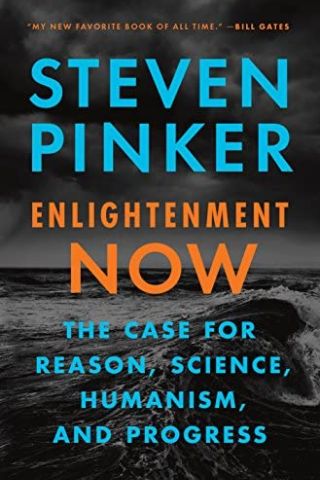
Enlightenment Now
| Book Author | |
|---|---|
| Published | February 13, 2018 |
| Pages | 576 |
| Greek Publisher | Διόπτρα |
The Case For Reason, Science, Humanism, and Progress
What’s it about?
Enlightenment Now (2018) offers a refreshingly optimistic take on the state of the world today. With reams of data, charts and graphs, Steven Pinker shows how much progress we’ve made since the eighteenth century, when the Age of Reason, otherwise known as the Enlightenment, shifted society away from centuries of rule by superstition and paranoia.
About the author
Steven Pinker is a professor of cognitive science and linguistics at Harvard University. He is also a frequent contributor to the New York Times and the Atlantic and sits on the usage panel at The American Heritage Dictionary. Many of his books on popular science have been influential cultural touchstones, including How the Mind Works and The Language Instinct.
Basic Key Ideas
Think things are bad today? If you get all your information from the daily news, you just might think we’re living in the worst times ever. But the reality is, we occupy a period in time that’s better than any other.
If you look at the rates of violence, famine and poverty, they’re each at all-time lows, while life expectancy, overall wealth and happiness levels are at all-time highs.
Sure, the environment needs our attention, but even here, the rates of pollution are down drastically from what they were just a few decades ago. So rather than panic and despair, you actually have every reason to believe that things may continue to improve, with more diseases becoming things of the past, and even less poverty and hunger in the world.
How has all this been possible? Thank the Enlightenment, the movement that took us out of the Dark Ages and emphasized science, reason and humanism as the principles that might guide us to a better tomorrow.
In these blinks, you’ll discover
- just how far life expectancy has improved since the dark ages;
- why the poor in England used to be forced to grind bones; and
- why you shouldn’t waste time worrying about artificial intelligence.
If you’re familiar with European history, you’ve probably heard of the period known as the Enlightenment. Sometimes referred to as the “age of reason,” it was a historical watershed moment. Indeed, it profoundly influenced the future development of Western society.
The Enlightenment started in the first half of the eighteenth century and it offered a bracing antidote to the rampant ignorance, terror and paranoia to which society had previously been in thrall.
Prior to the Enlightenment, spells of bad weather were blamed on witches or angry, sky-dwelling gods; oceans and forests were the domain of evil beasts; and scores of people were tortured and killed in the name of religion. It was high time for a change. And thus four main Enlightenment themes began to take shape: reason, science, humanism and progress.
Reason means that there are things in the world that are non-negotiable – that no matter what your so-called sacred text or authoritarian leader says, only reason can dictate the ultimate right. A good example is slavery. Prior to the age of reason, slavery was seen as a fact of life, but as the values of Enlightenment spread, reason shook the foundations of this barbaric practice and eventually helped bring it down.
With the emphasis on science, people began to value knowledge, especially as it pertained to certain universal human traits. Early versions of neuroscience, psychology and cultural anthropology opened the door to humanism, which offered a secular way for people to understand and respect one another. Before this period, religious fervor had been responsible for the bloodbath of the Crusades, and humanism offered a moral footing to acknowledge that genocide and murderous conquests weren’t acceptable.
Humanism also led to what’s known as cosmopolitanism, which can be seen in today’s modern values. Cosmopolitanism is a rejection of tribalism and the narrow-mindedness that pits one group against all others. It looks at everyone as a child of the world and recognizes that just because someone was born in a different country doesn’t mean they’re less deserving of the same rights.
Though people didn’t know it at the turn of the nineteenth century, there’s a very good reason for the establishment of a cosmopolitan system of global trade and mutual benefit. Why? Because the more diverse and interconnected a system becomes, the more resilient it becomes against entropy.
Entropy is described in the second law of thermodynamics, and it says that a closed system will eventually fall apart due to the impact of outside forces. If you build a sandcastle on the beach and walk away from it, the wind and the tide, as well as animals and other people, will all but guarantee its disappearance.
This law of entropy pertains to humans and the entire universe and it’s why some people will keep insisting that things are in a state of decline. Every so often, another cultural critic will say that the benefits of the Enlightenment are long gone and we’re now circling the drain. According to them, one look at the news suffices to show that reason is out of favor and that war, violence, crime and resurgent tribalism mentalities reign supreme.
However, there are many holes in this perspective, which we’ll explore in the blinks ahead. But first, it’s important to recognize that an organism isn’t a closed system – and can therefore push back against entropy. This is part of why the Enlightenment can, and has, continued to flourish.
By taking in a growing amount of energy from a variety of sources, an organism can increase the level of order rather than let that order fall apart. Now, if we look at any number of graphs and hard, factual data about the state of the world over the past hundred or more years, we can see that we’re still in the process of adding energy and greatly improving.
Whether it’s life expectancy, crime rates, happiness levels, wealth or quality of life, just about every measurable indicator of “the good life” has been on the rise and shows no sign of stopping. Let’s take a look at some of these numbers.
At the start of the Enlightenment, in the mid-eighteenth century, the global average life expectancy was 29 years. That’s not good at all – even our hunter-gatherer ancestors are believed to have lived to around 32.5 years!
But post-Enlightenment, the life expectancy of people around the world has increased by leaps and bounds.
One of the greatest factors is the reduction of the child mortality rate, which, statistics-wise, significantly improves overall life-expectancy numbers. And while far fewer infants are dying, mothers are also surviving childbirth at a much greater rate than they were just a few generations ago. It doesn’t matter if you’re 50, 60 or 70 years old – you can now expect to live longer than ever before.
In 1845, a 30-year-old person in Britain could expect to live another 30 years while an 80-year-old could count on about another five more. In 2011, that 30-year-old could expect another 52 years, while the 80-year-old could expect nine more years.
This kind of improvement is global: in Ethiopia, a ten-year-old in 1950 could expect 34 more years, but a ten-year-old today can expect 51 more years.
These years can also be expected to be lived in better health than that of previous generations, thanks to further gains in knowledge that have led to the entire or near eradication of diseases such as polio, smallpox, measles and rubella.
In the 1800s and early 1900s, it didn’t matter if you were the poorest or the richest person in the world; you were just as likely to die from an infection. Just consider the son of thirtieth US president Calvin Coolidge. At 16 years old, Calvin Jr. succumbed to infection after suffering a particularly bad blister from a game of tennis.
Today, we place value on science and knowledge, and people know the benefits of washing their hands, using mosquito nets and boiling their drinking water.
Also, remarkably, famine is very nearly a thing of the past.
Just 150 years ago, children in Sweden were starving to death during long winters. And a mere 45 years ago, 35 percent of the world was malnourished. That number dropped to an all-time low of 13 percent in 2015. Making this even more impressive is the fact that five billion people have been added to the planet in that time.
This is due to the science of agriculture and the progress that has been made, especially in our ability to use less land and water to grow more nutrient-packed grains.
Prior to the Enlightenment, it was common for a nation’s poor people to be forced into backbreaking labor for next to no pay. In England, the poor would grind up bones for fertilizer, while in Paris, they’d be chained together and made to clean out the city’s drains.
In 1820, close to 90 percent of the world was in extreme poverty, but this is when the tools of the Enlightenment really began to take effect. Between 1820 and 1900, global income tripled.
Nations, like England, had begun using trade as a tool to improve international relations, pushing aside religious differences in favor of mutual benefit. This cosmopolitan attitude was taken up by many other countries and, gradually, wealth spread across the globe.
Between 1900 and 1950, the world income tripled again, and then it took only 33 years to triple a third time. Now, South Korea and Singapore are getting rich while Vietnam, Rwanda and El Salvador are doubling their income every 18 years, with another 40 nations doubling theirs every 35 years.
With this growth, it’s to be expected that a period of inequality will follow. But as time goes on, this inequality naturally levels itself out, which is what we’re seeing today. This is called the Kuznets curve, named after economist Simon Kuznets.
A lot of nations experienced fast growth in the 1970s, and at this period inequality was grossly apparent. But, since then, things have followed the Kuznets curve: data shows a gradual decline in wealth inequality. This decline also parallels declining poverty levels.
Another rule we can see in action is Wagner’s law, which states that the wealthier a country gets, the more it spends on social programs that benefit the poor. In European countries during the early twentieth century, the average amount of earnings spent was 1.5 percent. Now, an average of 22 percent is spent on social programs and relief for the poor.
There’s little room for optimism in the ongoing war being waged in Syria. Very conservative estimates have put the number of deaths, in 2016 alone, at 250,000 people. But if you want an accurate assessment of how violent we are globally these days, the data shows that war is a lot less rampant than it used to be.
You might think there’s an unprecedented number of refugees today, too, but if we go back a few decades to 1971, we see that the Bangladesh War displaced 10 million people. In 1947, the shift in India’s borders turned 14 million people into refugees. And, during World War II, 60 million people were forced to flee.
The Enlightenment believed problem-solving was the key to progress and resolving disputes, and in the twenty-first century, this has been by and large a success. In 1945, the United Nations was formed, and, with it came the Universal Declaration of Human Rights. Written by a diverse group including Mohandas Gandhi, Aldous Huxley and Muslim scholars, this is perhaps one of the most humanist and Enlightenment-aligned documents ever created.
Since then, this organization has been extremely influential in helping settle disputes, along with the continued trade and commerce agreements that have helped forge healthy international relations.
So, for 70 years, wars have been few and far between. And in 2009 they became significantly fewer after a number of civil wars drew to a close, including ones in Angola, Chad, Peru and Sri Lanka.
With rising wealth across the majority of nations in the world, there’s less of an opening for militant groups to form an uprising and try to convince the people that they should join in a revolution. With increased wealth, a nation can begin offering better health care and education, and the incentive for civil war is greatly reduced.
This is what we can see in the data from around the globe, and we see fewer incentives for crime as the world becomes a more prosperous place.
In the 1970s, things didn’t look so good for democracy. In West Germany, Chancellor Willy Brandt called democracy a “peculiar holdover with no future.” But little did Brandt know that just around the corner was a huge push toward democracy that would find one nation after another adopting their own version of the Enlightenment form of government.
Democracy is very much the result of Enlightenment thinkers looking for a better form of government than the reign of terror that had plagued the world since biblical times. People were tired of slavery, torture, human sacrifices and the public mutilation of dissidents.
Another thing people wanted to avoid was leadership breakdowns, such as those that led to the bloody revolutions in China and Mexico in the early twentieth century.
In this sense, democracy is a way to protect people from both tyranny and anarchy, and it’s proven to be the one form of government with healthier economic growth, fewer genocides and better education.
As of 2015, there are 103 democratic nations, a pretty good number, considering that it fell to 12 during the fascist uprisings of the 1920s.
The shift toward democracy has been a boon to the Enlightenment agenda and, since it’s allowed the world to become more cosmopolitan, it’s also reduced racist and sexist attitudes.
Simply put, racism and sexism are untenable arguments, which means they can’t withstand scrutiny and there’s no rational or reasonable defense of them. In a more cosmopolitan world, with more travel and more people crossing paths, people are far more likely to be exposed to enlightened ideas and have their unenlightened assumptions challenged and refuted.
So it makes sense that the modern world has far fewer ethnic and racial discriminatory laws on the books. In 1950, half the world’s nations had these laws, but by 2003, that number was down to under one-fifth. And with the exception of Vatican City, women can now vote everywhere that men are allowed to.
The daily news offers no shortage of things to freak out about. But if you do some digging and uncover the real problem, there’s not as much reason to panic as you think. Case in point: terrorism.
The actions of ISIS and other terrorist organizations are abhorrent, but are Americans right in thinking that ISIS is an immediate threat to the existence of the United States? After all, this is what a majority of Americans believed in a 2016 poll.
The reality is that an American is more likely to be killed by lightning or a bee sting than a terrorist. If we look at the worldwide statistics, all people would still be 125 times more likely to die in an accident than at the hands of a terrorist.
People are afraid because of the negative bias and fearmongering sensationalism that taint the media’s presentation of world news. The press is fond of exaggerating the severity of all sorts of existential threats.
It’s not uncommon to read articles about artificial intelligence (AI) that suggest that we’re moments away from some Terminator-like scenario, and that an AI program will soon begin killing humans because it misinterpreted its programming directives. Even Elon Musk and Stephen Hawking have been quoted as saying AI is an all-too-real threat.
But there’s really little reason to conclude that AI’s ability to drive a car or beat someone at the board game Go means it poses a serious threat to humanity. In fact, as technology has progressed, it’s also gotten safer, with more levels of fail-safe monitoring. If something poses any threat, chances are there’s someone with a switch who’s monitoring the person with the switch who’s monitoring yet another person and so on.
If people are clever enough to create a groundbreaking AI program, they no doubt have contingency plans for any problem you can dream up.
Believe it or not, science doesn’t have an agenda, other than using information to gain knowledge. It’s not a field that exists with the intent to poke holes in your religion or belief system. And contrary to what some have suggested, science isn’t racist, sexist or responsible for the Holocaust.
It might sound absurd, but there’s a long history of science being attacked by ignorance and misunderstanding, not to mention by people trying to advance their own agenda. Since science is one of the tenets of the Enlightenment, it’s important to spot this nincompoopery and see the truth.
A popular claim is that science fueled Hitler’s Nazi agenda, even though Hitler was expressly anti-science, anti-reason, anti-progress and, therefore, anti-Enlightenment.
Nevertheless, some people claim that science led to the Holocaust, an argument that hinges on the Aryan myth, which was invented by Arthur de Gobineau, promoted by Wagner and embraced by Hitler. According to the myth, the Aryan race was perfect until it was blighted by other races, an idea that flies in the face of Darwinism, which argues that all humans have base impulses and that no group is superior to any other.
People also blame eugenics for Hitler’s actions, even though the eugenics proposed by Francis Galton, a Victorian statistician and polymath, was limited to incentivizing talented people to procreate. It had nothing to do with sterilizing “unfit” people, which is an unscientific proposal that other people came up with some time later.
These days, attacks on science are likely to be thinly veiled attempts to discredit a legitimate concern, such as climate change.
One of the greatest challenges facing humanity is cutting back on CO2 emissions by 50 percent by 2050 and eliminating them completely by 2100. If we don’t do this, the threat of global temperatures exceeding an additional 2 degrees Celsius is extremely likely, which will cause permafrost to melt, raise sea levels and cause all manner of catastrophe. This isn’t some Chinese conspiracy, as Donald Trump has suggested – this is real science.
While it’s certainly distressing to see Donald Trump, who the author sees as distinctly anti-Enlightenment, win the US presidency, we can still take some small comfort in the fact that he lost the popular vote by a significant margin and has one of the lowest approval ratings of any US president.
Another advantage of democracy is that there are checks and balances in place to prevent authoritarian demagogues from wreaking too much havoc, and we’ve already seen the justice system prevent some of his attempts at overstepping his bounds.
In Europe there has also been a movement of people pushing back against the values of the Enlightenment, but there are reasons to believe that this too will pass.
Across Europe, the populist parties, which favor nationalistic, tribalist, anti-cosmopolitan values, have only managed to get about 13 percent of the vote, while ultimately losing as many legislative seats as they’ve gained. They may have gained a foothold in Poland and Hungary, but the numbers show that these populist voters are old, and not the voice of the future.
While the Brexit vote may have been alarming, only 29 percent of people with a college education voted in favor of it. In 2016, the “pro-leave” voters signaled their disapproval of how the world has become more cosmopolitan, but it’s likely to continue to do so despite their protests.
Younger generations across the globe are polling as more progressive, tolerant and less religious than the previous generation. According to WIN-Gallup International’s Global Index of Religiosity and Atheism, even in traditionally religious countries, like Poland, Turkey and Russia, there was an average nine-percent decrease in people who identify themselves as religious between 2005 and 2012. So, with each successive generation, we see more people relying on reason, science and humanism as the source of their values. While religion needn’t be at odds with Enlightenment, progress can be impeded when people base their values on the interpretations of sacred texts.
Despite cultural critics’ doom-and-gloom prophecies and the media’s negativity, the data shows a positive story, a story of the triumph of reason and humanism over the past 100 years. And there’s no reason to think this progress will be reversed. In fact, the opinions and polling of today’s youth show them to be even more in line with the values of the Enlightenment than the people who got them to where they are today.
The key message in this book:
There is still war, violence, disease and poverty in the world, but if we put this into the context of history, we’re looking at a tiny fraction of what once was. Ever since the age of reason in the eighteenth century, we’ve been making progress at reducing poverty, disease and war. By reducing superstitions, racism and warmongering, we’ve turned the world into a much safer and enlightened place than it’s ever been before.
Suggested further reading: The Mind Club by Daniel M. Wegner & Kurt Gray
The Mind Club (2016) is all about how we perceive beings as having a mind or not, and how this determination affects our moral judgments. These blinks explain what constitutes a mind as well as how and why we perceive minds the way we do.
SECOND REVIEW FROM SHORTFORM
About Book
Do you ever get the sense that the world is getting worse over time? In Enlightenment Now, psychologist Steven Pinker says you might be falling prey to psychological biases that are distorting your perception. Because, he argues, things are actually getting better by every measure.
Pinker provides statistics on such factors as health, wealth, equality, human rights, happiness, peace, and freedom, to show that all of those things have improved over time, all around the world. And he says the driving forces of this progress are reason, science, and humanism— values that are derived from the European Enlightenment.
In this guide, we’ll delve into the data Pinker presents to show why he believes humanity is on the path of progress. Throughout, we’ll compare his ideas to those of other scholars, provide counterpoints, and update some of the statistics with more current data.
In Enlightenment Now, psychologist Steven Pinker argues that 17th- and 18th-century Enlightenment values and modernization have contributed to gradually improving the world on “every single measure of human well-being.” He says people tend to think the world is getting worse because of psychological biases and errors in perception, but the data supports the conclusion that life for humans everywhere is getting better.
Pinker explains why our perceptions of a worsening world are wrong and provides statistics to challenge those misconceptions. Through presenting data on such factors as health, wealth, equality, human rights, happiness, peace, and freedom (among other measures), he explains how The Enlightenment’s key ideas of reason, science, and humanism are the driving forces behind progress in all these areas.
Pinker is a professor of psychology at Harvard University. This book, published in 2018, follows The Better Angels of Our Nature, which examined questions around peace and violence, arguing that the world has gotten consistently more peaceful over time. Pinker has gained a wide following—in 2004 he was named one of “The 100 Most Influential People in the World Today” by Time magazine, and his TED Talk presenting a synopsis of Enlightenment Now has been viewed over 4 million times.
In this guide, we’ll first explain what Enlightenment values are and where they come from, as well as what some of the prominent anti-Enlightenment positions are. We’ll then discuss Pinker’s definition of “progress,” and his explanation for why we tend to mistakenly think things are getting worse when they’re actually getting better.
Finally, we’ll delve into the data Pinker presents to support his argument that the world is improving everywhere, on all measures, due to the ongoing impact of Enlightenment thinking. We’ve reorganized Pinker’s measures of progress into three categories of well-being: human, societal, and environmental. Throughout the guide, we’ll compare his ideas to those of other scholars, provide counterpoints, and update some of the statistics with more current data.
What Are Enlightenment Values?
The Age of Enlightenment refers to a historical period in the 17th and 18th centuries when European intellectuals and philosophers were concerned with re-thinking social values and moving toward a more “progressive” vision for humanity. This included thinking about the most rational ways to go about organizing and governing society to maximize human well-being, including discussions of freedom, equality, and empirical truth. Some of the best-known thinkers associated with this movement are René Descartes, Jean-Jacques Rousseau, Immanuel Kant, John Locke, and David Hume. Enlightenment philosophy led to revolutionizing many aspects of European society and ultimately had global influence.
The Origin of Enlightenment Values
David Graeber and David Wengrow, in The Dawn of Everything, argue that much Enlightenment thinking originated in conversations between European colonists in America and the indigenous people there. In these conversations, Native Americans raised scathing critiques of European social customs and values, particularly criticizing monarchical rule, social hierarchies, emphasis on accumulation of wealth and materialism, and punitive justice systems. The social values in their own societies at the time were essentially Enlightenment values. These descriptions made their way back to Europe, where they were widely distributed among the intellectual class and, Graeber and Wengrow argue, became inspiration for much Enlightenment thought.
The major theme tying all Enlightenment thinking together is reason. But, according to Pinker, Enlightenment also implies science, humanism, and progress:
Reason: Pinker contrasts reason with religious faith and dogma, on which he says most pre-Enlightenment thinking was based. He says consciously applying reason to all matters is necessary precisely because humans aren’t always rational thinkers. So it’s crucial to think through our beliefs, values, and social policies in a rational and logical way, rather than relying on feelings, intuition, or religious texts. (Shortform note: In The Laws of Human Nature, Robert Greene says we’re all naturally prone to irrationality. We have a tendency to react based on our emotions rather than reasoning. But rational thinking, he says, is a skill that can be learned. And that begins with not allowing our emotions to influence our thoughts and decisions.)
Science: When we apply scientific methods to our beliefs, Pinker says, we can prove or disprove them. Therefore, he argues, the scientific method is necessary to generate knowledge that is reliable. On the topic of science, Pinker includes modernity as an essential feature of Enlightenment, meaning that continuous technological innovation and advancement, through scientific endeavors, are key to continued progress.
(Shortform note: Pinker strongly associates Enlightenment values with modernity, and argues throughout this book that modernization necessarily corresponds to progress and improvement. As an example, he describes access to electricity (and other technologies) as an undeniable improvement in the human condition. But in The Dawn of Everything, Graeber and Wengrow argue that indigenous peoples in America were living according to Enlightenment values in vibrant, healthy, peaceful societies, without any electricity or other modern technology.)
Humanism: The Enlightenment is fundamentally associated with humanism, a system of thought that prioritizes the good of humanity over any divine or supernatural concerns. Pinker argues that humanism provides a secular basis for morality, allowing us to look at what contributes to human well-being, without allegiance to religion, race, or nationality, which divide humans. He says humanism compelled Enlightenment thinkers to condemn such practices as slavery, torture, and cruel execution methods.
(Shortform note: Some argue that a humanistic worldview promotes human exceptionalism, meaning humans are centered and prioritized above other living things, which can be damaging to animal-rights and environmental causes. This ideology can fuel extreme “anti-humanist” environmentalist campaigns to reduce population growth.)
Progress: Pinker defines progress as using reason, science, and humanism to better conditions for all of humanity. He argues that progress is made by making changes in social institutions like laws and educational systems, not by trying to change anything in human nature. (Shortform note: Some people believe the opposite—that progress is made by changing people. Conservative thinkers have argued that human flourishing must begin within the individual, often through spiritual development, and they oppose attempts to regulate progress by law.)
Pinker argues that Enlightenment values have improved life for humans globally, and that in order to continue to improve, we need to reinvigorate our public discourse with these values and push forward on the path of progress through reason, science, and humanism.
Anti-Enlightenment Positions
To fully understand Enlightenment values, and their historical impact, we should also understand the opposing positions. Pinker identifies four anti-Enlightenment positions, which he sees as stalling the progress of humanity. He argues that in order to continue to improve the human condition, we must challenge these foes of progress.
The anti-Enlightenment forces Pinker identifies are:
- Religion: Pinker sees religion as the most obvious of the anti-Enlightenment forces, because belief in anything based on faith is inherently in conflict with belief based on reason and science. Because religious dogma often advocates putting “higher” goods above human interest—for example, embracing suffering in this life in order to appease a God and attain happiness in an afterlife—it’s inherently contradictory to humanism. Also, Pinker points out that organized religion typically translates to power imbalances and curtailing of freedoms, and he sees equality and freedom as essential to human flourishing.
- Anti-scientism: Often overlapping with religious approaches, anti-science stances claim that science is just another “narrative” or myth. Pinker points out that this belief creates distrust of scientists, which can have far-reaching negative consequences for society. For example, in response to the COVID-19 pandemic, there was a widespread distrust of scientific experts, resulting in many preventable deaths. Pinker argues that continued scientific progress is essential for human progress, so anything that impedes science will necessarily stall human progress.
- Tribalism: Pinker defines tribalism as allegiance to a group, and prioritizing that group above the individual. This can apply to actual tribes, but he explains that in the modern world it’s most often seen as nationalism, and it can also manifest as religious, ethnic, racial, or class groups. He argues that the idea that the good of the group matters more than the good of individuals is essentially counter to humanism. He says groups don’t feel pain or suffering, or joy—people do. So to make the world better for people, we need to focus there. An example might be the expectation for individuals to sacrifice their lives for their country or religion. He contends that religion and nationalism are major cornerstones of political conservatism, and they impede a progressive agenda.
- Declinism: Pinker defines declinism as the belief that the modern world is declining in stability and on the verge of collapse. He says that while people have had such dystopian visions for thousands of years, one major form of declinism in the current world is the idea that technology will destroy us. He argues that this sentiment is becoming more widespread and cuts across political lines, with some believing our destruction will come in the form of threats like nuclear war or cyberterrorism and others believing it’ll be due to technology making us lazy, soulless, and miserable. These ideas impede progress, Pinker explains, because they create a culture of pessimism and anti-technology sentiment, contrary to his belief that technology is a major contributor to improving the human condition.
Romanticism as an Anti-Enlightenment Movement
One of the earlier historical foes of Enlightenment thinking was Romanticism, a philosophical and artistic movement that formed partly as a reaction to the hyperrationality of Enlightenment thought. From the late 18th through the mid-19th century, scholars and artists pushed back against Enlightenment values in favor of a more spiritual, emotional, and creative approach to the world. Romantics believed Enlightenment philosophy, through its emphasis on rationality, order, and objectivity, treated humanity as soulless and mechanistic. The Romantic movement encompassed some of the anti-Enlightenment forces Pinker mentions:
Religion: Romanticism embraced a spiritual and transcendent approach to the world over a secular and rational one.
Anti-scientism: Romanticism included skepticism of science. Romantics believed an objective scientific approach to the world would never give a full understanding of a world full of emotion, passion, and mystery.
Tribalism: Since Romanticism placed a high value on celebration of the individual, it might be difficult to argue that tribalism, in the sense of allegiance to a group, would be a Romantic notion. However, the theme of merging oneself with the divine is certainly a feature of Romantic literature. In this way, there is a theme of self-sacrifice in Romanticism.
Declinism: One recurrent theme in Romantic literature, called the “Last Man” theme, is essentially an apocalyptic vision of the future, where only one person remains on Earth. This theme is employed in the writing of such notable Romantic authors as Lord Byron and Percy Shelley.
What Is Progress?
While a definition of “progress” as using reason, science, and humanism to improve conditions for humanity seems straightforward, the word “improve” implies a value judgment and is therefore subjective. Who decides what’s better? Pinker believes we can agree on some universals in this area—there are some things we can all agree are better than other things. For example, he says: Health is better than sickness, peace is better than violence, and freedom is better than enslavement.
While some of these dichotomies may seem obvious, there are some other measures of “improvement” that Pinker strives to defend, as they are not as obviously universally “better.” For example, the claim that wealth is inherently better than poverty can be challenged by pointing out that a person who is poor but happy is better off than a person who is wealthy but miserable. Or, one could argue that wealthier, more technologically advanced human societies are not worth the sacrifice of an environmental crisis.
(Shortform note: Scholars have argued that the focus on continuous economic growth is at the root of the environmental crisis, and they call for implementing “no growth” or even “deliberately de-growth” economic models for the future. They admit, however, that the continuous growth ideology is deeply embedded in the thought patterns of modern people, so the idea of deliberate de-growth is highly unsettling for many. Therefore, they say changing the way people think is crucial in the fight against climate change.)
Pinker tackles some of these objections, arguing that to solve the dilemmas we face in the modern world, we simply need to push forward with reason, science, and humanism. He argues that people today who don’t think life is all-around better than it was for humans in the past suffer from two problems:
- They have distorted perceptions of the world, due to biases in what they see and how they think.
- They’re ungrateful for what they have, because they’re so disconnected from the unpleasant reality of what life in past societies was like.
So let’s look at why so many people have these distorted perceptions and do feel that life in the modern world is getting continuously worse, despite what Pinker says is ample evidence to the contrary.
Is the World Getting Better or Worse?
Pinker’s major goal in this book is to counter the widespread belief that the world is getting worse, by showing data that indicates it’s actually improving on many measures. But why do people think things are so bad if they’re not? Pinker explains that this happens for a few intersecting reasons: media slant, cognitive biases, and ingratitude.
Media slant: Pinker explains that we tend to believe our societies are worse than they are because the media focus on negative news. This skews our perception of how bad things are. To support this claim, Pinker points to a study that analyzed emotion words in news articles from 1945-2010, which showed that the news has gotten progressively more negative. But we must ask whether more negative things have actually been happening, or whether news outlets are becoming more negative in what they focus on and how? Pinker says a look at the data clearly shows it’s the latter. We’ll look at that evidence in the following sections of the guide.
(Shortform note: Researchers found negativity slant in news media around the world, but it was most pronounced in the US. One theory about why this might be is that it’s what consumers want, and the US news media tend to be profit-motivated, while news outlets in other areas of the world receive government funding, so they’re less likely to be motivated by consumer demand.)
Cognitive biases: As an evolutionary psychologist, Pinker is well-versed in cognitive biases. He explains that humans have these biases evolutionarily built into us to help us survive. However in a modern context, he says, these biases tend to work against us instead of in our favor. He describes three cognitive biases that are at work in our brains, influencing us to think things in the world are getting worse.
1. Availability bias: Pinker says when we estimate how likely something is to happen, things that come most readily to mind will seem more likely than those that don’t. And he says events or ideas that are sensationalized tend to stick in our minds. So, for example, if you read a news story about a grisly murder and another story about a local political campaign, you’re more likely to remember the murder story later. Because of this, Pinker says, seeing hypernegative media on a daily basis means we drastically overestimate the frequency of negative occurrences, like murder.
(Shortform note: Psychologists say this bias, also called the “availability heuristic” is a mental shortcut our brain takes to help us make decisions. In some scenarios, it can cause us to make bad decisions. To minimize this bias when you’re making an important decision, try asking someone else to play “devil’s advocate” and give you alternative or challenging perspectives.)
2. Negativity bias: Another bias that’s built into our brains, Pinker says, is a general bias toward negativity. Why would we be built with this tendency? Pinker says we’re hardwired to interpret things in the most negative light as a protective measure against danger. For example, if we see movement in the bushes, our brains will instinctively tend toward the worst case scenario and interpret it as a predator to prepare us for fight or flight. When this negativity bias activates in everyday life, though, it means we tend to think things are much worse than they are.
(Shortform note: According to positive psychology, our negativity bias not only distorts our perception of how good or bad things are, but it can lead to major mental health problems like depression and anxiety, cause us to make poor choices, and hurt our relationships. Psychologists suggest practicing mindfulness techniques, savoring the good things in life, and doing Cognitive Behavioral Therapy (CBT) to combat your negativity bias.)
3. Nostalgia: Pinker points out one exception to the negativity bias, and that’s in regard to memories of the past. He says we also have a cognitive bias for nostalgia, meaning we tend to remember events of the past as more positive than they were and forget the negative aspects. For example, when you reminisce about your childhood, you’re likely to remember it as more fun and carefree than it really was. This means people will naturally tend to think things were better in the past, which can only mean things have gotten worse over time.
(Shortform note: This is due to what psychologists call the “reminiscence bump” and the “positivity effect.” The reminiscence bump refers to the finding that older people recall events from their childhood and young adulthood better than they remember their middle-aged years. The positivity effect says that as people get older they tend to remember things more positively. These two effects together mean older people are more likely to remember their early years in a positive light.)
- Romanticization and ingratitude: Finally, related to the nostalgia factor, Pinker argues that people who don’t appreciate the positive contributions of modernity to life are simply ungrateful, because they don’t realize how much worse life was for people in the past. They’re romanticizing the past, he says, and he argues that almost nobody would actually choose to live in a pre-modern society if they had to face the reality of what that would be like.
Satisfaction With Life in the Modern World
In The Dawn of Everything, Graeber and Wengrow take issue with the assertion that nobody would really want to live in a pre-modern society, arguing that there are many historical accounts of people choosing to do exactly that. They also point out that Native Americans, and other indigenous cultures around the world, consciously rejected attempts to force modernization on them. They ask, if modernization is unequivocally good, why did it have to be forced on people?
If people are unappreciative of the positive aspects of modern life, however, this may be due to what psychologists call hedonic adaptation, also referred to as a “hedonic treadmill.” This is the idea that we don’t enjoy things as much when we’re used to them. For example, if you ate your favorite meal every day, it would become less pleasurable over time, and you would begin to crave something else. Perhaps life in the modern world feels dissatisfying for many because it’s all we know, so we yearn for something new and different.
Recognizing the media slant and our cognitive biases should enable us to intellectually challenge and correct our assumptions, Pinker says. But we rarely do this. He explains that it’s difficult to overcome those biases and to challenge what feels intuitive. If things feel like they’re worse than they used to be, in other words, it’s difficult to actually believe that feeling is wrong. So, Pinker says that the solution is to count—when we look at the data, we can no longer deny that things are getting better. So, let’s turn to the data he presents.
The Data on Progress
In this section, we’ll review the statistics Pinker presents to support his argument that the world is getting better for humans everywhere. We’ve organized his data into three categories of well-being: human, societal, and environmental. Pinker notes throughout the book that the United States tends to be an outlier on many of the measures, like happiness and equality, and that it’s not showing as much progress as other wealthy democratic nations.
Human Well-Being
The first area of progress we’ll look at is that of human well-being. In this category, we’ll consider statistics presented by Pinker on overall lifestyle, health, safety, human rights, and happiness. According to Pinker, we can track how well humans are doing as a whole by looking at measures in these areas. And when we do, we see improvements on every measure.
Lifestyle
Overall, Pinker argues that people have a much better work/leisure balance than they did in the past. He says that modernization has made this possible through the invention of electricity and time-saving appliances. Modern technology means we have to work fewer hours to support our households, and we spend far fewer hours on basic household chores, allowing us more free time to pursue pleasurable activities, like travel. Some of the statistics presented to support Pinker’s argument are:
- Work hours: Between 1870-2000, in Western Europe and the US, weekly work hours decreased from between 60-70 hours/week to around 40 hours/week.
- Retirement: In the US, the percentage of people over 65 who were still working decreased from almost 80% in 1880 to around 20% in 2000.
- Housework: In the US, hours spent on housework decreased from around 60 hours/week in 1890 to around 15 hours/week in 2015. Pinker attributes much of this to the availability of electrical appliances. He shows that the percentage of households with electricity, running water, a microwave, stove, dishwasher, and washing machine has risen from almost none in the early 1900s to almost everyone in 2000.
- Household expenditure: In 1925 around 60% of US household income was spent on basic necessities, as compared to around 35% in 2015.
- Leisure time: Leisure time in the US has risen more for men than women, though it has increased for both. In 1965, men spent about 32 hours/week in leisure, compared to 41 hours/week in 2015. For women the number of leisure hours rose from around 30 to 35 hours/week.
- Travel: The cost of air travel has declined sharply between 1975 and the present. Pinker points out that this, along with extra money and leisure time, allows many more people to travel for pleasure. Globally, international tourism has risen from around half a billion travelers in 1995 to around 1.2 billion in 2015.
How Do We Spend Our Leisure Time?
While we may have more leisure time than our immediate forebears, the earliest humans may have had even more. According to Yuval Noah Harari, in his book Sapiens, people in early foraging societies likely spent significantly fewer hours per week working than the average person in the modern world. Anthropological studies comparing foraging to farming societies generally find the same: Foragers spend less time working and more time engaging in leisure activities.
Regardless of the amount of leisure time, though, it’s how we spend it that determines how it affects our lives. And technology has changed the way we spend our leisure time. According to the American Time Use Survey by the Bureau of Labor Statistics, the average American spends more than 60% (over three hours) of their daily leisure time watching TV or on the computer. Scientific studies have documented a number of negative effects of technology use on our mental and physical health. Psychologists offer advice for using your leisure time more effectively: Engage in activities that challenge you, improve yourself and your relationships, or achieve a state of creative “flow.”
Health and Nutrition
Next, we’ll look at a factor that Pinker argues is universally understood as a measure of progress: health. On this topic, he looks at access to food and nutrition, how long people live, and how medical advancements have eradicated many diseases that once plagued humanity. Pinker cites the following evidence that humans are living longer, healthier lives around the globe:
- Life expectancy: Worldwide average life expectancy was only around 30 years in the 1700s, whereas today it’s around 70. Of course, this doesn’t mean an average person only lived to age 30 in the 1700s. It means many babies and children died, bringing the overall average lifespan down.
- Child mortality: Defined as death before age 5, child mortality in the 1700s was around 30-35%. Now it’s only around 4% globally.
- Disease: Modern medical science has eradicated or nearly eradicated many infectious diseases that once killed many. Some examples are smallpox, parasites, polio, cholera, and HIV/AIDS.
- Hunger: Pinker argues that the developed world has so much food that we have an obesity epidemic, rather than anyone starving, like people used to. And he says the developing world is vastly improving. He points out that China, India, and Africa (as a whole) now have populations that average over 2,400 calories per person per day.
- Malnourishment: From 1970-2015, rates of undernourishment in all of the “developing world” have declined.
- Food shortage: In 1798, Thomas Malthus predicted famines would get worse, because population grows exponentially and food production couldn’t keep up with it. He argued that efforts to feed the starving would only make the problem worse, because they’d just survive to have more children. He was wrong. Pinker shows that when people become better educated and wealthier, they have fewer children. And projections show that by the end of the 21st century, worldwide illiteracy will effectively be zero. So he argues that eradicating poverty and increasing education are essential for the overall good of humanity, and they will also naturally solve the problem of overpopulation and food shortage.
The Benefits of Progress are Unevenly Distributed
Pinker readily acknowledges that none of the above benefits are equally distributed around the world.
Much of this is the legacy of colonialism. Countries that were previously subject to European colonization, especially those in Africa, have some of the poorest outcomes on all of the above measures. The countries with the lowest life expectancy rates and poorest health are all African countries. Child mortality in Sub-Saharan Africa is 14 times higher than it is in Europe and North America. The countries with the greatest food crises are all in Africa and the Middle East.
In Development as Freedom, economist and philosopher Amartya Sen examines the connection between food production and population, and his conclusions align with Pinker’s. Sen argues that despite the growing global population, there is no overall food shortage in the world. He says enough food is produced to feed everyone; it’s just not distributed well.
So, the biggest challenge for the future will be addressing these inequalities in how the benefits of progress are distributed.
Safety
The next measure of progress we’ll look at is safety. On this measure, Pinker examines data on both intentional and accidental causes of harm and death, and says that we’re safer on all counts. While we can never avoid violence, accidents, or natural disasters entirely, he says we can put policies in place that minimize their threat and make us safer. Let’s look at the data Pinker presents to support a claim that we’re safer than people were in the past.
1. Violent crime: To look at the threat of violent crime and how that’s changed over time, Pinker provides statistics for homicide deaths in the US and England, as compared to the worldwide average. He shows that while the homicide rate in England has remained consistent from 1965-2000, it’s consistently very low. The US rate by contrast has fluctuated between about six and 10 deaths per 1,000 people during those decades, with the most recent two decades dropping to the lowest rate, around five deaths per 1,000. The worldwide rate also has gotten continuously lower since the year 2,000, dropping from around nine to six per 1,000.
Pinker says statistics on homicide show that the great majority of it happens in very small portions of the world—specific neighborhoods in specific cities in specific countries. He believes targeted (“effective, fair, and humane”) law enforcement in those areas is the solution. He also advocates for CBT-style therapy for populations that are in these high-violence areas, to teach self-control and thereby reduce violent tendencies.
(Shortform note: The suggestion to increase law enforcement in high-crime areas is a complex issue. Researchers have found that on average, every police officer added to a city results in between 0.06 and 0.1 fewer homicides. Which means it would take more than 10 new police officers to save one life per year, at a cost of between $1 million to $2 million annually. While this may seem worthwhile, researchers also note that increasing police presence also means an increase in arrests for lower level, “victimless” crimes, like drug possession, as well as increasing the incidence of racial profiling and police brutality.)
2. Accidents and disasters: Pinker argues that we’ve become much better over time at preventing and responding to natural disasters and accidents of all kinds. He points out that rates of death from both accidents and natural disasters have decreased steadily over time. As an example, he shows that deaths from traffic accidents in the US were 24 times lower in 2021 than in 1950. He attributes this to improved safety features in cars, campaigns and policies targeting drunk driving, driver education programs, and law enforcement. He also shows consistently declining rates from other kinds of accidents, including from fire, drowning, and gas poisoning.
(Shortform note: The United Nations has said that natural disasters related to climate change have increased five-fold over the last 50 years, with over 90% of the deaths being in developing countries. As Pinker points out, the rate of death from such disasters depends heavily on the warning and response systems in place. Because these disasters are only expected to increase in the future, the UN emphasizes the importance of ramping up efforts to prepare for and respond to them, especially in poorer nations.)
There is, however, one notable exception to the “accidental death” trend, and that is in the area of accidental drug overdose. In this category, the rate of death has risen sharply and steadily in the US since the 1990s. Pinker acknowledges this rise, but he argues that this one exception doesn’t negate the overall trend of decreasing deaths by accidents. And he believes the best way to address the issue is to push forward with Enlightenment thinking and apply reason and science to the problem. In other words, by creating social programs and policies to address it.
The Root Causes of Drug Addiction
While Pinker categorizes drug overdose under “accidents,” it certainly isn’t the same kind of accident as drowning or being killed in a tornado. Overdose is usually a result of addiction, which has a psychological root cause. This probably makes it more appropriate for the “happiness” category. Since the 1970s, researchers in psychology have noted the social and environmental causes of addiction, beginning with the “Rat Park” experiments.
In this series of experiments, groups of rats were studied side by side. Some rats were put into empty cages with no stimulation, while the others were put in a “park” setting with a stimulating environment where they were free to socialize, play, and exercise. All groups of rats were given two bottles of water to drink—one plain water, and the other laced with morphine. The rats in “Rat Park” preferred the plain water, while the rats with the isolated environment were 10-16 times more likely to choose the morphine water and become addicted.
Johann Hari addresses this issue in his book Lost Connections, which looks at the social causes of depression (and the addiction that often follows). He says “the opposite of addiction isn’t sobriety—it’s connection.”
Human Rights
Next, we’ll look at Pinker’s data on human rights progress. He specifically considers racism, sexism, and homophobia to be the biggest contributors to human rights abuses and argues that we should acknowledge the great advances the world has made in these areas.
Racist, sexist, and homophobic attitudes: Pinker provides data from the Pew Research Center on racist, sexist, and homophobic opinions that shows those have all steadily declined in the US from 1985-2015, and they are far more likely to be associated with the oldest generation. He shows us that hate crimes have also declined, and he says that while there were upticks during the Trump presidency, that is not indicative of an overall trend.(Shortform note: Racism isn’t only about bigoted attitudes. It’s built into the structure of society. Systemic racism includes inequalities and discrimination that are part of social institutions. For example, discriminatory practices in hiring, housing, and policing result in large-scale social disadvantages for some groups as compared to others.)
Women’s rights: Pinker shows that women around the world have increasingly gained more rights, freedom, education, and economic security. He points out that in 1900, only one country allowed women to vote—New Zealand. Today, women can vote in every country that men can, except one—Vatican City. This supports Pinker’s claim that religion is one of the major barriers to Enlightenment values.
Gay rights: Pinker points out that homosexuality used to be considered a crime in almost every country in the world. He says the first suggestion that sexuality between consenting adults should not be legislated came from European Enlightenment thinkers such as Voltaire, and some countries began revising their laws shortly thereafter. The statistics Pinker presents show that as of 2015, around 90% of the world’s countries have decriminalized homosexuality.
Liberalization: Pinker says that when we look at the overall trends, we see that the world is becoming increasingly liberal. He defines liberal values as “emancipatory” values that encourage personal freedom and autonomy, individuality, and creativity over authority, conformity, and discipline. He points out that there are still gaps between regions, but all world regions are becoming more liberal over time. He argues that when we look at correlations between liberalization and other social features, we see that more liberal countries correlate with:
- Greater wealth
- Higher levels of education
- Urbanization
- Lower fertility rates
- Peacefulness
- Democracy
- Less corruption
- Lower crime rates
Women’s and LGBTQ rights in Indigenous Societies
On these measures, Pinker compares the present to the relatively recent past, and the progress is undeniable. However, if we look further back in time, we find that in some cases, these issues got worse before improving again. For example, there have been many indigenous matriarchal societies around the world, meaning societies in which women have high status and leadership roles. Women’s status tended to decline in many of these cultures only after European colonization, but there are still some solidly matriarchal societies existing today, such as the Mosuo in rural China.
Many indigenous cultures, as well as early state societies like the Greeks and Romans, also accepted homosexuality as natural and normal long before the Enlightenment. This may even be one of the ideas the Enlightenment thinkers “borrowed” from Native Americans—many of those tribes are known to have had sex/gender systems that were characterized by fluidity in gender and sexual identity and categorization.
Happiness
Finally, in the category of human well-being, we’ll look at happiness. We might ask, does any of this really matter if we’re not any happier? Pinker says, despite beliefs to the contrary, we are happier. He acknowledges that happiness can be difficult to measure. It can only be measured by self-reporting, which can be unreliable. However, he argues that there are intrinsic goods in life—life itself, health, education, leisure, and freedom—and we can measure those. People who have more of those things should be happier than those who have less, Pinker says. And if they have those things and they’re still unhappy, Pinker says it’s an issue of ingratitude.
1. Levels of happiness: In order to examine what actually makes people happy, Pinker looks at levels of happiness across different countries and then compares those to other features of those countries. He says the research shows that happier countries also have better health, greater freedom, higher wealth, and better social welfare systems.
Although these correlations exist, Pinker acknowledges that there are outliers. Specifically, the data shows that in general, wealthier countries tend to have happier citizens. However, based on relative wealth, Pinker says the US is not as happy as it “should” be, and Latin American countries are happier than they “should” be. So clearly wealth isn’t a consistent predictor of happiness if considered in isolation.
(Shortform note: Two factors influencing how much money affects our happiness are how we prioritize it in our lives and how we spend it. Researchers have found that people who prioritize money over time tend to be less happy than those who value time more. And those who spend their money on experiences and on other people are happier than those who spend their money on material items for themselves. Differing cultural values related to those factors could explain why wealth and happiness don’t correlate so neatly across countries.)
2. Mental illness: Pinker acknowledges we’ve seen a rise in mental illness in recent years. However, he attributes this rise largely to a rise in diagnoses. He says over-diagnosis, and expanding definitions of what constitutes a “mental illness” mean more people are now considered to be mentally ill, but that doesn’t mean more people actually are mentally ill. In fact, he argues that the fact that we’ve gotten better at acknowledging and diagnosing mental illness is a positive sign that we’re becoming more compassionate and is actually a sign of moral progress.
(Shortform note: Scholars disagree on whether mental illness rates are increasing or if it’s an over-diagnosis problem. However, some research suggests that a mental illness diagnosis can be a self-fulfilling prophecy. In other words, believing you’re mentally ill can have negative effects on your mental health. If this is true, then the long-term results would be the same: an increase in mental illness.)
3. Loneliness: Pinker says there’s a widespread belief that people are lonelier now than they were in the past, because we have fewer in-person relationships and less community involvement. But (although he only looks at data for Americans on this measure) he says the data shows that people aren’t actually lonelier now—they just have different types of relationships than they did in the past. They interact more on social media than in person, but they have wider social networks because of this.
Does Social Media Impact Our Well-Being?
Research examining the link between social media use and well-being is contradictory, so the correlation is still unclear. A 2019 study looked for links specifically between social media use and overall well-being, academic achievement, and narcissism. The researchers found little to no correlation on the first two factors, but they did find higher rates of narcissism associated with social media use.
On the other hand, a 2020 study did find a correlation between social media use and poorer mental health. Researchers in this study report that “social envy” associated with social media use can increase levels of depression and anxiety.
Harvard Health says asking whether social media causes loneliness is like asking whether eating causes obesity—in other words, only if you overindulge. Several research studies have found that heavier users of social media are more prone to loneliness.
Researchers also caution that as social media use is a relatively new phenomenon, there’s still insufficient research to make solid conclusions yet about its long-term effects.
Societal Well-Being
Next, we’ll turn to Pinker’s data on how Enlightenment values have affected humans on a larger scale—at the societal level. In this section, we’ll discuss research on wealth distribution and inequality, peacefulness, democracy, and technological advancement.
Wealth and Inequality
On the topic of wealth distribution, Pinker says that it’s a mistake to think that inequality in itself is a bad thing. He argues that inequality in distribution of wealth isn’t a problem in itself, because it doesn’t matter how much money rich people have, as long as everyone has enough. For example, if the richest people in society triple their wealth and the poorest people double their wealth, that may make the inequality between richest and poorest greater, but it still means everyone is better off. So the problem, he says, is poverty, not inequality. A more equal society isn’t necessarily good either, he argues, because the things that tend to level societies are tyrannical leaders, war, disease, and state collapse.
Global Distribution of Wealth
Pinker says the idea that “as the rich get richer, the poor get poorer” is actually false. The data shows that all around the world, the rich have indeed gotten richer, and the poor have also gotten richer, just to a lesser degree. Historically, Pinker tells us, worldwide inequality increased dramatically starting at the Industrial Revolution, because that allowed some people to get very rich on others’ labor, creating major class gaps. But since then, wealth has become more equally distributed again, as people in all classes have prospered.
The overall global pattern, Pinker says, shows that the lower and middle classes of poorer countries have improved their conditions steadily, along with the upper classes of richer countries. The lower-middle classes of the rich countries have not improved as much, though, and he argues that this causes Americans and Europeans (particularly in those classes that haven’t fared as well) to think conditions are not getting better. But Pinker says the UK and US lower-middle classes just happen to be the worst off as far as gains. But he says when we focus on the big picture, “the trade-off is worth it.”
(Shortform note: It can also be argued that inequality in wealth creates inequality in power, and that means the very wealthy tend to have a disproportionate amount of influence over the political process. And when this is inherited wealth, it can create a situation much like a nobility, with generations of families becoming a ruling class. Improving the economic situation of the poor and working class would not necessarily eliminate this power imbalance problem if the people at the top of the social structure still have vast amounts of wealth that those at the bottom never come close to reaching.)
Poverty Alleviation
One major mechanism for poverty alleviation in developed countries is taxation systems that charge a greater proportion to the wealthier groups and distribute it to the poorer ones through social programs, which Pinker says is a feature of modern capitalism. He says pre-modern/pre-capitalist societies did much less to help the poor.
Since the middle of the 20th century, social spending in developed countries has increased dramatically. Of these countries, Pinker says, the US is notoriously resistant to social spending, with conservatives and libertarians always trying to limit it. And still, he says, the US spends 19% of its GDP on social services. By comparison, Pinker notes that Indonesia spends 2% and India 2.5% of their GDP on social services.
(Shortform note: Still, the US lacks many social services that most of the developed world has, like government subsidized health care and child care, and mandatory paid leaves. Some suggest the lack of public support for expanding social services in America is due to entrenched racism in American culture. Beliefs that these programs would disproportionately serve people of color create resistance from the white majority and from the wealthier classes that hold stereotypes about welfare recipients.)
Pinker points out that some European countries (for example, Germany and the Scandinavian countries) have fared better than others, and better than the US, because they have more robust social welfare systems, ensuring that everyone has a decent standard of living. He believes that universal basic income may be the next historical trend we’ll see to prevent poverty.
Is Universal Basic Income Realistic?
Universal Basic Income (UBI) is a controversial topic, but there’s growing support for the idea worldwide. Generally, the idea is that the government gives a specific amount of money to the citizens each month to subsidize their cost of living. This sometimes comes with stipulations, such as the requirement that you must be working or actively seeking employment to qualify.
Norway is the only country that currently has a national UBI for all citizens, and Brazil has UBI for the poorest citizens. But many other countries have considered it, and there have been a few pilot experiments with it in Finland, Canada, and the US.
The city of Stockton, California ran a two-year experiment with giving all residents $500 per month—without any stipulations. Despite the common belief that UBI would encourage people to be lazy and not work, this experiment found that even this small amount increased the overall well-being of residents, and increased the rate of full-time employment. Other experiments have shown similar results. When people have enough money to meet their needs without constant stress, they have the time and energy to seek out full-time work in more satisfying jobs.
The major challenge of UBI is the question of how to fund it. Taxation is the most obvious answer, but that can work in different ways—for example, through diverting funds from other areas of the national budget, or by increasing taxation on corporations or citizens. Facebook co-founder, Chris Hughes, argues in his book Fair Shot, that the wealthiest citizens of society, like himself, should pay for a UBI for the less wealthy.
Peace
In the discussion of peace and violence, Pinker refers to his previous book, The Better Angels of Our Nature, to review historical trends, and then extends the data to include the seven years between that book and this one. That book showed that globally, violence has declined by every objective measure. But he says people have critiqued it, pointing out major episodes of violence that have happened since its publication. Still, he argues that those are blips on the radar and don’t change the overall historical trend, which is that instances of violence are declining globally.
Pinker focuses here on statistics of wars between major world powers. He says from the 1500s through the 1700s, major powers were fighting each other 75-100% of the time. War was far more the norm than peace. However, he shows us that between 1800 and the present, less than 25% of the time has been spent in war between major powers. After World War II, we entered what’s called the Long Peace, with no major world wars since. Although wars still break out, Pinker says, they’re no longer the norm.
He says since “war begins in the minds of men,” making explicit anti-war policies contributes to fewer wars because people come to see war as unacceptable. The UN Security Council exists for this reason—countries technically can’t wage war on one another without approval from this council. Pinker points out that for most of human history, that hasn’t been the case.
(Shortform note: Although Pinker would surely remind us that this is an exception that doesn’t negate the rule, it should be noted that since the writing of this book, in February of 2022, Russia launched a military invasion of Ukraine. And this is having global consequences in the form of major disruption in supply chains. The disruption has caused shortages and soaring prices of certain goods, including food. Ukraine and Russia supply a large proportion of the world’s wheat, barley, and sunflower oil, and some experts believe long-term disruption in this supply has the potential to cause widespread famine.)
Democracy
Pinker says human societies are always trying to find a balance between the violence of anarchy and of tyranny. He considers democracy to be the form of government that best finds that balance between allowing citizens freedoms and also protecting them. He argues that democratization of the world’s nations constitutes progress, and the world is clearly going in that direction. He points out that in 1971 there were 31 democratic governments in the world. In 1989 that number was 52. In 2009 it was 87, and in 2015 it was 103. This shows the world is increasingly moving toward democracy as a form of government.
Next, Pinker makes a connection between democratic government and human rights protections. He says, along with democratization, government protections of the human rights of their citizens have gradually increased worldwide over time. Pinker points to Norway as the “gold standard” for human rights protections, and North Korea as the opposite. He shows that when South Korea democratized, human rights protections improved there, by comparison.
How Do We Measure Democracy?
Rather than counting the number of democratic nations, some experts prefer to look at the number of people living in democratic countries as a measure of how democratic the world is. They say counting this way tells us how many people in the world enjoy democratic rights. And according to researchers for Our World in Data, between 2017 and 2021, this number fell from 3.9 billion to 2.3 billion people. To explain this, the researchers point to Brazil, Indonesia, and Poland as examples of three countries that have become more autocratic in this time period, with a total of over 500 million people living in them.
Another trend undermining democracy is the rise in democratically elected authoritarian leaders, sometimes called “Democratic Strongmen.” Such leaders assume power by being elected in via populist movements and propagandist campaigns, and then gradually chip away at democratic rights as they hold office.
Capital Punishment
Pinker considers capital punishment to be a form of abuse by a government of its own citizens, so he argues that abolition of capital punishment is progress. The top five countries that execute people are China, Iran, Pakistan, Saudi Arabia, and the United States. Pinker points out that the US is an outlier among wealthy democratic nations on several measures, including this one. In this case, he says the problem is that the US is too democratic, meaning a majority of citizens tend to think the death penalty is just, so it stays in place. In some cases, with issues like this, he says, the government needs to legislate based on reason by legal scholars, instead of the will of the “common man.”
Even though the US lags behind its democratic counterparts in this area, Pinker says capital punishment is on its way out. States have gradually banned the death penalty, and those that still impose it do so less frequently than in the past. So he says it’s only a matter of time until the US abolishes this practice.
(Shortform note: The declining trend in capital punishment appears to be continuing. Amnesty International has reported decreases in the number of executions worldwide every year for the past decade. It should be noted that China cannot be included in the data because they keep executions secret, though Amnesty reports that the number is likely in the thousands annually. In 2020, 18 countries carried out executions, with the top six being China, Iran, Egypt, Iraq, Saudi Arabia, and the US.)
Technology
As a final measure of societal well-being, Pinker turns again to that enemy of Enlightenment: anti-technology sentiment. He says there are fears that technology will destroy us, but most of the major threats humanity has faced could actually have been avoided or solved with technology. And that’s still the case with the problems we face today. Some of those fears include: artificial intelligence, bioterrorism and cyberterrorism, and nuclear technology.
Pinker argues that fears about artificial intelligence are simply irrational, because computers have to be programmed and operated by humans, so they cannot possibly evolve the way things in nature do. Because of this, he says, they’ll never have human-like motivations. So, this fear, in Pinker’s view, is simply based in irrationality: People need to use reason to counter these kinds of fears.
(Shortform note: Although scientists generally agree that computers likely can’t become sentient in the way humans are, there are other very real concerns. AI technology can certainly be used to manipulate people, and it can make dangerous mistakes—for example, self-driving cars or automated weapons can malfunction. There are also concerns about humans being susceptible to using AI technology to replace human interaction, which could have devastating effects on our relationships and identities.)
There are also widespread fears of attacks by biological weapons or cybersecurity attacks that could cause the collapse of civilization. Pinker argues that these fears are far overblown compared to the likelihood of them happening. Biological organisms like viruses, he says, are widely recognized as poor weapons, because once released they can’t be controlled, so the user can’t avoid becoming a victim of them. Cyberterrorist threats could cause a breakdown of technologies, but that certainly wouldn’t need to entail the collapse of civilization or anything so dramatic as people imagine.
(Shortform note: On the topic of the potential for biological warfare, a biophysicist notes that while it’s true that using biological weapons might be irrational because of the potential for backfire, there are plenty of people who don’t think rationally in the world. As far as the dangers of cyberterrorist attacks, experts agree that fears are probably overblown, but they caution that younger generations will continue to be more tech-savvy, which means the threat may increase with time.)
Pinker says that although nuclear technology itself can be used in positive ways, one technological threat is real: nuclear war. But fear-mongering is counterproductive, he says. It immobilizes people. People are more likely to try to solve problems if they think they’re solvable, so we need an approach somewhere between panic and apathy. Therefore, like all other challenges we face, we must address the nuclear threat with reason.
How Can We Minimize the Nuclear Threat?
Economist and philosopher Max Roser analyzes data on nuclear risk, and he suggests some strategies for combating that risk. He says that we’ve made steady progress in nuclear disarmament over the past 30 years or so and argues that we should continue toward a goal of eliminating all nuclear weapons from the world. Some other strategies he suggests we employ in the meantime are:
Promote cultural value shifts toward peacefulness, including transitioning to more democratic governments.
Monitor current nuclear risks more closely. This monitoring is done by the International Atomic Energy Agency. We need to ensure this agency has the resources necessary to do the best job possible.
Sign treaties between nations to stop proliferation of more nuclear weapons.
Educate the public to be more aware of the dangers and risks and to actively work against this threat. He points out that this subject was once at the forefront of social dialogue and awareness but has slipped out of our focus, even though we still have weapons that can kill billions of people.
Environmental Well-Being
Pinker’s final measure of Enlightenment progress is perhaps the one that poses the greatest challenge and is the basis for the strongest pushback against his argument that things are getting better: the environment.
Pinker acknowledges that arguments about environmental destruction are among the most common criticisms he gets. It can be argued, for example, that the good of modernization does not outweigh the harm it does to the environment. So he asks whether progress and modernity are worth the environmental cost. He argues that they are—because, he says, environmental problems are solvable if we keep on the “enlightened” trajectory of applying reason and science to them. He calls this position “ecomodernism.”
An ecomodernist position, Pinker argues, begins with the acknowledgment that some amount of pollution is an inevitable result of the human lifestyle. Acknowledging that, we then have to weigh the positive effects industrialization has had on human lives against the negative effects it’s had on the natural world. (Shortform note: Industrial pollution has had a negative impact on human health as well as the environment. It has been linked to asthma, bronchitis, skin and eye diseases, and cancer, among other problems.) And he says modern gifts such as electricity, food surplus, advanced medicine, and freedom from servitude are certainly worth some degree of environmental pollution. Most importantly, he argues, this trade-off is worth it because it’s exactly those modern advancements that will solve the environmental crisis.
On the topic of “resources,” Pinker argues that it’s a fallacy to think we’ll eventually run out of the resources we need to sustain our lives because humans have always been able to switch to new resources before the previous ones ran out. For example, modern societies are switching to electric vehicles and moving away from gasoline long before petroleum runs out. (Shortform note: Others are less optimistic. A 2021 study predicted that if economic and population growth continue at their current pace, the world’s natural resources will be depleted in 20 years.)
Here, Pinker revisits the topic of nuclear technology. He advocates developing nuclear technologies for sustainable energy while we continue to push for value and policy shifts that will discourage use of this technology for weapons. And again, he says, we need to acknowledge the danger of the environmental crisis without panicking to the point of resignation.
The environmental issue illustrates Pinker’s overarching argument. He says that when we are confronted with challenges, we have a tendency to overreact or withdraw and desire the past. For example, environmentalists might oppose development of nuclear technology. Some, like neo-Luddites, even take hardline anti-technology stances, arguing for returning to a pre-modern way of living. But Pinker says this is exactly the wrong response. He says only reason, humanism, and continued scientific progress will adequately address climate change—along with all the other problems we face in the world today.
Paths to a More Sustainable Future
Environmentalists tend to take very different, even opposing, positions on how to best address the impending climate change crisis and create a more sustainable future for humanity.
On one hand, the ecomodernist movement seeks to address the problem with technology by “decoupling” humans from nature. This path would entail most humans living in densely populated, highly modernized urban areas, relying on nuclear energy and intensive production of genetically-modified or synthetically created foods. Supporters of ecomodernism believe there’s no way for humanity to return to a symbiotic relationship with nature, so therefore removing ourselves from it, and letting nature “rewild” itself is the only way forward.
On the other hand, back-to-the-land movements promote a closer integration between humans and nature. Emerging in the 1960s and ’70s, this movement has seen a resurgence in recent years, especially among the Millennial generation. This path entails creating more sustainable and harmonious relationships with nature to minimize our impact. It promotes a return to rural living, which includes reducing reliance on technology and engaging in small-scale farming and self-sufficiency.