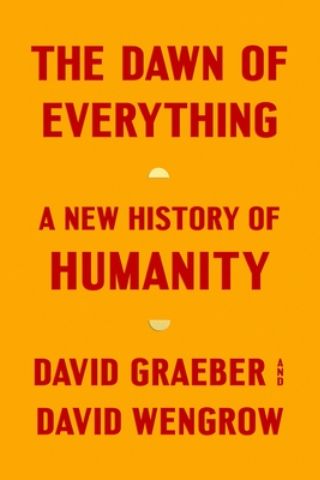
The Dawn of Everything
| Book Author | |
|---|---|
| Published | October 19, 2021 |
| Pages | 692 |
A New History of Humanity
What’s it about?
The Dawn of Everything (2021) is a reimagining of the history of humanity, based on new discoveries in the worlds of anthropology and archeology. According to the authors, new findings challenge what we thought we knew about hierarchies, inequality, property, and the state.
About the author
David Graeber was an American anthropologist and anarchist. He authored several books including Bullshit Jobs and Debt: The First 5,000 Years.
David Wengrow is a British archeologist who has written extensively about Neolithic societies and the emergence of the first states in Egypt and Mesopotamia.
Basic Key Ideas
We like to think that prehistoric humans were simpler than we are. We might even think they were stupid – think cavemen and -women dragging clubs around and gnawing raw meat. Of course, these depictions are far from accurate. The Flintstones is not a documentary. But these ideas point to a deep-rooted idea, an idea long espoused by philosophers and intellectuals – that people in the past weren’t capable of abstract political thought or social organization.
We now know that this isn’t true.
New findings show that prehistoric peoples were certainly political. They not only fought about political arrangements; they discussed and debated those arrangements. The archeological and anthropological record paints a clear picture: prehistoric societies were more complex, and more interesting, than we’ve long believed.
In these blinks, you’ll learn the real story of how modern ideas about property, human rights, and the state came into existence – and why history is still being written.
When it comes to how human society developed, there are two opposing stories.
The first one comes from the French philosopher Jean-Jacques Rousseau, and it goes like this: Once upon a time, we were all hunter-gatherers. We lived in small bands, and everyone was more or less equal. Then came the advent of agriculture. We figured out how to cultivate plants and animals, and we stopped hunting and gathering. This agricultural revolution led to more complex political structures, not to mention advancements in cultural phenomena such as the arts, philosophy, and literature. It also spawned hierarchical phenomena like patriarchy, mass execution, and interminable bureaucracy.
The other story was developed by a decidedly grumpier thinker, the English writer Thomas Hobbes. His story goes like this: Humans are, at their core, selfish creatures. In the past, life was “solitary, poor, nasty, brutish, and short.” Hierarchy and domination, he believed, have always been an aspect of human society.
So which story is true? Most social scientists would anwer: a bit of both. But when you look at the evidence, including an ever-increasing archeological archive, it becomes clear that the bit-of-both answer is also unsatisfactory. You see, both stories posit linearity. That is, they both argue that, from a pre-civilized condition – be it Rousseau’s condition of equality or Hobbes’s condition of hierarchy – we evolved into our current “civilized” state. But when you examine the evidence and think carefully about it, the truth is that human society did not develop linearly. Civilization did not march forward. It marched sideways, it went backward, it stood still. And, anyway, the “marching forward” metaphor is silly and misleading, since it’s not necessarily accurate to think that our society is better than those that preceded it.
So why is it so hard for us to imagine alternatives to the stories of Rousseau and Hobbes?
Early societies were a lot more complex – and interesting – than we’re taught to believe. These blinks seek to restore our ancestors to their full humanity, showing that many more possibilities for political organization and social interaction exist.
In the 1690s, a leader from the Huron-Wendat people in North America sat down with French colonists in Montréal to debate a variety of socio-political topics. His name was Kandiaronk, and his French interlocutors loved him. They described him as both witty and singularly brilliant. A book of his ideas sold like hotcakes throughout Europe, and inspired a response from nearly every Enlightenment thinker.
To put his views very simply, Kandiaronk was curious to understand why people in Europe were so obsessed with money and private property. And – come to think of it – why did their kings have so much power, whereas everyone else had practically none. What’s all this poverty about? Why do people put up with it? He didn’t hold back: “I have spent six years reflecting on the start of European society and I still can’t think of a single way they act that’s not inhuman . . .”
His criticisms were brutal, and they both shocked and excited Europe’s philosophers. But Kandiaronk’s views weren’t unique. They were shared by many indigenous people after coming into contact with European colonists. They became known at the time as the indigenous critique.
For conservatives in Europe, the indegenoius critique just wouldn’t do. To undermine North American indigenous critiques of European culture, right-wing thinkers began dismissing indigenous people, and their ideas of individual freedoms and social checks on authoritarianism, as “savage.”
European society was simply more advanced, further along the inevitable path toward “civilization.” Indigenous peoples hadn’t even begun marching. Sure, in Europe, there was poverty, domination, and religious persecution. But these losses of freedom represented a much larger gain: the achievement of a true civilization.
The term “egalitarian” became a default to describe societies without the trappings of what these Europeans called “civilization,” a kind of imaginary utopia left over when one strips away things like judges, kings, and overseers. Conservatives even blamed the links of Kandiaronk for the violence of the French Revolution, asserting that they’d introduced new, liberal ideas into a stable social hierarchy.
But of course, lumping together so many communities and societies as idyllically, unrealistically egalitarian tells us less about those communities, and more about the culture that needed to define itself against them.
In the end, if we are to understand how modern systems of domination came about, we need to set aside the question of equality or inequality. Instead, we need to work out why kings, princes, and overseers emerged. So let’s work it out . . .
Humans were around for more than three million years before they started writing things down. As there’s no written record, we know very little about what happened during that time.
One thing we can glean from the archeological record, though, is that humans were far more physically, and culturally, diverse than any of us are today. Human-like species coexisted alongside each other, much as giants, hobbits, and elves coexist in fantasy narratives.
Another thing we know is that people roamed around a lot. They only came together at certain times of year, such as the summer harvest. During these times, archeological evidence indicates that they didn’t adopt the dominant-submissive behavior of our ape cousins. This is borne out in the social checks we find in ethnographic accounts of forager bands in South America and Asia. Whereas gorillas beat their chests to signal dominance (and are taken seriously by other gorillas), humans tend to make fun of braggarts and showoffs.
The anthropological record can help fill in the gaps in other areas too. For example, for centuries, many post-Enlightenment philosophers argued that pre-agricultural humans weren’t capable of rational thought. But of course this is nonsense.
The anthropologist Claude Lévi-Strauss spent time living with and studying the Nambikwara, a community of part-time farmers, part-time foragers living in western Brazil.
Nambikwara chiefs play a dual role, brokering between two different social systems – farming during the rainy season and foraging during the dry season. When foraging, chiefs make or lose their reputations based on their exploits, behaving largely as authoritarians. When farming, life is much more sedentary, and people congregate around chiefs based on their dry-season antics. In these times, chiefs act more like statesmen, resolving conflicts and leading by example. These chiefs, Lévi-Strauss reasoned, were self-conscious political actors.
The example of the Nambikwara shows that in many societies, fixed social order was not immutable. Socio-political orders varied seasonally, and they varied according to whether farming or herding was something people were trying out at the time.
From this, we can reason that the first kings may have been temporary, rising up theatrically but relatively briefly. But when did kings and queens – and the permanent systems of inequality they ushered in – become mainstays of society? How, in other words, did we get “stuck” in the system we’re in today?
Well, let’s find out.
In earlier centuries, shared cultural norms and practices spanned thousands of miles, even continents. Aboriginal Australians and North Americans could travel halfway across the continent and still be among people with the same totemic designations that they had at home.
Our distant ancestors assumed three central freedoms, which are largely forgotten today.
First, the freedom to leave home, knowing one will be welcomed in faraway lands.
Next, the freedom to shift back and forth between social structures.
And, finally, the freedom to disobey authorities without consequence.
Why can’t we? Or to return to that question from the last blink: When did kings and queens and systemic inequality come into the picture? Well, it might be better to not ask when kings and queens emerged but instead ask when it was no longer possible to laugh them out of court.
The erosion of this freedom, the freedom to disobey authority, as well as of the other two freedoms, may have begun with the development of the idea of property. For European colonists, indigenous people didn’t own the land because they didn’t work on it, according to European convention. But this isn’t quite accurate – some foraging societies’ use of land was enough to support a wide variety of social structures, from royal courts to priestly castes to standing armies.
Communities like the Nambikwara haven’t developed the same idea of property as cultures who call themselves “Western.” But there is a similarity that we can point to that may give insight into how the idea of property developed. Both the idea of private property and the idea of the sacred are structures of exclusion. The Polynesian word tabu means “not to be touched” – it relates to the sacred, and is similar to the British legal theory of property as meaning rights held “against the whole world.” For example, if you own a car, you have the right not to let anyone in the whole world into it, according to British legal theory.
Ritual theaters were developed as places where exclusive claims over property – and demands for unquestioning obedience – are likely to be made, in communities all over the world.
How did these ideas of the sacred, and of property, come to order so many other aspects of human life? In the next blink, we’ll explore how ideas of property and humanity intersected on the west coast of North America, and further ensnared freedoms that earlier humans took for granted.
Scholars often see indigenous and pre-agricultural communities not as what they were in their own right but, they saw them as what they were on their way to becoming: a proper kingdom, whose subjects paid tribute to a ruler. But some peoples, including indigenous peoples of the California region, weren’t pre-agricultural. They were actually anti-agricultural.
Take the indigenous peoples of California. The evidence suggests that they developed their society in opposition to the society of their northerly neighbors of the Northwest Pacific coast.
Chattel slavery is one example. In the Northwest Pacific communities, as of the late eighteenth century, up to a quarter of the population was enslaved. These communities enjoyed ecstatic celebrations of excess known as the potlatch. These were occasions of gluttony and sacrifice, including human sacrifice.
By contrast, indigenous Californians were ascetics, consuming staple instead of luxury foods at ceremonies, and avoiding any kind of self-aggrandizement. They also rejected the idea of slavery.
The rejection of slave-taking in California communities has strong political dimensions. Enslaving people didn’t fit into the order of society for indigenous Californians. We know that people traveled widely back then, so they must have been aware of slavery as a possible social order. But we believe that they actively rejected it, or at least upheld social values like industry and self-reliance that would have clashed with the enslavement of others.
On the contrary, Slavery became commonplace in the Northwest coastal communities because the aristocracy found itself unable to support itself without a dependable workforce. In northern California, the communities most exposed to their northern neighbors developed social institutions to insulate themselves against slavery. More and more, coastal peoples began to define themselves against each other.
This suggests that hierarchy and equality begin to emerge together, as complements. And domination emerges first on a very intimate level, at home.
This cultural division is important for understanding how human freedoms came to be lost. It also shows that decisions about whether to adopt entrenched hierarchies reflected a community’s values and ideas about human relationships.
The ancient Athenians had a strange ritual. On a certain sweltering midsummer day, women would carry little gardens in baskets, planted with quick-sprouting grains and herbs, onto rooftops. There, they would be left in the sun to wilt. It was a botanical reenactment of the death of Adonis, slain in his prime.
This ritual, which had been going on from way before the ascent of agriculture, can be understood as a type of play farming. It was a game representing a foray into the world of agriculture – a game that eventually became the serious business of producing food to feed large populations.
Farming is back-breaking work: you have to clear fields, pull weeds, lug water. As a result, the advent of agriculture meant that humans had to put a lot more effort into feeding themselves than they’d had to previously. It’s not beyond the realm of imagination that some communities tried it and quit, or only farmed for part of the year.
It may be because of this that it took such a long time to domesticate cereals such as wheat – it took us up to 3,000 years, ten times as long as necessary, according to scientists. Human communities flirted with farming, cultivating plots while also foraging and hunting as they’d always done, before finally settling into agriculture. The transition was slow, progressing in fits and starts. Also, interesting fact, this work was most likely done primarily by women.
It was also dangerous to become too reliant on farming. Neolithic societies in modern-day Austria and Germany suffered terrible consequences for relying on a single food source: not only did they starve when crops failed, but the crisis sparked horrific violence. Learning from catastrophes such as these, populations that dabbled in farming seemed to maintain a careful balance between foraging and farming.
And what’s more, there’s no evidence that the shift to farming also meant the advent of land ownership or private property. Communal tenure of fields, redistribution of plots, and communal management was – and is – very common among agricultural communities from Highland Scotland to the Balkans.
Given the perils of farming, and the work involved, it seems strange that humans did ultimately decide to settle together in urban environments?
Well, what’s clear is that early cities – which could have millions of inhabitants – weren’t hierarchical.
For example, early Mesopotamian cities show no evidence of monarchy at all. Chores were done collectively, on a system similar to the French corvée, where labor is obligatory on certain seasonal civic projects. Other institutions were established to ensure that citizens played a role in government. Popular assemblies were commonplace in Hittite, Phoenician, Philistine, and Israelite mega settlements. And, finally, archeological surveys of Mesopotamian mega settlements reveal a strikingly even distribution of wealth, craft production, and administrative tools across the main districts, which were ethnically diverse. Different small groups within a city might have different theories about how to run it, and they would clash in the public assembly. Sometimes this would lead to violence, and sometimes it would be resolved peaceably.
Twelfth-century Teotihuacan, in today’s central Mexico, was formed later, but the setup was similar. Home to at least a million people, it was an ethnically diverse place of grandeur and sophistication, as well as subtly complex social organization – without overlords. The visual arts of the city depict Teotihuacanos as all roughly the same size, and clearly celebrates the community as a whole and its collective values.
Things were different in the smaller hill towns adjacent to these cities. In these places on the edge of urban civilization, we see the beginnings of an aristorical elite. A warrior aristocracy developed in sites like Arslantepe in eastern Turkey, heavily armed with swords and spears, living in palaces or forts. These warriors competed fiercely with each other for retainers and slaves, and rejected certain features of nearby urban civilizations, like writing.
Some of the societies we’ve considered begin to resemble what we might think of as a state. A state, according to conventional definition, claims a monopoly on the legitimate use of coercive force within a given territory.
Three principles form the basis of social power: control of violence, control of information, and individual charisma. Each of these has become the basis for institutions the modern state depends on, such as bureaucracy. Many assume that these three modes of domination were destined to come together at a certain time. But how did domination at scale first emerge?
The Olmec civilization, known as the “mother culture” for later Mesoamerican societies, centered around charismatic leaders who derived power from excelling at ball games. In the pre-Inca city of Chavín de Huántar, in the highlands of Peru, leaders derived power based on control of esoteric knowledge.
But despite their power, these cultures weren’t states. For something akin to a state to form, two of the three principles of domination had to be brought together in some spectacular display of violence. This happened in ancient Egypt. In Egypt and other early states, kings were buried with their followers – sometimes thousands of them, especially killed for the occasion. Archeologists now regard ritual killing as a sure sign that state formation was underway. Violence, in a way, makes kings.
But it’s really important to remember that political organization wasn’t only found in violent proto-states. Actually, archeological evidence suggests that the first systems of specialized administrative control emerged in small Neolithic villages, like Tell Sabi Abyad in today’s Syria, to keep track of resource allocation. These emerged as a corrective to bureaucrats taking more than their share. Neolithic people seemed to know that things could always be adjusted if they weren’t working out. So we’re still left with the question, Why did kings and ruling classes develop?
Remember how large scale agricultural production started out with play farming? What if political systems like kingdoms started out with temporary play kings? It makes sense for newly raised royals to be concerned with building monumental architecture like pyramids – huge structures like these were meant to project eternal power, just as massive human sacrifices were.
In other words, it seems clear that the state was never an inevitability, but a relatively recent confluence of the three forms of domination. And if the state was never inevitable, maybe it’s not permanent, either.
Remember the indigenous critique of European colonist political systems we mentioned back in the second blink? The critique itself didn’t just come out of nowhere. It was an amalgamation of centuries of political conflict and debate among indigenous North Americans.
From 400 to 800 CE, people began cultivating maize as a staple crop along the Mississippi River floodplain. Soon after, there was an intensification of armed conflict, finally culminating in an urban explosion at the site of Cahokia in modern-day Illinois. Cahokia soon became the greatest city in the Americas north of Mexico. Around 1050 CE, Cahokia exploded in size, ultimately totalling somewhere around 40,000 inhabitants.
Within a century, an event triggered a long, slow, violent period of destruction and depopulation in Cahokia, similar to the demise of cities like Teotihuacan, and those in ancient Egypt and Mesopotamia. We don’t know what that event was. But we do know that dissatisfied residents of Cahokia simply walked away.
This proves something important: state formation is not the inevitable end point of societal evolution. Once a society has begun moving toward state formation, there’s nothing stopping it from not forming a state – from simply going in a different direction. In subsequent communities across North America, the backlash against Cahokia spawned values like political debate, diversity of opinion, and a decidedly anti-authoritarian sentiment. In communities around the Great Lakes, social orders were developed as a barrier against what had happened in Cahokia.
These ideas are with us today in a number of forms. Not only did indigenous North Americans sidestep the trap we assume exists for communities on the path to state formation; they developed independent, anti-authoritarian political sensibilities that dazzled the European colonists who learned from them. What’s more, the ideas that became the indigenous critique profoundly influenced the Enlightenment thinkers whose ideas form the foundation of modern political thought.
Neither social nor political development is linear. As we’ve seen, both happen in fits and starts, trials and errors. History isn’t over, and neither is political evolution and experimentation.
The key message in these blinks:
Early human societies were much more complex than previously imagined. There was no linear journey to get from band society to the modern state – rather, there were prolonged periods of experimentation. This shows us that history isn’t over; it’s still possible for things to change.
SECOND REVIEW FROM SHORTFORM
About Book
Why does inequality exist and when did it start? Is inequality a necessary evil of any large, complex society? In The Dawn of Everything, anthropologist David Graeber and archaeologist David Wengrow attempted to answer these questions by looking at historical and anthropological research. What they discovered instead is that our beliefs about the evolution of human societies have been wrong all along.
Throughout humanity’s long history, cultures have always been much more diverse than we tend to believe, and the presumed evolution of societies from “primitive” to “civilized” is a myth. Armed with this new worldview, the authors challenge us to use our imaginations to envision new possibilities for our world today.
In this guide, we’ll explore different notions of freedom and equality, and we’ll delve into the authors’ thought-provoking questions about the inevitability of inequality and the potential for dismantling and reorganizing social systems. Throughout the guide, we’ll clarify and expand on some of the academic concepts and examine counterpoints by other scholars and authors.
Why does inequality exist and when did it start? Is inequality a necessary evil of any large, complex society? In The Dawn of Everything, anthropologist David Graeber and archaeologist David Wengrow attempted to answer these questions by looking at historical and anthropological research. What they discovered instead is that our beliefs about the evolution of human societies have been wrong all along.
Throughout humanity’s long history, cultures have always been much more diverse than we tend to believe, and the presumed evolution of societies from “primitive” to “civilized” is a myth. Armed with this new worldview, the authors challenge us to use our imaginations to envision new possibilities for our world today.
David Graeber was an American anthropologist and professor at the London School of Economics. He was an anarchist and political activist and is credited with being a driving force of the Occupy Wall Street movement. After a decade-long collaboration, Graeber had just finished working on this book with David Wengrow weeks before he passed away unexpectedly in 2020. The book was published posthumously.
David Wengrow is a British archaeologist and professor at the University College London. He has done archaeological research in Africa and the Middle East, and he focuses on questions of human evolution and the origins of civilizations. This book was the result of a decade-long correspondence, collaboration, and friendship between Graeber and Wengrow.
We’ve organized this guide into four major parts:
- In Part 1 we’ll discuss what’s known as the “indigenous critique” of European culture and show how that led to the “enlightened” thinking that revolutionized European philosophy.
- In Part 2, we’ll explore how indigenous notions of freedom and equality contributed to a simplified anthropological narrative about the evolution of human societies.
- In Part 3, we’ll examine Graeber and Wengrow’s critique of that conventional narrative.
- In Part 4, we’ll delve into the authors’ thought-provoking questions about the inevitability of inequality and the potential for dismantling and reorganizing our own social systems.
Throughout the guide, we’ll clarify and expand on some of the academic concepts and examine counterpoints by other scholars and authors.
Part 1: The Indigenous Critique: A Precursor to Enlightenment Values
Graeber and Wengrow’s examination of diverse social structures, values, and beliefs begins with a discussion of the relationship between the indigenous tribes and European colonists in North America. These interactions informed the European view of indigenous societies in general and ultimately came to influence European culture itself. This is because, the authors argue, European Enlightenment philosophy was inspired by the native North American people’s critique of European customs.
In the late 1600s, European colonists in North America became engaged in philosophical discussions with the indigenous peoples of that land. Some of the indigenous people and the colonists learned to speak one another’s languages fluently. Graeber and Wengrow explain that the native North Americans had strong philosophical traditions and skilled orators who challenged European colonial officials in debates. In particular, French Jesuits in the area around Montreal (known then as New France) had a series of lively intellectual and philosophical discussions with a leader of the Wendat people, named Kandiaronk. Many of these conversations were recorded in writing.
In these conversations, Kandiaronk raised scathing critiques of European social customs and values, particularly criticizing monarchical rule, social hierarchies, emphasis on the accumulation of wealth and materialism, and punitive justice systems. These descriptions then made their way back to Europe, where they were widely distributed among the intellectual class and, Graeber and Wengrow argue, became the inspiration for much Enlightenment thought. They say several Enlightenment thinkers explicitly stated that they were drawing on these indigenous American ideas, but that attribution was either lost or purposefully discarded over time, and the ideas became associated entirely with the European scholars.
Let’s look now at how that happened. In this section, we’ll discuss the indigenous notions of freedom and equality and their connection to Enlightenment values.
The Influence of The Rat
The Wendat people of the Great Lakes region of Canada, called the Huron by the French, forged political alliances with French colonists for trading furs and protection against their tribal enemies, the neighboring Iroquois. This meant people in the Wendat and French cultures learned one another’s languages and developed close relationships with one another.
Wendat chief Kandiaronk (c. 1649–1701), who was known as The Rat, was widely considered by the French colonists to be the most brilliant thinker and orator among the indigenous peoples they’d encountered. A Jesuit historian named Father Charlevoix described him as “the Indian of the highest merit that the French ever knew in Canada.” A French statesman, Baron de Lahontan, published these dialogues in 1703, under the title Curious Dialogues with a Savage of Good Sense Who Has Traveled, and it’s this publication that Graeber and Wengrow argue influenced “almost every major Enlightenment thinker.”
Notions of Freedom and Equality
One of the major cultural differences the Europeans and indigenous people found they had was the notion of equality and its connection to freedom. Indigenous ideas about equality and freedom directly conflicted with the European notions of social status and a natural hierarchy.
Graeber and Wengrow say that Europe before the 1700s lacked a notion of social equality. They believed that some people are naturally higher or lower in status and authority than others. They lived in monarchies and they derived that system from biblical notions of nobility and authority. In other words, God decided one’s station in life.
By contrast, many of the Native American cultures had no notion that anyone could be born higher or lower in status than anyone else, or that anyone could have authority over anyone else. In such cultures, status might be gained with age or according to merit. But the notion that people are inherently unequal, or that any status could give someone the right to dominate someone else, would not have existed in this kind of cultural worldview.
The Role of Religion in Upholding the Social Order
Historically, we can see a connection between types of religion and types of social organization. In his book Sapiens, Noah Yuval Harari argues that agriculture and organized religion evolved alongside one another. He argues that the role of religion is essentially to give “superhuman legitimacy” to the established social order, making it hard to challenge, and therefore more stable.
He compares the animistic belief systems of most indigenous peoples with the polytheistic and monotheistic belief systems often associated with agricultural states. Since an animistic belief system views humans as simply one part of a natural order that includes everything living, equality is an inherent part of the worldview. In this worldview, everything in nature is considered to be imbued with spirit, and to be valued and honored. Therefore the human world is constructed similarly.
In a polytheistic belief system, there are multiple gods that are often ranked, with some being higher than others. Although Harari says this form of religion tends to be more tolerant and inclusive than a monotheistic one, it still supports a hierarchical worldview.
A monotheistic religion, he argues, can create a rationale for domination and intolerance, since it’s based on a belief that only one god exists, and therefore any other belief form must necessarily be wrong. With such a belief system in place, a doctrine such as the Divine Right of Kings can be justified. This doctrine, which arose in medieval Europe, asserts that a King derives his absolute power from the one absolute universal power, God.
According to Graeber and Wengrow, people in societies that we would call egalitarian (meaning everyone is equal) actually seem to be less concerned with equality than they are with autonomy, meaning an individual’s right to self-govern. Each person having autonomy over him or herself is the most important value in these cultures. And while this means nobody can rightfully dominate anyone else, which in turn creates a relatively egalitarian society, individual liberty is prioritized over actual equality.
Graeber and Wengrow identify three forms of freedom that are commonly at the foundation of an egalitarian cultural value system:
- The freedom to move away: One should be free to leave at any time and know there’s somewhere else they can go and be welcomed.
- The freedom to disobey: One should be free to disobey orders without repercussion.
- The freedom to build new social worlds: If what exists isn’t working, there should always be freedom to imagine new possibilities and implement them.
The authors ask us to consider how these notions of freedom align with our worldview in modern society. They point out that even though much of our thinking has been influenced by these ideals, and we are much closer to them than were 17th-century Europeans, we still don’t fully embrace all of these freedoms. For example, most of us can’t even imagine a society in which disobedience of the law has no consequences. We tend to have paradoxical ideas about freedom, wherein we all want our personal freedoms but we believe authority, embedded in the government, is absolutely necessary.
Conflicting Ideas of Freedom
We can see the difference in ideas about what freedom entails by looking at contemporary American politics. One of the defining distinctions between right- and left-wing politics is the differing concepts of freedom.
Conservatives tend to place a high value on individual liberties—the unhindered right to enjoy their own private lives and property. In this view, government regulation of private lives and economic pursuits should be kept to a minimum, but laws that protect individuals’ rights and property must be strictly enforced. For example, in the conservative view, the government should not put restrictions on an individual’s right to profit from their business.
Liberals also value individual liberties but believe that must come with the responsibility to not encroach on others’ freedoms. This means the government must sometimes regulate issues of freedom to ensure one person’s liberty isn’t infringing on another’s. For example, in the liberal view, the government should mandate minimum wages and other fair labor laws to prevent employers from exploitative practices that violate their employees’ rights.
In both worldviews, we can see that these concepts of freedom fall short of the egalitarian model. Neither of these ideologies would embrace the idea that nobody can be subject to the authority of another.
Enlightenment Values
Even though we in modern state societies don’t fully embrace the freedoms of an egalitarian society (for example, we believe authority and law enforcement are necessary), Graeber and Wengrow point out that the values of contemporary American and European cultures are more aligned with the values of indigenous Americans in the 1700s than with European culture from that time. They argue that this is because the “indigenous critique” by Kandiaronk and others like him had a profound influence on European Enlightenment thought.
What Is the Enlightenment?
The Age of Enlightenment refers to a historical period, largely throughout the 1700s, when European intellectuals and philosophers were concerned with rethinking social values and moving toward a more progressive vision for humanity. This included thinking about the most rational ways to go about organizing and governing society to maximize human well-being, including discussions of freedom, equality, and empirical truth.
As this was a period of European expansion, Enlightenment thinkers took inspiration for their ideas from around the world. Since the conversations with (and descriptions of) the indigenous peoples in North America were published and widely circulated in the early 1700s, it’s clear those were among the influences.
Enlightenment philosophy led to revolutionizing many aspects of European society and ultimately had global influence. Some of the most well-known thinkers associated with this movement are René Descartes, Jean-Jacques Rousseau, Immanuel Kant, John Locke, and David Hume.
The major theme tying all Enlightenment thinking together is reason. Graeber and Wengrow explain that because the Wendat and other tribes didn’t believe anybody had the right to control anyone else, they placed a high emphasis on reason. They considered rational, intelligent argumentation to be fundamentally important because, in those indigenous value systems, the only way one could legitimately compel others was through persuasion.
So the authors argue that indigenous ideas about reason, individual liberty, and equality clearly had an impact on the thinking of Enlightenment philosophers, as these were concepts that were almost entirely absent from the European cultural worldview at the time. In fact, these conversations naturally stirred up conflict with the conservative monarchic governments and the Church in Europe, as they challenged religious knowledge and authority as well as social hierarchies.
(Shortform note: In his book Enlightenment Now, Steven Pinker argues that organized religion is fundamentally opposed to Enlightenment values because religious dogma often advocates putting the higher good above human interest—for example, embracing suffering in this life in order to appease a god and attain happiness in an afterlife. Also, Pinker says that organized religion typically translates to power imbalances and curtailing of freedoms, which conflict with the Enlightenment emphasis on equality and freedom.)
Part 2: The Conventional Anthropological Narrative
European colonists’ descriptions of indigenous societies made their way into academia, and the study of such cultures became known as anthropology. Early anthropologists used these descriptions (and sometimes their own fieldwork) to create theories about how human societies evolved. The conventional anthropological narrative has led to a simplistic idea about indigenous societies that persists even today.
Graeber and Wengrow explain that since Enlightenment thinkers were particularly fascinated with the indigenous people who had egalitarian ideologies, those descriptions received the most attention in Europe. Over time, Europeans came to view all indigenous peoples as living in societies where everyone was equal and there was no formal leadership. Likewise, when they looked at their own societies and others like them, which were arranged in monarchies, they believed that all modern societies were hierarchical. This was a gross oversimplification, as we will explain later. This flawed, established narrative led scholars to ask: How did humans go from living in egalitarian societies that value personal liberty to hierarchical societies that value control over citizens?
The Evolution of Human Societies
Prompted by the above question, anthropological scholars theorized that human societies evolve over time from simple egalitarian bands and tribes to complex stratified states. According to Graeber and Wengrow, scholarly discussions of equality and inequality tend to assume that inequality is a result of the rise of agriculture. One of the major points the authors argue in this book is that this conventional narrative is wrong. We’ll delve into their critique in Part 3. But first, let’s take a closer look at what the conventional narrative is.
According to Graeber and Wengrow, anthropologists traditionally describe the evolution of human societies as follows:
Bands: The earliest human societies were small groups of hunter/gatherers (also called foragers) organized into bands. A band is a small group of usually fewer than 100 people, composed of a few extended families living and working together. These societies would have been egalitarian, meaning everyone was equal in social status and resource distribution. As the story goes, all humans lived in foraging bands for the vast majority of humanity’s history.
Tribes: A tribe is a larger group than a band, with a leader and a more complex organization around distinctions in rank and status. Tribes can range from a few hundred to hundreds of thousands of people. Tribal societies may make their living by foraging, raising animals (called pastoralism), or by small-scale farming, called horticulture. While they do have rank and status distinctions, tribes are still fairly egalitarian, certainly as compared with a state-level society. There are typically customs in place to ensure that resources are distributed equally and everyone is taken care of.
Chiefdoms: A chiefdom is typically somewhat larger and more complex than a tribe, often with social status being tied to how closely one is related to the chief’s family. Chiefdoms are usually organized around small-scale farming of communal plots, and they also have customs and rules for ensuring that everyone has the resources they need. There are inequalities in rank and status, but that doesn’t translate into haves and have-nots, and a chief’s main function is to ensure that doesn’t happen. So, these are also considered relatively egalitarian societies, as compared with states.
States: The advent of large-scale agriculture led to a much larger and more complex social organization called the state. Humans began farming at least 12,000 years ago, but intensive cultivation leading to large, dense populations and state societies didn’t arise until several thousand years later, around 3700 BC.
A state-level agricultural society is fundamentally different from any of the other kinds of societies. A state implies a centralized government with the absolute authority to enforce laws. The state is also ranked hierarchically, based on relative access to resources such as ownership of land and monetary wealth. This creates a situation where a large portion of the population has few or no resources and is indebted to the smaller portion of the population who owns the land and other means of production. The rise of the agricultural state is associated with the origin of private property, hierarchy, and patriarchy (male domination).
From “Savage” to “Civilized”
This conventional narrative was drawn from the works of early anthropologists and social theorists who were quite ethnocentric—meaning, they saw their own cultures as superior and evaluated all other cultures against this standard. In his 1884 book The Origin of the Family, Private Property, and the State, Friedrich Engels argued that humans had evolved for some time in a state of equality, but with the invention of farming came inequality in all its forms, including gender inequality. However, Engels was drawing his conclusions based on only a small sample of descriptions of non-state societies, on the assumption that they were all generally similar.
Some of the work Engels drew upon was that of early anthropologists, sometimes called social evolutionists or social Darwinists because they took Darwin’s ideas about biological evolution and applied them to human societies. One of these social Darwinists was Lewis Henry Morgan, who wrote the book Ancient Society in 1877. In this book, Morgan described human societies in terms of three levels of social development: savagery, barbarism, and civilization. Morgan defined these levels based on the tools and weaponry the societies had developed, as well as their social organization and structure. So, bands and smaller tribes might have been classified as savages, while larger tribes and chiefdoms might have fallen into the barbarism category. Only state societies could be classified as civilized. And in fact, Morgan subdivided this category into upper and lower civilizations— with the upper civilization category being reserved for the colonizing countries like Britain, France, and America.
Morgan was American and studied the Iroquois tribe firsthand, so he was basing his categorization system on his fieldwork among the Iroquois, combined with descriptions written by other anthropologists of cultures around the world. Since the Wendat were Iroquoian people, and Morgan’s work was taking place in the mid- to latter-19th century, it’s possible his work was influenced by the indigenous critique of the 18th century.
The authors say the dominant narrative in this framework is that the adoption of agriculture dramatically changed the way humans lived, and it led to formal social and economic inequality. The above categories, they explain, are often presented as an evolutionary trajectory, wherein human societies inevitably go through this linear progression from the simple egalitarian band to the complex hierarchical state, with the degree of farming being tied to the degree of social inequality.
According to Graeber and Wengrow, early anthropologists explicitly defined these stages in terms of “progress.” Societies at the state level were considered to be civilized while simpler societies were categorized as primitive or savages. The authors clarify that contemporary anthropology patently rejects such value judgments and would no longer classify any human society as savage. But, they point out, it’s still commonly accepted that the forms of society that existed before agricultural states were all somewhat similar—small, simple, and relatively egalitarian.
We can also see in this framework what Graeber and Wengrow challenge in this book: the idea that inequality is an inevitable fact of life in a state-level society.
As a result of this view of simple indigenous societies, Graeber and Wengrow argue that in the modern imagination there are two general views of what a pre-state kind of lifestyle was like—it was either an idyllic life of harmony with nature, or it was a miserable existence of constant suffering. These two disparate views, they argue, can be traced back to philosophers Jean-Jacques Rousseau, who described the admirable life of the “noble savage,” and Thomas Hobbes, who described pre-modern life as “solitary, poor, nasty, brutish, and short.”
The State of Nature
The debate between the views of Jean-Jacques Rousseau and Thomas Hobbes is often referred to as a debate about the state of nature, meaning it revolves around the question of whether human nature is inherently good or evil.
Rousseau’s view was that human nature is peaceful and compassionate and that it’s only corrupted when humans move away from their nature and live in an unnatural way—-meaning, in a hierarchical state-level society.
Hobbes, on the other hand, believed human nature was selfish and greedy and tended toward violence. He argued that these natural tendencies must be controlled by man-made institutions, like government and organized religion, that essentially force people to behave.
We can see this dichotomy of thought in many aspects of society today, from political ideologies to education. For example, in the US, the public education system is a highly structured, hierarchical environment with a standardized curriculum and a high value placed on technology. By contrast, Waldorf and Montessori schools place emphasis on allowing children to explore in less structured environments, encourage creativity, and eschew technology. This system values an idyllic concept of pre-modern life and emphasizes sustainable skills like handcrafts and gardening.
Part 3: Challenging the Conventional Narrative
After presenting these conventional views, Graeber and Wengrow argue that the truth is much more complex than our traditional narrative suggests. They say when you look at the historical evidence without an evolutionist bias, you find that people in all times and places have been conscious political actors making deliberate decisions about how to live, and they’ve chosen the kinds of social and political organizations that suit them best.
In this section, we’ll look at specific challenges to the myth that earlier societies were all egalitarian, and then explain why that myth may have been intentionally perpetuated to undermine the indigenous critique of European culture. Then we’ll examine the authors’ critique of the myth that agriculture led to inequality.
Debunking the Myth of the Egalitarian Tribe
Graeber and Wengrow argue that when we examine the anthropological evidence, the evolutionist narrative doesn’t hold up to scrutiny. They say the historical evidence shows us that hierarchy and equality have existed in a variety of ways alongside one another throughout all of recorded history.
The whole idea that societies have evolved—from bands to tribes to chiefdoms to states—suggests that all human societies are in whatever stage of development they’re in just because they haven’t yet reached the next stage of development, and they don’t know anything else. But Graeber and Wengrow say there are two major problems with this assumption:
First, many non-agricultural societies had a combination of features of those different structures. Some would be impossible to fit into one of the four evolutionary categories. For example, they say when you look at chiefdoms, those chiefs look a lot like kings. The authors say, for example, some Native American tribes—especially on the northwest coast—had ranks and titles, nobles and commoners, and slaves. Records indicate that in some of these tribes, up to 25% of the population was enslaved.
By contrast, the authors say that the Californian tribes to their south were truly egalitarian and adamantly opposed to slavery. This helps illustrate that as far back as recorded history goes, even cultures living in proximity to one another were often radically different. In fact, Graeber and Wengrow point out that cultures often define themselves in opposition to their neighbors. So, historically, we see more contrast and diversity than similarity among indigenous groups.
So this means there are many societies that wouldn’t be able to be placed on the evolutionary scale.
Native American Tribes and Slavery
Not only were some of the Native American tribes slaveholding societies before European contact, a few tribes even enslaved Africans brought to America by Europeans. The Smithsonian Institute says high-status members of five tribes (the Cherokee, Chickasaw, Choctaw, Creek, and Seminole) enslaved African Americans in order to prove themselves more “civilized” in the eyes of the white settlers. Slaves would have been symbols of, and tools for, economic success, and such success would have garnered privilege and status for Native people seeking to improve their situations in the colonizer’s society.
The Smithsonian notes, however, that most Native Americans did not own slaves, and in fact, many more of them were enslaved themselves than were slaveholders.
Second, there are records of some indigenous cultures choosing to change their social organizations, either temporarily or permanently. For instance, there’s evidence that some societies tried farming for a while, then abandoned it and went back to hunting and gathering. This implies they knew there were multiple options.
The authors say band foragers weren’t always just band foragers because they couldn’t even imagine anything else and had no other options available. People in these societies made conscious decisions to organize themselves in ways that suited their environments, values, and preferences.
This defeats the claim that all societies inevitably progress through these stages over time.
(Shortform note: Researchers have also recently learned that some of the cultures originally assumed to be foragers were actually cultivating plant food. In the forests of British Columbia, First Nations people were believed to be engaged in hunting and gathering wild animals and plants. The plentiful forest gardens looked like wild natural spaces to white settlers. But in fact, ecologists have recently determined that those tribes were intentionally cultivating many of the fruit trees and berry bushes in the area. This is another factor that complicates the simplified classification system of indigenous societies.)
Undermining the Indigenous Critique
Graeber and Wengrow argue that this oversimplified view of indigenous societies was deliberately used to undermine the indigenous critique of European culture by equating “egalitarian” with “primitive.”
The authors explain that the reasoning went like this: If “primitive” tribes were egalitarian (as they were all presumed to be) then one could logically conclude that an egalitarian structure was primitive and associated with a simple-minded worldview. Then, by contrast, since “civilized” societies were all hierarchical, that structure must be associated with a more sophisticated worldview. Then, when we add notions of social evolution to the narrative, Graeber and Wengrow point out, it’s easy to conclude that an egalitarian structure is less evolved and that as human societies progress, they naturally and rightfully become more stratified.
So this rationale worked to undermine the indigenous critique by discrediting the source: If indigenous societies were primitive and simple-minded, they obviously couldn’t have any valid critique of a civilized, sophisticated society. They just didn’t understand the complexities of civilization.
Survival of the Fittest
The evolutionist narrative of human societies is not only incorrect, but it’s also actively harmful, as it has been used to justify racism. In thinking about these systems for categorizing societies on a scale from savage to civilized, early social scientists also noted that people in these different societies looked different. It was only at this point in history (during the colonial era of the 1800s) that the concept of human “races” as distinct biological categories emerged. When the concept of race overlapped with the idea of social evolution, this could justify the claim that some humans were naturally less-evolved, and therefore inferior, to other humans.
In fact, contrary to popular belief, it was not Charles Darwin who coined the phrase “survival of the fittest”—it was social Darwinist Herbert Spencer, in discussing the evolution of societies. Using these ideas, then, the colonizing societies could conclude that they were naturally superior and more fit for survival, while the indigenous peoples they encountered were less fit and destined to die out. And, of course, they could use this to justify eliminating them.
Debunking the Myth of the Agricultural Revolution
The idea of an agricultural revolution is also something of a myth, according to Graeber and Wengrow. They point out that there’s evidence that people were cultivating crops since at least 10,000 BC, while major state-level societies didn’t happen until long after that. Also, they say, some societies have farmed and never become hierarchical states. For example, Çatalhöyük is an ancient site in Turkey that was settled around 7,400 BC and was occupied for around 1,500 years. Archaeological remains tell us that this community was engaged in foraging as well as raising animals and farming, and it doesn’t appear that there were any social distinctions in rank, including between men and women.
(Shortform note: The argument Graeber and Wengrow put forth here doesn’t make the distinction between what anthropologists call horticulture versus agriculture. Anthropologists are aware that people were farming long before what’s called the agricultural revolution—it’s large-scale intensive farming that’s associated with the revolution and the subsequent hierarchies. A society like Çatalhöyük would be considered horticultural, which actually isn’t conventionally associated with a high degree of inequality. On this point, the authors seem to be arguing against a claim that isn’t being made.)
Additionally, Graeber and Wengrow point out that there were non-agricultural societies that had the concept of private property, such as strict territorial boundaries, as well as the notion of the sacred, which can translate to “this is mine and you can’t have it.” And they point out there have been many farming societies that understood all land as communally owned.
So, the authors suggest that farming allows for the possibility of a hierarchical state to emerge, and it is conducive to notions of private property, but it doesn’t make these things inevitable, nor does it cause them to happen. Some cultures have intentionally chosen not to cultivate crops, and some have moved back and forth between farming and foraging.
(Shortform note: It could be argued that the authors’ accounts of ranked foraging societies are exceptions, not the rule, and that those are examples of “complex foragers.” Such societies became complex and ranked because they had a steady, abundant source of wild food. For example, those who lived near salmon-rich rivers were able to harvest and store a surplus of fish, which served the same purpose as farming. Anthropologists acknowledge that such groups exist. Graeber and Wengrow claim they’re more common than what could be considered exceptions to the rule, but some anthropologists disagree.)
Part 4: Conclusion: Is Inequality Inevitable?
To circle back around to the driving question of this project, Graeber and Wengrow ask: How did we come to view inequality as inevitable and get stuck in unequal state-level societies? Rather than answering this question, the authors simply raise it for the reader’s consideration, suggesting that understanding the complexity and diversity of different kinds of societies throughout history might prompt us to broaden our ideas about the possibilities for our contemporary societies.
Imagining Alternatives
A thorough examination of the literature shows us that people throughout history have deliberately changed social and political customs that weren’t working, and they were able to creatively envision different alternatives. Could we use these examples as templates to imagine alternatives for ourselves?
Graeber and Wengrow say that most citizens of modern states have a hard time even imagining a different social order than the one they live in. Indigenous people, however, are not only able to imagine it, they sometimes move back and forth between different social orders in cycles with the seasons. And some have abandoned their social organization entirely and reorganized because what they had wasn’t working well.
For example, Graeber and Wengrow describe the Nambikwara people of Brazil, who live in two different places at different times of the year—one location in the rainy season and another for the rest of the year. They farm during part of the year, they hunt and gather during another part of the year, and they have different political systems, social organizations, and rules for those different phases of the year. (Shortform note: Many people consider nomadic cultures to be a thing of the past, but millions of nomads still exist today and they are present on nearly every continent.)
If people throughout history have been assembling and dismantling hierarchies on a seasonal basis or even in a historical pattern, then the authors challenge us to consider: Why have we been stuck in the state structure for so long? Why did most of humanity allow these permanent hierarchical systems to take root? How did we as a species come to give in and accept these systems?
Graeber and Wengrow leave us with more questions than answers. But in conclusion, they point out that earlier people took conscious steps to avoid domination and hierarchy and to protect personal freedoms, liberties, and equality. And they say this indicates that we could also dismantle the systems we have in place and build something different. We’re only limited by our imaginations.
Can We Have Peace Without State Control?
In the spirit of imagining alternative ways of living, you might wonder: Is it possible to have a peaceful society and true egalitarian freedoms?
Taking Hobbes’s pessimistic perspective of human nature, Steven Pinker would say that in large-scale societies, a formal government is necessary to keep our violent instincts in check. In his book The Better Angels of Our Nature, Pinker argues that today’s modern societies are less violent than small-scale societies of the past, specifically because we have greater social control mechanisms, which have led to what he calls the “pacification process.” He argues that the reason we need a government, police, and a criminal justice system in complex societies is because it would all descend into chaos if we didn’t have that.
Graeber and Wengrow disagree with this notion. They say the evidence doesn’t support the claim that a formal government is necessary for a peaceful society. It can also be argued that the modern state’s monopoly of force can be used for much larger-scale acts of terror and oppression, and that it curtails the kinds of freedoms and liberties associated with an egalitarian society.
Which Modern Countries Are the Most Egalitarian?
Although none embody the freedoms of the indigenous egalitarian societies, some contemporary nations are much more egalitarian than others. Could we look at those countries as models to start thinking about global steps in that direction?
Ranking countries in terms of equality is complicated because there are many different dimensions of inequality, including economic, gender, and racial inequalities. However, when we look at the data, we see some common names appearing on the “top five” lists.
Top five countries with the greatest income equality: Norway, Denmark, Finland, Sweden, and Switzerland
Top five countries with the greatest gender equality: the Netherlands, Sweden, Norway, Denmark, and Finland
Top five countries with the greatest racial equality: the Netherlands, Sweden, Norway, Canada, and Finland
It’s clear from these lists that there are a handful of countries full of people who may not believe they’re stuck in a system of inequality, and who are actively using their imaginations to re-think their social systems to move toward a more egalitarian world.