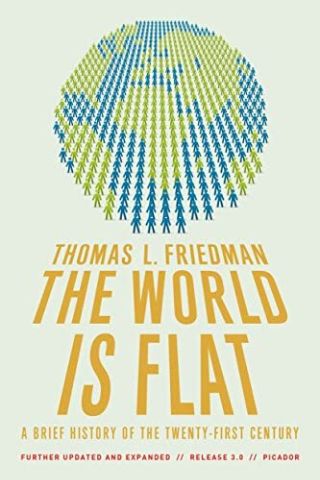
The World Is Flat
| Book Author | |
|---|---|
| Published | January 1, 2005 |
| Pages | 593 |
| Greek Publisher | Ωκεανίδα |
A Brief History of the Twenty-first Century
Around the turn of the 21st century, the world changed more dramatically than perhaps at any other time in history. Seemingly all at once, shifts in the political landscape, technological advancements, and collaborative business practices came together to create a new globalized society. In this new world, free markets reign supreme, global trade is the centerpiece of economies, and people have access to more information and are more connected than ever before. The global playing field has evened out. In other words, the world has become flat.
In The World Is Flat, New York Times writer Thomas L. Friedman examines these forces of globalization, where they came from, how they’re changing the world, and what the globalized future might hold. By understanding how the world is changing, countries, communities, and individuals can better position themselves to thrive in the 21st century. In our guide, we’ll weigh the potential costs and benefits of a flatter world and help you determine how you can best contribute to a globalized society.
Basic Key Ideas
SECOND REVIEW FROM SHORTFORM
About Book
Around the turn of the 21st century, the world changed more dramatically than perhaps at any other time in history. Seemingly all at once, shifts in the political landscape, technological advancements, and collaborative business practices came together to create a new globalized society. In this new world, free markets reign supreme, global trade is the centerpiece of economies, and people have access to more information and are more connected than ever before. The global playing field has evened out. In other words, the world has become flat.
In The World Is Flat, New York Times writer Thomas L. Friedman examines these forces of globalization, where they came from, how they’re changing the world, and what the globalized future might hold. By understanding how the world is changing, countries, communities, and individuals can better position themselves to thrive in the 21st century. In our guide, we’ll weigh the potential costs and benefits of a flatter world and help you determine how you can best contribute to a globalized society.
Thomas L. Friedman’s The World Is Flat examines the causes, effects, and potential future of a globalized world. Due mainly to technological advancements and changes in the political landscape, the world in the 21st century is now more connected than ever before, and more people than ever have access to the same information and opportunities. In other words, the world is becoming flat. Because the world is flattening, Friedman argues that individuals, companies, and countries must adapt quickly to the new global economy or risk falling behind.
Friedman has written extensively for The New York Times about foreign affairs and globalization. For The World Is Flat, published in 2005, Friedman traveled around the world, interviewing business executives, entrepreneurs, and politicians about the rapid changes occurring in the world and the instability such changes bring.
In this guide, we’ll explore Friedman’s discussion of the leading causes of modern globalization and how they converged at the turn of the 21st century to change virtually every aspect of society. We’ll lay out his argument that globalization, despite its potential dangers, benefits the world and its inhabitants. Then, we’ll present his advice on how governments and individuals can best navigate the challenges of globalization. Throughout the guide, we’ll look at the most recent data behind globalization and compare Friedman’s views to the works of other economic experts.
Brief History of Globalization
Friedman argues that the globalization of the modern era is happening at an unprecedented pace. Because of this, individuals in the 21st century will have more power and opportunity than in previous generations—especially non-Western and non-white individuals. The world is thus becoming less stratified and flatter.
To better understand this argument, let’s look at the history of globalization, which Friedman breaks down into three periods:
The Period of Nations (1492-1800): Starting with Columbus’ journey to the Americas, which opened up global trade, in this era, powerful nations and governments drove globalization. Western European, imperialist nations such as Great Britain, Portugal, and Spain, did most of the work, as they sought to journey across the world to advance their empires and trade globally.
(Shortform note: Friedman argues that globalization was kickstarted by European imperialism. But why did European countries become imperialist powers in the first place? In Sapiens, Yuval Noah Harari argued that the main reasons for Europeans’ dominance is their focus on science and their cultural homogeneity. Scientific breakthroughs gave European powers the ability to travel around the world and conquer lands with advanced weaponry. Also, because European countries shared many values and sociopolitical structures, countries like Portugal and Spain were more willing to follow England’s imperialist ways.)
The Period of International Companies (1800-2000): In this period, large, multinational corporations drove globalization. With the Industrial Revolution in full swing, companies were able to expand globally in search of new markets and labor: Inventions like the steam engine and railroads made trade cheaper and quicker in the 19th century. Then, in the 20th century, inventions such as the telegraph, telephone, and later the computer and satellites, made communication cheaper and quicker. The combination of accessible trade and communication led to an economy in which companies could take advantage of global opportunities.
(Shortform note: In Naked Economics, Charles Wheelan, like Friedman, defines globalization as the increase in international trade that exploded in the 20th century, when exports went from 8% of global GDP in 1950 to around 25% by the end of the century. Wheelan notes that while companies were able to profit from this, it also helped people, and the economy as a whole, in several ways: 1) It lowered the cost of goods and services globally. 2) It gave people access to a larger variety of goods and services. And 3), it increased productivity: When people can rely on others for more of their goods and services, more time and energy can be spent working.)
The Period of Individuals (2000-present): With personal computers, the internet, and new software at their disposal, people now have the ability to communicate, collaborate, and compete with others globally. Thus, the top-down, hierarchical structures that controlled the world to this point are giving way to decentralized, crowd-sourced systems: Though governments and corporations still hold a lot of sway, this third era of globalization has given power to billions of people who were previously powerless.
Globalization Helps Alleviate Poverty
Friedman mentions that the flat world gave power to billions of people, making globalization one of the best ways to lift people out of poverty. Here are a few ways globalization helps people in underdeveloped countries:
By letting people sell in the markets of developed countries: When people can sell their products to consumer-rich populations, they will make a lot more money.
By creating jobs: As more money comes in, jobs in manufacturing, exporting, and other industries become available.
By increasing skills and knowledge: When a country opens up to trade, people will gain the skills and knowledge to thrive in a global economy.
Political and Technological Changes Flattened the World
Friedman argues that the flattening of the world was caused by the convergence of several factors around the end of the 20th century. These factors fit into two broad categories: political change and technological advancement.
Political Change
According to Friedman, the political change that initiated the process of globalization was the fall of the Berlin Wall on November 9, 1989. This event marked the end of the Cold War, a victory of capitalism and free markets over communism and government-run economies. This then encouraged the rest of the world to also adopt free market strategies. Within a decade, countries like India, China, and Brazil moved away from centralized economies, adopted more democratic systems, and joined the global marketplace.
As more governments embraced a free market, globalization flourished. Nations were no longer divided between Eastern and Western philosophies, and they began to trade goods, services, and information more freely. As countries learned to work together effectively, businesses adopted common practices and hired globally, and people traveled around the world, absorbed new cultures, and learned new languages.
The Importance of Economic Freedom
Thomas Friedman argues that the Cold War was a struggle between capitalism and communism, between free markets and centralized economies. To get a better understanding of this dichotomy, we can look to a work by another ‘Friedman’: Milton Friedman’s 1962 economic treatise Capitalism and Freedom.
Milton Friedman argues that democracy and free market capitalism go hand-in-hand because economic freedom is an essential component of a free society. When people have the ability to engage in a free market, to buy and sell products as they choose, they have more power in their day-to-day life.
Though written decades before the world became flat, Capitalism and Freedom predicted the democratizing effects of capitalism that came at the turn of the century. To take full advantage of free markets after the Cold War, governments loosened economic regulations, which in turn gave more freedom to their citizens. For example, India’s deregulation of trade and other industries in the 1990s led to a period of economic growth, and many people have been lifted out of poverty as a result.
Technological Advancements
While countries embracing free markets helped globalize the world, Friedman argues that technological advancements helped put globalization into overdrive because people and businesses from around the world could now collaborate and trade hyper-efficiently.
It began with the emergence of personal computers (PCs) in the 1980s and ’90s, which allowed people to use relatively inexpensive machines to create, store, and manipulate digital content (words, art, music, data, video). Then, the internet and World Wide Web (the “web”) allowed people to post this content for anyone to access.
Web browsers and web protocols developed in the ’80s and ’90s made the internet even more useful. Commercial web browsers paved the way for the internet as we know it today by giving people the ability to easily access digital content and display it on their screens. Standardized web protocols, meanwhile, allowed the internet to be a truly interconnected and integrated network by making it possible to transmit and access content no matter the type of computer or software you’re using.
Once PCs became widespread and the internet, the web, web browsers, and web protocols were widely adopted, people and businesses could create, share, and work together from all corners of the world. For example, with a PC, you can type up a business report, edit it, add pictures, graphs, or videos, all from your living room or office. With the web, you can put it on a webpage for anyone to see. Then, using web browsers, people can pull up the report with just a few clicks. And because of web protocols, they can do this from any device.
Globalization and Technology
In Zero to One, venture capitalist Peter Thiel compares technological advancements with globalization. While Friedman sees new technology as a key driver of globalization, Thiel sees them as two different forms of progress: New technology is a form of vertical progress, because it creates something out of nothing. Globalization, on the other hand, is a form of horizontal progress—it occurs when existing technologies, products, or methods of production are spread around the world.
Thiel agrees with Friedman that globalization will lead to a more homogeneous world, and standards of living across the globe will become more equal as a result. But he also notes a potential downside: A more homogeneous society might lead to conflict instead of progress. As the world becomes more homogenous, people will be competing for the same limited resources. As technology allows China to become a manufacturing powerhouse, for example, that country will require more energy in the form of oil, which may lead to conflict with other nations.
Collaborative Business Practices Accelerated the Flattening
Friedman argues that as political and technological changes flattened the world, new forms of collaboration emerged that accelerated the flattening. Here we’ll discuss three developments contributing to it: the emergence of search engines, the outsourcing and offshoring of jobs and processes, and the worldwide integration of supply chains.
The Emergence of Search Engines
The development of search engines greatly enhanced people’s ability not only to inform themselves, but to collaborate on a much larger scale. With Google and other search engines, people have access to an enormous amount of information, which they can use in unprecedented ways: People use search engines to find friends, communities, and collaborators across the world. They can also uncover new sources of information. Search engines level the global playing field perhaps more than anything else because they open up a world of possibilities to billions of people.
The Power of Search Engine Optimization
To understand how important search engines are to individuals and businesses, we can look at the search engine optimization (SEO) market. SEO is the process of increasing website traffic by moving that website higher on the list of search engine results. Companies pay SEO firms to ensure their ecommerce website is a top result of a Google search because this will get them more clicks and make them more money. The global SEO services market was $51 billion in 2021, and it is expected to grow to $134 billion by 2026.
Companies have good reason to pay for SEO: Studies have found that people are inherently biased toward top search engine results, regardless of their relevance. Indeed, the first result in a Google search is clicked over 25% of the time, compared to 5.1% for the sixth highest result.
However, our trust in a search engine’s ability to rank websites by their relevance to the query can lead to undesired consequences. A top result of a search engine could be irrelevant, biased, or misleading, but because it’s the top result, it will get a lot more clicks. Furthermore, once a site is high on a search engine’s results, it’s difficult for smaller or lesser known sites to gain traction. This could undermine a searcher’s ability to find good connections or information.
Outsourcing and Offshoring
Outsourcing is when a company pays someone else—an individual, group, or another company—to do a specific job that it previously did in-house. Friedman explains that when the world became connected by the internet, the outsourcing of jobs grew cheaper because communicating and collaborating over long distances became easier. For example, around 2000, outsourcing from America to India became popular. American companies paid Indian companies to help with their call centers, business operations, or any other form of work that could be digitized. Because of this, American and Indian companies are now more intertwined.
Globalization also accelerated offshoring, which is a little different from outsourcing. Instead of allowing a third party to help with a function or process of a company, offshoring sends in-house jobs overseas. The most prominent example of this is the common practice of sending manufacturing jobs to China. As China opened itself up to the world market, it became a global hotspot for offshoring jobs, as other countries can’t compete with China’s low-cost manufacturing.
The outsourcing and offshoring of US jobs is generally considered to be a negative aspect of globalization, as jobs are leaving American soil. But Friedman argues that it isn’t quite that simple. Cheap goods made in China have saved the American consumer hundreds of billions of dollars. In addition, American companies have seen increased profits because of the practice, which allows them to grow their businesses and hire more workers in the US.
Pros and Cons of Outsourcing
Friedman admits that the outsourcing and offshoring of jobs is one of the most controversial aspects of globalization, and while he argues that the pros outweigh the cons, there are contradictory reports on how damaging it is to a country’s economy.
The offshoring of manufacturing jobs in particular is a great concern of economists and politicians, as they have historically provided stable middle-class jobs to many Americans. From 1998 to 2020, an estimated 5 million US manufacturing jobs were lost due to globalization. A 2016 study suggests that this could have a big impact because it found that when US manufacturing loses $1 of growth to China, the entire US economy loses $6 of growth.
Other economists, however, feel the drawbacks of offshoring jobs aren’t that serious. They argue that first, the number of jobs lost to offshoring is small when compared to the size of the labor force. Second, most trade is still done between high-income countries, so earning inequality shouldn’t be affected. Third, though there are fewer manufacturing jobs than in the past, there has been a rise in the earnings of skill-based jobs. For those with a college degree, there are more opportunities to find jobs outside of manufacturing.
Global Supply Chains
When the world began collaborating on a global scale, businesses began using parts and products from all over to save costs, thereby creating global supply chains. Friedman says these drive globalization even further because they encourage companies from different countries to work together and adopt common business practices. They also discourage global conflict: If your country is an integral part of a global supply chain, you don’t want to risk losing economic benefits by going to war with another country within that supply chain.
According to Friedman, global supply chains have produced both positive and negative outcomes. They’re generally good for consumers: They allow us to purchase all sorts of products cheaply and quickly. For workers, though, supply chains can cause problems. In order to implement an efficient supply chain and compete globally, companies look to cut costs wherever possible. This cost-cutting is often seen in workers’ wages and benefits. Walmart, for example, runs one of the world’s most efficient global supply chains, but they’ve also been criticized for their worker relations.
(Shortform note: In the 21st century, Walmart has consistently ranked as one of the leading supply chain companies in the world while simultaneously being one of the worst places to work in the US. In 2020, for example, Walmart ranked 11th in Gartner’s annual Supply Chain Top 25. Also in 2020, a federal study of 11 states found that Walmart had among the highest number of workers enrolled in federally funded social safety net programs such as Medicaid and SNAP.)
Issues of a Global Supply Chain
Friedman argues that global supply chains are generally good for consumers, but there are many risks associated with our reliance on a hyper-efficient, global trade system. Though supply chains are increasingly efficient, recent events exposed just how vulnerable and fragile they’ve become: Supply chains are increasingly complicated, and a small disruption can have an enormous ripple effect. The semiconductor shortage that started in 2020, for example, limited new vehicle production, delayed the release of electronic products, and caused a spike in prices across many industries.
Because supply chains have too easily broken down due to the pandemic, wars, or natural disasters, improving the resilience of supply chains has become a key focus for many businesses and industries. Here are a few ways we can improve global supply chains and make them more resilient to unforeseen circumstances:
Increase domestic capabilities: By increasing domestic production of goods, we can limit the impact of a supply chain disruption across the globe.
Increase storage and inventory: Many companies rely on a “just-in-time” approach to replenishing inventory to fulfill orders, as it saves time and money. But having greater storage capacities and more backup inventory will mitigate supply chain risks.
Improve transport tracing: As we saw with the 2021 blockage of the Suez Canal, transportation logjams can seriously disrupt global trade. Improving our ability to track container ships could help us anticipate these disruptions and ease logistical problems.
The World Became Flattest at the Turn of the 21st Century
Friedman argues that around the year 2000, these forces of globalization—political change, technological advancements, and collaborative business practices—coalesced and began reinforcing each other in life-altering ways.
Through technology, the world has become more interconnected, and at the turn of the century, people and businesses were beginning to figure out how to make the most of the new tools at their disposal. Around the same time, because much of the Eastern world was opening up, billions of people from China, India, and the former Soviet Union were also joining the playing field. The result, for better or worse, has been a period of change, collaboration, and innovation unlike any other time in human history, with implications for the health and success of all nations.
Globalization by the Numbers
A look at the data shows just how rapidly globalization developed in the 1990s and 2000s. From 1990 to 2007, the value of the global flow of goods, services, and financial investments went from around $5 trillion to $30 trillion, which was about 53% of the world’s GDP. Due to the Great Recession and other factors, however, around 2008 these numbers began to drop, and global trade is not expected to return to this level of growth for the foreseeable future.
Some suggested the drop in global trade marked the end of globalization, but others contend it’s just taken on a new form. Instead of the rapid increase in global trade of goods and services, we now have a rapid increase in the global flow of information and data. Digital media platforms, like YouTube and Facebook, and ecommerce websites, like Alibaba and Amazon, have exploded in popularity. From 2005 to 2014, the data exchanged across continents (information, internet searches, digital communication, and so on) increased by a factor of 45.
How America Can Thrive in a Globalized World
Friedman argues that globalization is the most significant force shaping the world today, one that presents every person, group, and country with new opportunities and challenges. As one of the most powerful and wealthy nations in the world, the United States has a lot to gain and lose from this rapidly changing world. Yet despite the many challenges, America has all the tools necessary to thrive in a global economy. If it wishes to do so, it must focus on three things: education, government policies, and infrastructure.
Education
According to Friedman, one of the most important things the US can do to achieve success in the flat world is to properly educate its citizens: People need to have the right knowledge and skills to find jobs and provide value to society. A large and thriving middle class is important for economic and political stability, so the US needs to educate its citizens to find good middle-class jobs.
However, many of the middle-class jobs people relied on in the past will no longer exist in the flat world. They’ll be automated, outsourced, or simply obsolete. There is no way to know exactly how these jobs will change in the future, so Friedman provides three general tips on how the US can best educate its young:
- Teach kids how to adapt.
- Teach kids how to properly navigate technology.
- Teach kids how to make mental connections.
How to Adapt
Friedman argues that the most important thing to impart to our kids is the ability to learn and adapt: to absorb new information and figure out how to do different tasks in different ways. For instance, in a flat world, jobs and industries will constantly evolve, making it necessary for workers to adapt to changing workplace demands.
(Shortform note: In Make It Stick, the authors give advice on learning “how to learn,” which may lead to greater adaptability. Because adapting requires you to learn things quickly, learning how to learn is an important skill to grasp. They claim the learning strategies many people are taught today are ineffective. They rely too heavily on repetition and only provide a surface-level understanding. To learn a new skill or concept well, focus on two things: comprehension and retention. The best way to improve comprehension is to identify the underlying principles instead of merely memorizing the information. To improve retention, use forms of retrieval practice that commit the information to long-term memory.)
How to Navigate Technology
Another important skill Friedman recommends we teach our children is how to properly navigate the digital world. As more people gain access to the internet, knowing how to use it to your advantage becomes critical. In particular, being able to find useful knowledge in a sea of online information can set you apart from others.
(Shortform note: Understanding technology may improve your job prospects in the short term, but a major concern of the 21st century is the automation of jobs causing mass unemployment. In 21 Lessons for the 21st Century, Yuval Noah Harari points out that the rise of new technologies, particularly artificial intelligence, may result in a “useless class” of people who can no longer contribute to the labor force. AI could replace even high-skilled jobs that were previously immune to automation. For example, machines could potentially learn to diagnose illnesses and injuries in patients, replacing doctors and nurses across the world.)
How to Make Mental Connections
In a flat world, Friedman argues that making connections between different areas of knowledge and expertise will be an invaluable skill because these kinds of connections are what lead to innovation and creativity. One way to foster creativity is to focus on liberal arts curricula, which promote a well-rounded education. While math and science are also crucial in a flat world, having a basis of knowledge in things like music, art, and literature can help people apply their math and science education in creative ways.
(Shortform note: With the transition to a digital, globalized world, many education experts are recognizing the importance of creativity in modern curricula and in particular how education in the arts is vital to US success. One educator, for example, stresses that art and design will transform the 21st century economy as much as science and technology transformed the 20th-century economy. This is because art and design are an essential part of creativity, which in turn is essential to innovation.)
Government Regulation
Friedman argues that to thrive in a flat world, the US must find the right balance between free trade and governmental regulation. If it tries to insulate itself from globalization, it runs the risk of losing major ground to its global competition. But doing nothing to protect its citizens from the potential downsides of globalization is also dangerous. Let’s look at three issues that illustrate the importance of finding this balance: the outsourcing and automation of jobs, tax policies, and intellectual property laws.
Outsourcing and Automation
Friedman argues that America shouldn’t fight the outsourcing or automation of jobs. First, these changes will happen whether the government wants them or not. Trying to stop the changes will only delay the inevitable and hurt the US in the process.
Second, Friedman points out that the outsourcing and automation of jobs could actually benefit the US job market in the long run. Though certain factory and service jobs may leave the country, new jobs will replace them as long as the global economy is growing. The key is to make sure people are properly educated to take advantage of the opportunities.
The Downsides of Protectionism
In Naked Economics, Charles Wheelan argues, like Friedman, that international trade is good for the world and the countries that participate in it. But though it may benefit countries as a whole, it can hurt certain individuals, like those who lose their manufacturing jobs to someone across the world.
When globalization affects enough people, there’s often public pressure on the government to implement protectionist policies: barriers to trade such as tariffs, taxes, sanctions, or regulations. These can save some local jobs, but protectionism can be damaging in several ways:
It decreases productivity: If a company or industry is protected from foreign competition, it won’t have the incentive to be as productive and efficient as possible.
It discourages innovation: Global competition will force companies to get creative, leading to innovation and a stronger economy.
It increases prices: When tariffs are implemented to make foreign goods more expensive, domestic products are usually made more expensive as well.
To help soften the blow of job loss without implementing protectionist policies, there are some things a government can do, such as retrain or relocate displaced workers, provide assistance to hard-hit communities, and encourage schools to teach applicable skills.
Tax Policies
To keep pace with globalization, Friedman argues that the US needs fair and balanced tax policies that support businesses and the working middle class. Both are important for economic growth.
If there is a high corporate tax rate, businesses will simply move locations. In the flat world, this is cheaper and easier to do. However, the government can’t put the tax burden on the middle class, either. A strong middle class is crucial to economic growth, because it ensures there is a stable demand for goods and services.
What Are Optimal Tax Rates?
Friedman notes that finding the right tax rate is crucial but says that he’ll leave it to the experts to figure that out. Here’s what the experts at the Economic Policy Institute (EPI) have to say: Top marginal tax rates in the US aren’t nearly high enough. They argue that determining the right tax rate is primarily about finding the balance between three economic challenges: economic growth, long-term sustainability, and income inequality. When considering these three factors, the EPI found that the ideal top marginal tax rate is roughly 68%. As of 2022, the top federal marginal tax rate in the US is 37%.
The EPI argues that raising top marginal tax rates could raise revenue and mitigate income inequality without significantly affecting economic growth. But their research fails to address Friedman’s key concern about raising tax rates, which is that companies will move their businesses out of the country. As studies have shown, globalization has led to reduced tax rates in developed countries due to increased tax competition. To determine the most effective tax policies, countries have to take globalization into consideration.
Intellectual Property
According to Friedman, to succeed in the flat world, America should also figure out how to properly regulate intellectual property—inventions, art, or other creations of the mind. Such regulation must strike a balance: On the one hand, innovators must be protected by patents, copyrights, and trademarks so they can benefit from their creations—this incentivizes innovation, which is a hallmark of a free market system. On the other hand, intellectual property shouldn’t be over-protected because the sharing of ideas also fosters innovation. Thus, the law needs to be set up in a way that protects ideas but also encourages innovators to share these ideas.
Intellectual Property in the Modern Age
The rise of new technologies and knowledge-based industries has made intellectual property rights more important—and more complicated. The fastest-growing industries (electronics, software, biotechnology, telecommunications) all rely on the protection of intellectual property. The internet, however, has made protecting intellectual property difficult, because people can easily copy and reproduce material and share it with the rest of the world.
To establish optimal intellectual property rights, a key thing to consider is what should remain private knowledge and what should be made public: We need to encourage innovation by allowing some knowledge to be kept private, but it is good for society for some information to be widely available. It may be beneficial for educational technologies, for example, to be accessible to all. It could also be argued that certain biomedical knowledge should be made public, so that lifesaving technologies aren’t only available to those who can afford to pay private companies for it.
Infrastructure
Friedman argues that developing the infrastructure to connect and innovate in a flat world is vital for America. He identifies two key areas in which the US needs to build and maintain a strong infrastructure: internet technology and services, and scientific research and development.
Internet Infrastructure
As we’ve discussed, the internet has played a massive role in the most recent era of globalization. Therefore, according to Friedman, the US needs to make sure its internet services and technology remain strong in the 21st century. There are two benefits to this: First, internet services technologies are huge money-makers, so being at the forefront in these areas will be a boon to the economy. Second, having easy, affordable access to the internet across the country will help increase the innovation and productivity of all citizens.
Poor Internet Access in America
Recent data shows that America has fallen behind in terms of internet speed and access. Out of 30 developed countries, the US ranked 27th in percentage of its population with internet access (87%). America’s average internet speed ranks 13th globally, but internet speeds vary drastically from state to state. For average cost per megabit (MB), the US ranks second-worst out of 33 OECD countries, meaning Americans pay much more on average than other developed countries for worse internet speeds.
One of the main reasons the US has fallen behind in internet infrastructure is the lack of competition. Only 62% of Americans have access to a competitive internet market, with more than a third of the nation living in areas dominated by a monopoly or duopoly. To improve infrastructure, there should be more regulation of such monopolies, especially in smaller, rural communities.
Research and Development
One of America’s strengths is its robust network of research and science institutions, and Friedman argues that maintaining the strength of this network will be vital to success in the flat world. These research institutions, especially publicly funded universities, provide a great deal of the country’s innovation and scientific discoveries, which, in turn, are key factors in economic growth.
(Shortform note: In The Demon-Haunted World, Carl Sagan argues that government-funded basic research in particular benefits all of society. Basic research is scientific research with no short-term goal in mind, in which scientists are given funds to follow their interests and pursue knowledge. Most major scientific discoveries happened through basic research. Recently, however, government-funded basic research has been in decline, with private companies contributing more to research and development. This could lead to less scientific advancement and innovation in the long run.)
How You Can Thrive in a Flat World
If the forces of globalization are changing the world as quickly and drastically as Friedman suggests, what can you do as an individual to thrive in such a world? Friedman argues that you must come to terms with the way the world is changing, and focus on how you can add unique value to society.
(Shortform note: Figuring out how to thrive in a changing world can be a daunting task, but luckily for humans, our brains have evolved to adapt well to changing conditions. In the relatively short time hominids have existed, the climate and landscape of Earth have shifted dramatically. Because of this, our ability to think creatively and adapt to new environments proved to be a useful trait. Although the environment is changing much more quickly and in a much different fashion, our adaptability should help us thrive in the modern world.)
To add value to society, first understand that you’re now competing for jobs with billions of people across the globe, and that many jobs of the past will no longer be available. Then, prepare for this shift by identifying which jobs will be available and figuring out the skills and knowledge you need to attain them. The valuable skills in a flat world fall into these broad categories: cooperation, integration, and versatility.
(Shortform note: In Ultralearning, Scott Young elaborates on Friedman’s belief that you must accrue the skills needed for the jobs of the future by introducing the concept of “skill polarization.” This is the idea that in the future, medium-skill jobs will be outsourced, leaving only low- and high-skill jobs available. To avoid having to take a low-skill job, you must therefore constantly learn advanced skills and knowledge that prepare you for a high-skill role.)
Cooperation
With companies and workforces going global, Friedman argues that being able to cooperate with others or foster cooperation between others will be valuable. This could mean building relationships with clients from different parts of the world or helping new employees understand the cultural differences of their coworkers. In a world in which international collaboration is becoming the norm, working well with others will make you irreplaceable.
(Shortform note: Friedman advocates building your cooperative skills, but he doesn’t say how to do so. One way to encourage cooperative behavior in yourself and at work is by stressing the importance of relationships in the workplace. When you make work about social bonding (not just completing tasks), employees care about each other and their well-being, which fosters cooperation. It also improves performance, which is an advantage for the company.)
Integration
As we mentioned above, Friedman believes that many innovative ideas will come from the integration of two or more different ideas or skill sets. This means you should develop a wide set of skills and knowledge. Many graphic designers, for example, separate themselves from the pack by being exceptional at art and with computers.
(Shortform note: In Smarter, Faster, Better, Charles Duhigg elaborates on the idea that combining old ideas can be an especially efficient way to innovate. To devise an innovative product or idea, you don’t always have to come up with something entirely new. By combining old ideas in new ways, you can be creative without having to start from scratch. This can help you be more productive while also saving time and energy.)
Versatility
Friedman suggests another way to separate yourself from the pack: versatility. If you can quickly adapt, take on new roles, and provide value in multiple ways, you’ll be irreplaceable. He argues that being a specialist can be dangerous in a flat world because the world can change in an instant, leaving you and your specialized field behind. Experts in one programming language, for example, may find themselves out of a job when that language becomes obsolete. But if you’re versatile and know multiple languages, you’re less likely to run into this problem.
(Shortform note: Because modern organizations must be able to adapt and respond quickly to changing market conditions, workforce versatility has become a key focus when hiring new employees. A versatile workforce benefits both employers and employees: A versatile workforce lets employers capitalize on all the skills their workers have, which boosts productivity and helps keep workers motivated. For their part, versatile employees are likely to be more satisfied, as they have more variety and freedom in their day-to-day work.)