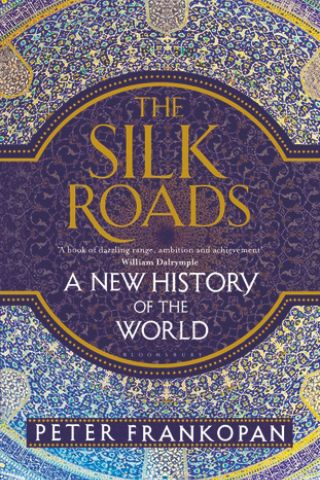
The Silk Roads
| Book Author | |
|---|---|
| Published | August 27, 2015 |
| Pages | 636 |
| Greek Publisher | Αλεξάνδρεια |
A New History of the World
What’s it about?
The Silk Roads (2015) is a comprehensive history of the world, written with an eye to the networks of trade that shaped it. The networks of trade first established in ancient Persia and later linked with Chinese trade routes created a great network between the East and the West. But these Silk Roads are not relics of the past. They have morphed and changed, and their impact can be felt today, right down to America’s fateful engagement in the region where it all began.
About the author
Peter Frankopan is director of the Oxford Centre for Byzantine Research. He has lectured at Cambridge, Yale, Harvard, Princeton, NYU and other Universities. His other books include The First Crusade: The Call from the East (2012).
Basic Key Ideas
The history of the world is a mighty big topic. When grappling with such an outsized subject, it’s tempting to try to streamline it. Some historians make it seem like an adventure story, zeroing in on kings and politicians and other prominent personalities. Others turn it into a narrative, a sort of epic tale of major events. But history isn’t actually like that. People, even mighty emperors, are tiny pieces in an impossibly complex puzzle.
So what actually is important? Well, to borrow a well-known phrase from Bill Clinton’s campaign team, the economy, stupid!
The network of trade routes that took shape in ancient Mesopotamia has morphed, changed and spread along with our ever-changing world. At the height of its importance, this network acquired a name, the Silk Road, which Marco Polo famously followed on his travels from Italy to China. This road brought the world together, as people from both East and West traded along its many arteries. But the Silk Road was not an isolated historical phenomenon. It’s been added on to and reiterated, and it’s been through many phases. Therefore, it might make more sense to think of it in the plural: the Silk Roads.
As Frankopan’s narrative makes clear, the history of the world can be told as a story of trade. In his view, whoever controls the Silk Roads also controls the globe.
In these blinks, you’ll learn
- where the word ‘slave’ comes from;
- why the Black Death wasn’t as disastrous as you might assume; and
- which trade deal led to the demise of the Persian shahs.
Thousands of years ago, the expanse of land bracketed by the Euphrates and Tigris rivers was called Mesopotamia. This area, which covered most of what is now Iraq and parts of the surrounding countries, is the cradle of Western civilization. It was here that the first towns, cities, kingdoms and empires emerged.
Of these empires, the greatest was the Persian. By the sixth century BCE, it stretched from Egypt and Greece in the West to the Himalayas in the East. It was an empire built on trade between its cities – trade that was made possible by a network of roads that connected the Mediterranean to the heart of Asia.
These roads were a mighty achievement, but their destiny was to become a constituent part of the Silk Roads, the famous network of routes that eventually linked China with the West.
Under the Han dynasty, between 206 BCE and 220 CE, China began to expand its horizons. It pushed its borders northward and westward as far as the Eurasian steppes, the sweeping grasslands that cover much of modern-day Russia’s southern regions. This expansion linked Persia’s trade routes with China’s own network of roads.
The steppes were a wild place. The Chinese sought to maintain peace in the region by trading with the nomads. Rice, wine and textiles were all favored commodities, but silk was by far the most coveted.
Silk became a symbol of wealth, luxury and power. It was even occasionally used as currency. As trade expanded, it attained a reputation as a luxury good in the West, too. In fact, by the time Rome came to dominate the Mediterranean, in the middle of the first century BCE, silk’s reputation there was secure.
But it wasn’t just goods that flowed between East and West. The routes facilitated the exchange and dissemination of ideas, too.
The most powerful of these were religious. Local cults became increasingly mixed with established belief systems, a process that created a rich melting pot of ideas concerning the divine. For instance, the Greek pantheon of gods headed east, while Buddhist ideas circulated from northern India into China and the rest of Asia.
In fact, these networks partly explain why Christianity was later able to spread so quickly from its humble origins in Palestine through the Mediterranean and across Asia.
In the first centuries of the first millennium CE, the eastern fringes of the Roman Empire – and, later, of the Byzantine Empire – constituted a contested zone. Both empires fought bitter campaigns against the Arsacid and Sasanian Persian dynasties for hegemony in the Western world.
By the sixth century, Western Europe had entered a dark age of upheaval and turmoil. In contrast, a new power united by a strong sense of religious identity was forming on the Arabian Peninsula.
In 610 CE, Muhammad, a trader from the Quraysh tribe based near Mecca, received a series of revelations from God. He believed he’d been chosen as God’s messenger. In a polytheist Arab world, Muhammad had been singled out to proselytize that this sole God was the all-powerful God of Abraham.
Muhammad’s message was heard and accepted. Before long, the Arabs had unified around the precepts of Islam and their identity was formed. The religion was also partly spread by the sword; Muhammad and his followers triumphed on the battlefield and the tribes of southern Arabia were persuaded to join the new faith.
The result of these conquests soon became apparent: the Silk Roads were now under the Muslim sphere of influence.
By around 700 CE, the writing was on the wall. The Arabs conquered and united these economic heartlands of the former Byzantine and Persian superpowers. It was only a matter of time before these once-dominant powers were no more.
Consequently, Muslims were able to take over the vast network of oasis towns, ports, roads and cities that connected the Arab realm with China. Goods flowed into the region and it became wealthier and wealthier.
A new golden age of flourishing trade, arts and science had begun. Luxury goods like Chinese porcelain poured into the region, as did academic texts and tracts. The Muslim world, which cherished education, became enriched with mathematical, geographical, philosophical and scientific knowledge. In contrast, Europe was becoming an intellectual backwater, as the Christian Church sought to suppress scientific study and inquiry.
The Muslim empire reached ever-greater heights. And, during this ascent, the demand for slaves grew considerably, too.
Interestingly, a great number of the slaves from eastern Europe were brought to the Muslim world by the Vikings. In fact, the word “slave” is derived from the name that was originally given to this group of people: the Slavs.
The consequences of the developing slave trade were far-reaching. Money poured into Europe and was, for example, used to import highly desirable luxury items, including spices and medicines.
The domino effect of these valued Eastern products turning up in Europe was soon felt. Europeans started to turn their gaze eastward and became increasingly interested in visiting – and conquering – the lands they associated with Jesus Christ and the Holy City.
Christian knights armed themselves for bloodshed and made their way to Jerusalem in the First Crusade. On July 15, 1099, Jerusalem fell.
At a stroke, a new era was ushered in – an era dominated by Western Europe. Muslims had controlled Jerusalem for four centuries. But no longer.
Interestingly, the initial resistance to the Christian occupiers was local and limited in scope. So the Crusades are perhaps best thought of as a springboard that Europeans used to claim more riches and power. In other words, saying it was no more than a religious conflict, as we’re prone to do these days, is actually a bit of a disservice.
Now that Jerusalem was in Christian hands, the balance of trade shifted once more. It wasn’t just Jerusalem that bolstered European interests. Trade with Constantinople and Alexandria also contributed to improving socioeconomic conditions in Europe in the twelfth century.
In particular, the Italian city-states of Genoa, Pisa and Venice grew rich as they plugged themselves into a trading network that stretched to the Far East.
In the late eleventh century, the Mongols were just one of many tribes that dwelt in the steppes north of China.
The Mongols were widely viewed with contempt. To outsiders, the Mongols appeared to be a chaotic horde, but they were actually highly strategic and precise planners. These qualities enabled the Mongols to conquer much of Asia and Europe by the end of the thirteenth century, thus establishing the world’s largest contiguous empire.
The Mongols ruled the Mongolian steppes as early as 1206. Thereafter, they brought other tribes under their rule, either threatening violence or committing it. Then, in 1211, the Mongols fought their way through China, even capturing the Jin dynasty’s capital, Zhongdu. After that, in the 1230s, the Mongols began pushing westward through central Asia. In 1258, they sacked Baghdad, and, a mere year later, they were making inroads into eastern Europe.
By the end of the century, the scale of the Mongolian Empire was monumental. It stretched down from the steppes into northern India, and from the Pacific as far as the Black Sea and the Persian Gulf.
The Mongols’ territorial conquest also gave them control over the Silk Roads and other trading routes. Thereafter, their cultural impact could be seen across Europe in fashions such as Mongol hats and dark-blue Tatar cloth.
But the Mongols introduced more than changes in sartorial taste. They also brought disease.
And not just any disease: the Black Death, a plague carried by the bacterium Yersinia pestis. By the mid-fourteenth century, the plague had brought much of the old world to its knees. An apocalypse surged along the trade routes. Beginning in the Asian steppes, the home of the Mongols, it soon arrived in Europe, Iran, the Middle East, Egypt and the Arabian Peninsula.
The death toll was almost beyond comprehension. Venice, to name just one city, lost approximately three-quarters of its population during an outbreak of the plague in 1347. It was terrifying. More than a third of Europe’s population was taken by the plague!
It seemed like there was no way Europe could recover. But, paradoxically enough, the plague actually resulted in conditions that contributed to a new European ascent.
Even though the death toll caused by the Black Death was astronomical, the feared apocalypse failed to materialize.
Europe after the plague was an altogether different place. The population had fallen dramatically, but this had served to empower the peasantry and to weaken the propertied classes.
Wealth was now more evenly distributed, and interest rates fell. These two changes to the socioeconomic landscape stimulated the economy and facilitated the development of new technologies. Of particular note were advances in military and naval technology. By the fifteenth century, discovery expeditions would sail through new oceans.
Portugal and Spain became the port of departure for many of these voyages. Before too long, European naval expeditions to Africa, the Americas and Asia made the world smaller. The Portuguese were the first to take initiative. They headed out into the Eastern Atlantic and along the coast of West Africa, discovering archipelagos like the Canary Islands, Madeira and the Azores.
Most famously, Columbus set sail in 1492 under the Spanish flag in an attempt to find a new trade route to India. The Americas rather got in the way of that mission. Then, shortly thereafter, in 1497, Portuguese explorer Vasco da Gama succeeded where Columbus had failed. In 1519, Ferdinand Magellan left port and, for the first time, managed to circumnavigate the globe .
As a result of these expeditions, new trade routes were established, with Europe as their hub. Europe was able to extract the riches from American gold and silver mines, to import Chinese porcelain and silks and, most importantly of all, to ship in spices like pepper, cinnamon, nutmeg and frankincense from Asia.
There was a massive downside to these economic advances in Europe, however. The rest of the world was made to suffer.
In the Mesoamerica, the mighty Amazon Empire fell, its inhabitants slaughtered by the Spanish conquistadors. The indigenous peoples of the Americas didn’t just die by the sword, either. European explorers and armies brought diseases, such as smallpox and measles, against which the native population had no resistance.
The Europeans, of course, also brought with them the most inhuman development of the era: the global slave trade. In order to feed economic growth on American plantations, Africans were shipped across the Atlantic and sold into servitude.
Thanks to the expeditions of the European seafarers, Europe now sat at the center of the world.
By 1500, Portugal and Spain had become the mightiest powers on the continent. But their reigns were short-lived. In the sixteenth century, Northern Europe came to the fore.
England had not sat idle as its southern neighbors set sail. The English, too, had dispatched expeditions in all directions to build new trade connections. By the end of the sixteenth century, it had established a series of companies. Each was granted a monopoly in the regions it was to trade. The Levant Company, the Turkey Company and the East India Company would become extremely successful economic outposts of England.
The Dutch were not far behind. They created similar companies – most famously, the East Indies Company, and the West Indies Company. In so doing, the Dutch essentially invented the modern corporation, as well as the ideas that capital could be pooled and risks could be shared among a corporation’s many investors.
But all things must pass. By the early nineteenth century, an increasingly ambitious Russia was on the rise. War seemed imminent.
Russia began to expand its frontiers and attacked the Ottoman Empire, which was based in what is now Turkey. By the 1820s, it had made gains in the Caucasus and succeeded in driving out the Persian army.
When Russia expanded into central Asia in the late nineteenth century, the threat to Britain was clear. Now, Russia’s borders were only a short march away from the British Crown’s Indian possessions.
The British needed a strategy. The idea was to maintain good relations with Russia and so encourage it to divert its attention to the western border it shared with Prussia, the forerunner to modern-day Germany. It was something the increasingly powerful French Republic very much appreciated, too. To stabilize the balance of power, an alliance between the three powers of Russia, Britain and France was established.
That wasn’t the best news for the newly established German state, however. It, too, had imperial desires, but found itself surrounded by allied enemy forces. Military confrontation between these nations was seemingly inevitable. And so it was that the First World War broke out in 1914.
It had long been known that large oil reserves were buried below Persia. But, before 1900, no one much cared for its black gold. It took a Briton, William Knox D’Arcy, to convince the Shah of Persia to allow access to the reserves.
Back in 1901, the Persian Shah, Mozaffar ad-Din Shah Qajar, signed an agreement that granted Knox D’Arcy the exclusive rights to Persia’s natural gas and petroleum for 60 years. In return, the Shah was to receive ₤20,000 in cash and another ₤20,000 in shares of the newly formed company, as well as 16 percent of its profits each year. This agreement was known as the Knox D’Arcy Concession.
It was a gamble on the Shah’s part, and he lost it. The British benefited far more than he did. Indeed, the concession became one of the most important documents of the twentieth century. The Shah’s decision planted the seeds for the downfall of the Persian monarchy nearly 80 years later.
As ships the world over were increasingly fueled with oil, demand for oil grew rapidly. D’Arcy’s company consequently became a multibillion-dollar business. In 1914, the British government acquired a 51 percent stake of the company. Within a few decades, it would become the British Petroleum Company (BP).
The Shah’s subjects were not impressed. As the British grew rich by exploiting Persia’s natural resources, the Persian people received barely anything.
Anti-British sentiment swelled, and it became clear that something had to be done to stop the British. And so, in the 1920s, much to the chagrin of the British, the American oil company Standard Oil was granted a fifty-year concession in northern Persia, where the Knox D’Arcy Concession didn’t apply.
The Persians hoped that American investment would challenge British dominance in the region. But this plan didn’t work. As one Persian representative remarked, the Americans showed themselves to be “more British than the British.”
For a region that had been the center of trade along the Silk Roads for millennia, the arrangement was downright insulting. Oil pipelines pumped wealth to the West and the Persians got little in return. Their Shah had sold them out.
In August 1939, arch nemeses Nazi Germany and the Soviet Union signed a nonaggression treaty. But the treaty was built on a secret: Hitler and Stalin had agreed that Poland would be divvied up between the two nations.
And so, on September 1, 1939, the German Wehrmacht invaded and overran its neighbor to the East. The Soviet Union, meanwhile, did nothing.
But Hitler had also kept something to himself. He wanted access to the Silk Roads in the southeast of Europe. These would bring resources that Nazi Germany needed – wheat and oil, most importantly – to wage an intercontinental war. Stalin had no idea that Hitler had this in mind. He had misjudged the situation entirely.
Of course, the pact between such ideological enemies was never going to hold. Hitler and Stalin both knew that. Nonetheless, Stalin was caught off guard when Germany attacked sooner than expected.
Hitler directed his forces toward the Soviet Union and his troops crossed the frontier early on the morning of June 22, 1941.
It seemed an odd time to do it. Germany had already attacked and occupied France to the west, and it seemed an act of madness to open a second front to the east.
Hitler’s goal was straightforward. The fertile wheat plains of southern Russia and Ukraine could be used to feed the Reich’s population and soldiers. The Soviets, deprived of grain, would starve.
At first, the German advance was unstoppable. But they soon came crashing to a halt as the realities of the icy Russian winter – along with overly-strained supply lines – set in. To make matters worse, the Russian and Ukrainian soil didn’t produce as much grain as expected.
The Nazis used this scarcity as an excuse to further enact their anti-Semitic agenda. Adolf Eichmann, the architect of the Final Solution, declared that the Jews “can no longer all be fed.” Of course, the Nazis had already gathered Jews into camps ready for mass extermination. But the author asserts that the lack of expected grain helped lead to the Holocaust.
In 1945, the horrors of the Second World War finally came to an end. The power balance in the world had been reestablished. Now, two superpowers were facing off against one another: the Soviet Union and the United States.
Before long, these powers turned their attention to where the history of the Silk Roads began: the 1950s marked the beginning of American dominance in Iran, formerly Persia.
By 1950, the call for nationalizing the entire Iranian oil industry for the benefit of the Iranian people was so loud that it couldn’t be ignored. In 1951, Prime Minister Mossadegh was elected and agreed to set the process in motion. It was an action that the United States knew would reduce their influence, not to mention their access to strategic resources. They acted fast. In 1953, the CIA staged a coup to remove Mossadegh.
The United States lined up a series of American oil companies to assume control of the Iranian oil wells. It sought to keep the Soviets from influencing this critical, influential and oil-rich region. The goal was to establish a belt of states, from the Mediterranean to the Himalayas, each with pro-American governments that could give economic and military support.
The Americans didn’t succeed, however, and paid a high price for their meddling. The Shah was overthrown in the Iranian Revolution of 1979. Anti-American feeling was palpable, and the situation escalated quickly. Militant Iranian students forced their way into the American embassy in Tehran and took around 60 diplomatic staff hostage. A year passed before they were released. And, when they were, it was clear that American influence in the region was no more.
The Americans made another mistake, too. During the late 1970s, the US gave substantial support to Islamic fundamentalists resisting the Soviets in Afghanistan, even supplying them with weapons.
After the collapse of the Soviet Union, these fundamentalists turned against the United States. They eventually attacked the US on its own soil in the terrorist attacks on September 11, 2001.
The misadventures of the United States and the European powers demonstrate the continued importance of eastern Europe, the Middle East and Western and Central Asia. The regions where the Silk Roads began millennia ago still have a future; that much is clear. After all, these lands connect East and West. But the exact nature of that future is up for debate.
Take Ukraine, for example. Thanks to different national visions for the country, it’s being torn apart by the East and the West alike. Or there’s Syria, whose horrendous civil war has pitted conservatives against liberals and freedom fighters against government forces. And then there’s the Caucasus, which is in a near constant state of political instability. Just think of Chechnya and Georgia.
But maybe these are the usual struggles that occur when an area is reemerging. Because the world’s metaphorical center of gravity is returning to the point where it sat for millennia.
There’s one obvious and important reason for this: the region possesses vast natural resource deposits. Take the crude oil reserves beneath the Caspian Sea, the coal in Ukraine’s Donbas region, the natural gas reserves in Turkmenistan or the rare earth minerals found in Kazakhstan.
In all these regions, cities are booming. New buildings rise from the ground to tower over the cityscape. Tourist resorts and luxury hotels are opening, and airports are being built.
New transport connections are being built, too, which is leading to more trade. Just think of the Northern Distribution Network, a series of transit roads through Russia, Uzbekistan, Kazakhstan, Kyrgyzstan and Tajikistan. There are even transcontinental railway lines that connect China with distribution centers in Germany.
As for the oil pipelines, they stretch all the way from the Middle East to Europe.
It’s not just a question of economics, either. Centers of arts and academic excellence are springing up across the Persian Gulf. There’s the Guggenheim Museum in Abu Dhabi, the Baku Museum of Modern Art in Azerbaijan there are even university campuses springing up run by Ivy Leagues schools like Yale and Columbia.
While many western minds still struggle with the “otherness” of the region and see it as despotic and violent backwater, the region itself is becoming a melting pot of trade and ideas again. It’s safe to assume that China’s influence over the Silk Roads region will grow and that it will push back the influence of the West. China already funds many of the area’s infrastructure projects, and with its investments, it’s creating a network of trade routes that will extend even beyond the Silk Roads. The lands of the Silk Roads are on the rise.
The key message in these blinks:
The Silk Roads first emerged when the trade routes in Persia and China meshed and grew. East and West were now connected. The exact location and extent of these Silk Roads have changed as humans have shaped the world around them. But the basic principle has remained the same: goods and ideas have flowed through the Silk Roads and, consequently, the desire to control them has shaped the course of history and the world of today.
Suggested further reading: Destiny Disrupted by Tamim Ansary
Destiny Disrupted (2009) tells history from an Islamic perspective. It begins before the emergence of Muhammad and Islam in the seventh century CE and ends with the decline of the Islamic empires in the nineteenth and twentieth centuries. On this epic journey, Tamim Ansary describes the fascinating stories of great Muslim states, scholars and leaders – a perspective on history that is, unfortunately, widely unknown to most Westerners.
SECOND REVIEW FROM SHORTFORM
About Book
In The Silk Roads, historian Peter Frankopan identifies Central and Western Asia as the crossroads of human civilization, the birthplace of the world’s major religions, the battleground where the great empires of history rose and fell, and the garden from which today’s global economy first sprouted. He argues that understanding the East is crucial to our understanding of the world—particularly for Westerners who have lost this global perspective.
In ancient times, trade routes known as the Silk Roads first brought European merchants to the luxury markets of the East, enabling the flow of both material goods and ideas from East to West. According to Frankopan, the Silk Roads have always been history’s crucial connection point, spreading not just luxury goods like silk and spices, but also technology, religion, languages, cultures, ideologies, and even conflicts and diseases. In this guide, we explore Frankopan’s history of the Silk Roads, while also incorporating insights and feedback from other scholars to supplement his analysis.
In The Silk Roads, historian Peter Frankopan identifies Central and Western Asia—which he defines as the region between the Mediterranean and the Himalayas, encompassing the Eurasian steppes and the Middle East—as the crossroads of human civilization. Frankopan writes that this area has been the birthplace of the world’s major religions, the battleground where the great empires of history rose and fell, and the garden from which today’s global economy first sprouted.
In ancient times, trade routes known as the Silk Roads (so called because silk—as a durable, non-perishable, highly valued, and easily transported good—was used as a medium of exchange) first brought European merchants to the luxury markets of the East, enabling the flow of both material goods and ideas from East to West. According to Frankopan, the Silk Roads have always been history’s crucial connection point, spreading not just luxury goods like silk and spices, but also technology, religion, languages, cultures, ideologies, and even conflicts and diseases.
In this guide, we explore Frankopan’s history of the Silk Roads chronologically, looking at:
- The beginning of the Silk Roads in ancient times
- The rise of Islam in the Arabian peninsula in the 7th century CE and its impact on the world
- The emergence of Western Europe as the world’s preeminent power center in the early modern period, beginning in the 15th and 16th centuries
- The centrality of the Middle East and Asia in the great conflicts of the 20th century, from the two world wars to the Cold War
- The decline of the West in the late 20th and early 21st centuries and the reemergence of Asia as the center of gravity of global politics and economics
We’ll also incorporate insights and feedback from other scholars to round out and supplement Frankopan’s analysis.
Critical Reaction to The Silk Roads
The Silk Roads received a mixed critical reception when it was published in 2015. A review in The Guardian noted that Frankopan’s work was often insightful and provided a good entry point for a general audience seeking to learn more about global history. However, the same review also criticized the book for placing disproportionate emphasis on certain historical periods and geographical regions at the expense of others—the book, for example, pays little attention to China, Japan, and East Asia in general.
Moreover, the Guardian reviewer also noted several factual and contextual errors made by Frankopan: for example, failing to mention the Jews killed by allies of the prophet Muhammad in the wake of his conquests, incorrectly claiming that the Crusaders succeeded in capturing Aleppo (they didn’t), and attributing the capture of Aqaba by the Allies in World War I to the sole work of British agent T.E. Lawrence (better known to history as Lawrence of Arabia).
A review for the London School of Economics praised the book for its willingness to challenge Eurocentric views of history. However, that review also gave the book relatively low marks for its lack of analytical insight and de-emphasis of Asian peoples and societies outside of Persia.
Part 1: The Ancient World and the Beginning of the Silk Roads
Frankopan writes that a defining feature of the ancient world was the rise and fall of large, multicultural, multiethnic empires, such as the Persian Achaemenid Empire and the Roman Empire. These great empires competed with each other for control over the Central Asian and Middle Eastern heartlands, which, because of their abundant natural resources and strategic location, were these empires’ main sources of economic and military strength.
The Economic and Military Importance of the Steppes
Part of the reason that this region was so crucial to the success of the ancient empires, from Persia to China, was that these lands were inhabited by nomadic steppe peoples who were important trading partners with the settled peoples of the great empires. The Chinese and Persian empires sent goods like grain, textiles, iron, and bronze to the Scythians and Sarmatians of the steppes in exchange for honey, furs, horses, cattle, and slaves. Access to these trade routes was a vital source of wealth for the ancient empires.
Equally as important, the steppe peoples were perhaps the first to master the domestication of the horse, which made them highly skilled warriors and charioteers. For the wealthier polities of Europe and Asia, this was a double-edged sword—the steppe nomads could be fierce and terrifying raiders and invaders, but their military prowess could also be harnessed to the advantage of the wealthy kingdoms, as the steppe nomads were highly valuable mercenaries who could deliver a decisive military advantage for those empires that could cultivate good relations with them.
The Persian Empire
The ancient Persian Achaemenid Empire (centered upon the area that is now Iran), which first came to prominence in the 7th century BCE, built a powerful and advanced civilization that was highly urbanized, artistically accomplished, militarily dominant, and governed by a sophisticated administrative state. Because of its strategic location, Persia became the crossroads between East and West and the empires of Rome and China. This strategic location would place Persia, and later, the modern nation of Iran, in a starring role on the world stage for centuries to come—a topic we’ll explore later in the guide.
(Shortform note: This first Persian empire—ruled by the Achaemenid dynasty—was the largest in world history at the time of its founding, stretching from Southern Europe to the Indus River. Throughout antiquity, the various empires and dynasties centered around Persia—the Achaemenid Empire, Hellenistic Persia, the Parthian Empire, and the Sassanid Empire—would be the primary rivals to Rome as the Roman state evolved from the Republic to the Roman Empire and finally to the Byzantine Empire.)
The Conquests of Alexander
Frankopan writes that the conquests of Alexander the Great in the fourth century BCE left a lasting legacy. Starting out as the leader of the tiny, obscure kingdom of Macedon (situated mostly in present-day North Macedonia) on the northern fringes of the Greek world, Alexander’s military prowess made him the master of the largest land empire the world had ever known up to that point. His stunning conquests established the expansive Macedonian Empire, which spread Greek and Western Mediterranean culture into Persia, India, and Bactria (modern-day Afghanistan).
Frankopan argues that the movements of Alexander’s armies added to the rich tapestry of language, religion, and culture in this region. This cross-cultural exchange went both ways: Classical Greek religions and gods were known and studied in Persia and India, Greek statues influenced the aesthetic style of Buddhist sculpture, and Indian texts like the Mahabharata shaped later Western works like the Latin Aeneid.
(Shortform note: The three centuries following Alexander’s death in 323 BCE until the emergence of Rome in the late first century BCE are known by historians as the Hellenistic period. This period is considered to be the zenith of Greek cultural power across the world, with Greek influences seen in art, architecture, literature, music, mathematics, religion, and science from the Mediterranean to the Indian subcontinent. The cultural impact of this period is still with us today in works like the Septuagint—the earliest surviving Greek translation of the Hebrew Bible, which is the main basis for the scriptures used in the Old Latin, Coptic, Ethiopic, Armenian, Georgian, Slavonic, and Greek Orthodox Christian churches.)
Rome Looks Eastward
Frankopan argues that Rome’s rise from a backwater city-state on the west coast of the Italian peninsula to a regional power happened thanks to its conquests of neighboring Italian city-states during the second century BCE. But it was Rome’s seizures of the rich lands of the East in Egypt and Western Asia in the first century BCE that transformed it into an imperial superpower. In the wake of Rome’s conquests, Roman merchants carved out new trade networks that extended to India and Southeast Asia, bringing luxuries from as far afield as Vietnam and Sri Lanka into the households of wealthy Romans.
(Shortform note: Interestingly, for all of Rome’s expansive conquests and extensive commercial contacts across the ancient East, historians have found scant evidence of close political or economic relations with one of Rome’s few peer empires—the Han Empire of China. There are few documented trade missions or diplomatic visits between the two powers and few references made by writers in either empire about the other. Still, Roman manufactures and coins have been found in China, indicating at least some degree of indirect commercial contact. Historians believe that intermediate powers in Western and Central Asia likely acted as middlemen between Rome and China, inhibiting direct exchange but facilitating indirect trade.)
Frankopan notes that the emperor Constantine (272-337 CE) strengthened Rome’s ties to the East in two important ways. First, he moved the capital of the imperial government east to Constantinople (present-day Istanbul). Second, he was the first emperor to convert to Christianity, marking the beginning of the process that would make Christianity the official religion of the empire.
The conversion of the Roman Empire to Christianity represented another influence of the East upon the Roman West, writes Frankopan. Christianity, although synonymous today with the West and Europe, was wholly Asian in origin, with its earliest communities based in Persia, Afghanistan, Jordan, Armenia, and the Caucasus. In fact, the East would remain the focal point of Christianity for centuries afterward, with Eastern missionaries fanning out to Iraq, Syria, and beyond, winning converts from Buddhism, Zoroastrianism, and Judaism.
The Eastern Roots—and Westward Spread—of Christianity
The Eastern Roman capital of Constantinople—home to opulent churches like the Hagia Sophia—was heavily Christian from the beginning, as Constantine made the conscious political decision to found the city with a distinctly Christian identity.
Constantine’s decision to make Christianity the Roman Empire’s official religion was a significant turning point, as Christianity was largely unknown in Western Europe for centuries after the fall of Rome. Instead, the peoples of what are today Britain, Ireland, France, Germany, and the Low Countries worshiped a mix of Celtic and Germanic gods. The reach of Christianity in these places during the Roman period had been limited at best. Beginning in the sixth century CE, early medieval missionaries like St. Columba, Augustine of Canterbury, and Remigius began the Christianization of Western Europe, usually by convincing local rulers to convert.
The Dark Ages in the West
By the mid-5th century, Frankopan writes, the once-mighty Roman Empire in the West would be gone, collapsed under the weight of pressures on its borders from migrating nomadic peoples and a string of disastrous military defeats (although the empire would survive in the East as the powerful and wealthy Byzantine Empire). The empire was replaced by a patchwork of barbarian kingdoms. This was the beginning of the so-called Dark Ages in Western Europe, which saw the population drop precipitously, literacy rates collapse, the disappearance of the integrated global economy, and a sharp decline in the standard of living. Western Europe would remain an economic and cultural backwater for centuries.
Was Christianity Responsible for the Collapse of the Roman Empire?
While there is still much scholarly debate about the precise causes of the fall of the Western Roman Empire, most modern historians concur with Frankopan’s idea that Rome fell because of a combination of internal instability, poor governance, and border incursions by migrating barbarians.
However, the English historian Edward Gibbon (1737-1794), who in the 18th century wrote the six-volume The History of the Decline and Fall of the Roman Empire, argued that it was in fact the empire’s aforementioned conversion to Christianity that brought about the collapse of the great imperial power. In Volume 3 of his work, Gibbon argued that Christianity’s doctrine of “turn the other cheek” sapped the empire’s military spirit, making it weak and vulnerable to outside attack.
He also wrote that the massive redirection of public and private wealth toward the endowment of new churches robbed the imperial treasury of much-needed funds, while theological controversies within Christianity gave rise to doctrinal factions and forced the Christian emperors to devote increasing time and attention to resolving religious disputes instead of focusing on matters of state.
Part 2: The Rise of Islam
Frankopan writes that the rise of Islam in the Arabian peninsula would once again prove in spectacular fashion that the East—in this case, the lands that comprise the modern Middle East—was the center stage in global religious, political, and cultural developments.
Islam’s Popular Appeal and Military Success
In 610 CE, the prophet Muhammad, living in the city of Mecca on the west coast of the Arabian Peninsula (present-day Saudi Arabia), first recorded his revelation from the angel Gabriel, who told him to preach the word of the one God, Allah. Frankopan argues that Muhammad’s message of spiritual and material salvation for the faithful and punishment and damnation for unbelievers found willing adherents in a region disillusioned with perceived failures of the old gods, riven by religious factionalism, and scarred by warfare.
Islam attracted followers by appealing to Arab tribal solidarity, emphasizing the common interests and experiences of the tribes of southern Arabia—in marked contrast to the powerful neighboring Byzantine and Persian Empires, both of which sought to control and dominate the region by playing local tribes against one another. Islam also attracted local adherents through its roots in the Arabic language, while its relative tolerance of religious minorities helped the new religion win crucial allies.
(Shortform note: One reviewer has argued that Frankopan underplays the often violent and intolerant nature of Islam’s stunning conquest of much of the Middle East, North Africa, and Europe. In particular, Frankopan gives little attention to the Muslims’ massacre and enslavement of Jews during the sixth century, including incidents like the 627 CE extermination of the Jewish Banu Qurayza tribe of Medina, whom the prophet Muhammad ordered to be eliminated after the tribe participated in a revolt against Muslim rule. However, a growing number of Islamic scholars question the historicity of this episode.)
Stunning military success further convinced people of the power of the new religion, as Muhammad’s armies conquered the overextended and weakened Persian state in the early seventh century and seized North Africa, the Iberian Peninsula, and the Balkans.
(Shortform note: The Persian dynasty toppled by the Muslims was the Sasanian Empire, which at the time was the longest-lived empire of ancient Persia, ruling from 224-651. The Sasanians left a lasting legacy that deeply influenced both Byzantine and Islamic art, religion, and politics. Important contributions from the Sasanian period include their state sponsorship of Zoroastrianism, one of the world’s oldest monotheistic religions and a significant influence upon Islam and Christianity; and the development of the Babylonian Talmud, the central text of Rabbinic Judaism and a product of the intellectual and theological cross-pollination between Jewish and Persian scholars during the Sasanian period.)
The Wealth of Baghdad
Muhammad’s armies founded Islamic states—known as caliphates—in the wake of his conquests, starting with the Rashidun Caliphate (632-661) and the Umayyad Caliphate (661-750).
But it was the third caliphate—the Abbasid Caliphate, centered on the wealthy and cultured new city of Baghdad—that linked together the wealth of Central Asia, North Africa, and Southeastern Europe, creating a new network of trade and tribute. Frankopan writes that Baghdad was the cultural, scientific, literary, and artistic center of the Islamic world in the eighth and ninth centuries. It was here, he observes, that Arab scholars preserved classical Greek and Roman learning in medicine, philosophy, and mathematics—much of which had been lost to Europe during the Dark Ages, when the Christian kingdoms of Western Europe were largely mired in poverty, backwardness, and illiteracy.
(Shortform note: Other scholars argue that, in addition to Muslim scholars in Baghdad and elsewhere in the Abbasid Caliphate, early medieval Irish monks and clergymen, at the western extreme of Europe, played a crucial role in preserving classical literature and culture. In How the Irish Saved Civilization, Thomas Cahill writes that Greek and Roman works of poetry, theology, science, and epic literature would have been lost without the work of Irish monastics like St. Patrick and St. Columba, who carefully and painstakingly hand-copied the ancient manuscripts at remote monasteries like Clonard Abbey, Killeany, and Glendalough.)
The Crusades: New Connections Between East and West
As Frankopan writes, the success of the Muslim conquests and the subsequent rise of powerful Muslim states threatened the Christian Byzantine Empire (which, as we saw, was the successor to the old Roman Empire in the East) as Muslim armies began to make incursions on Byzantine territory. In 1099, the Byzantine emperor, via the pope, appealed to the Catholic Christians of Western Europe for aid.
This was the beginning of the Crusades—the centuries-long religious struggle waged by European Christians against the Muslim states of the Middle East for control of the Holy Land (the name Christians gave to the area generally corresponding to modern-day Israel and Palestine, where Jesus Christ lived and taught). The Crusades were undoubtedly a period of violence and savagery, writes Frankopan, but they also marked the dawning of a new era of cultural and economic connections between East and West.
Thanks to the conquests of the Crusaders, Frankopan argues, Europeans gained new access to the rich markets and trade routes of the East, and European scholars marveled at the scientific, literary, theological, and cultural achievements of the Muslim world.
The Crusades would leave a lasting impact on Europe. By integrating Europe deeper into the cosmopolitan trading networks of the East, the Crusades brought new wealth and revenue to European monarchs, helping to finance the establishment of powerful, centralized kingdoms like England and France (supplanting the local feudal lords and landed nobility that had hitherto dominated European politics and hindered the formation of centralized states).
Moreover, the Crusades shook Western Europe out of the isolation in which it had languished since the fall of the Western Roman Empire and gave the new, rising monarchs wider ambitions about their role in the world. Thus, writes Frankopan, the Crusades helped lay the groundwork for the European global imperialism that would follow in the centuries to come.
The Crusades and the Idea of the West
Other scholars’ work supports Frankopan’s idea of the Crusades as a watershed moment for the development of European self-identity. In Orientalism, Edward Said writes that the Crusades followed an ancient cultural tradition of Western encounters with the so-called “Orient” that reinforced Europeans’ ideas of the East as a strange, exotic land of “otherness.” Indeed, he writes, the very separateness of the Orient was a key element in forging the emerging “Western” or “European” identity.
Said writes that, in the wake of the Crusades, Islam became the great existential menace of Christian Europe, threatening the frontiers of Europe while occupying the Christian holy sites of the Levant. For the next millennium, until the fall of the Ottoman Empire after World War I, Islam would occupy a singular role in the European mind as the only plausible threat to European Christian hegemony.
Said argues that Europeans saw Islam as a bastardization or perversion of the true religion of Christianity, with the prophet Muhammad as the fraudulent Muslim analogue to Christ—to Europeans, Said writes, the “Oriental” mind was only capable of producing an inferior facsimile of the superior Western original.
Part 3: The Emergence of Europe
With the Christian West’s emergence onto the world stage in the wake of the Crusades, Frankopan writes that new European powers began to assert their dominance in Asia and the Middle East as the Middle Ages gave way to the early modern period.
The Bubonic Plague
As Frankopan notes, the Silk Roads didn’t just bring new luxury goods from the East to the West. The new trading networks also brought terrifying diseases like the bubonic plague from their endemic home on the Central Asian steppes into Europe and the Middle East—unleashing a pandemic that would kill tens of millions of people in the mid-14th century. (An estimated 30 to 60% of the population of Europe perished.)
The Origins of the Plague in Kyrgyzstan
Recent scholarship has tracked down the precise origins of the 1347 bubonic plague outbreak. In 2017, researchers began studying a medieval cemetery in the Tian Shan mountains in what is today Kyrgyzstan. There, they found that a disproportionate share of the gravestones bore inscriptions that told of the deceased dying from an unknown “pestilence”—and that nearly all these people had died in just two years: 1338 and 1339, just a few years before the major European outbreak. After exhuming some of the bodies and extracting genetic material from the bones and teeth of the deceased, the researchers discovered that these people had indeed been killed by the plague bacterium Yersinia pestis.
Further, they found that the bacterium inside these victims was the most recent direct ancestor of the bacterium responsible for the 1347 outbreak. These researchers claim that this proves the plague victims found in that graveyard in Kyrgyzstan represent the origin point of the pandemic strain of plague that ravaged Europe in the 14th century and other strains of plague that still circulate today.
According to Frankopan, the depopulation in Europe also resulted in a major shock to the labor supply—the sudden scarcity of labor boosted wages and bargaining power for those who managed to survive the plague, forcing landlords to lower rents and reduce many of the repressive and onerous restrictions of the feudal economy. This gave European peasants and artisans new disposable income, boosting demand for goods, and, according to Frankopan, beginning Europe’s global economic dominance.
The Bubonic Plague and the Post-Covid Great Resignation
Some commentators have noted that the labor market scarcity in Europe in the wake of the bubonic plague has some parallels with the “Great Resignation” in the aftermath of the Covid-19 pandemic. Although the death toll from Covid-19 was far lower than that of the Black Death, the Covid-19 pandemic did spark a massive voluntary resignation from the workforce—creating a significant labor shortage that boosted the wages of workers who were willing and able to remain in the workforce, similar to the economic gains plague survivors enjoyed in the 14th century.
Over 38 million people quit their jobs in 2021, citing a desire for greater work-life balance, less potential exposure to the coronavirus, and, like their 14th-century predecessors, higher pay. One historian argues that shocks to the labor supply—and the social unrest that ensues—have consistently followed deadly pandemics as the working class seeks to use its increased bargaining power to assert greater control over the economy.
Covid-19 has so far proven to be no exception, as wages have soared in previously low-wage sectors of the economy, with the accommodation and food services sector seeing wage hikes of over 18% since the start of the pandemic.
The Decline of Spain and the Rise of England
Frankopan writes that one European power, in particular, emerged in the 17th and 18th centuries: England. Before this period, England was a second-rate commercial and naval power next to the Iberian kingdoms of Spain and Portugal. These countries (Spain especially) dominated the European political scene in the 16th and early 17th centuries, thanks to their early discovery, conquest, and exploitation of Central and South America, which brought unprecedented stores of gold and silver bullion into their treasuries.
But while this influx of money financed Spain’s lavish military campaigns across Europe, it also sparked massive inflation. These economic woes led Spain to repeatedly default on its foreign loans, precipitating its decline as a world power.
The Failure of the Mercantilist System
Part of the reason for Spain’s poor economic management of its gold and silver reserves was its adherence to the theory of mercantilism. Mercantilism saw national wealth in purely zero-sum terms: The country that accumulated the greatest supply of precious metals like gold and silver was the wealthiest.
This economic theory saw the global economy as a competition between European states for who could extract the most revenue from the rest of the world. Under the logic of the mercantilist system, rival countries sought to boost their supplies of gold and silver by exporting more than they imported (to earn more gold and silver) and establishing overseas colonies whose sole economic purpose was to serve as markets with demand for manufactured goods and supplies of raw materials to ship back to the mother country.
However, mercantilism proved a counterproductive strategy for the nations that made it their commercial policy. Even as early as 1752, writers like the Scottish Enlightenment philosopher David Hume were arguing that mercantilism produced gross distortionary effects on a nation’s economy: Hume wrote that increasing a nation’s money supply through mercantilist policies would decrease the value of that money, leading to runaway inflation.
This, historians argue today, was a major culprit in the decline of the Spanish Empire. As gold and silver from the New World poured in, inflation skyrocketed in Spain, making the nation’s exports uncompetitive in international markets. Meanwhile, the Spanish Crown failed to adjust the level of taxation to account for the growing money supply, meaning that the treasury was actually collecting a smaller share of national wealth as time went on. To cover the difference, the Crown took on new debts to cover the old ones, leading to a centuries-long cycle of ever-accumulating debt.
The decline of Spain, argues Frankopan, opened the door for the economic center of Europe to shift north and west to the British Isles by the 17th century. The English seized the opportunity to modernize and professionalize their Royal Navy, enabling them to secure new trading outposts on the Indian subcontinent in Madras, Calcutta, and Bombay (the British East India Company would eventually seize India as a colony in 1757), as well as establish burgeoning colonies on the Atlantic coast of North America. This was the germ of the soon-to-be mighty British Empire.
How Did Britain Become a World Power?
Scholars have debated what precisely made the British Isles—previously on the periphery of European politics—such a global force beginning in the 17th century. English historian Simon Schama argues in The Wars of the British (Volume 2 of his A History of Britain series) that the unification of the once-distinct kingdoms of England and Scotland under the same crown in 1603 was a pivotal moment in the creation of the modern British state—and, ultimately the British Empire. Schama writes that Scots played a powerful role in the founding, settlement, and governance of the burgeoning empire, providing crucial manpower as they fanned out across Asia, Africa, and the Americas as soldiers, merchants, and settler-farmers.
Other historians note that Britain, as an island on Europe’s Atlantic seaboard, was naturally in a prime position to tap into the new wealth of the rising transatlantic economy, especially once technological advances in shipbuilding in the 15th and 16th centuries made transoceanic voyages more feasible.
New Great Powers Clash in the East
As the centuries wore on, Europe’s power and influence over the rest of the world grew, with that power particularly concentrated in the hands of a few major players—Great Britain, France, Germany, and Russia. But the center of conflict between these great European powers old and new would remain where it had been for centuries—in the East.
Frankopan writes that, with the rise of the expansive Russian Empire beginning in the early 19th century, Russian influence would extend into Central Asia, Afghanistan, Kazakhstan, and Persia—dangerously close to India, now the crown jewel of the British Empire. He argues that, as the 19th century gave way to the early 20th century, British imperial policy became vitally concerned with boxing in Russia and establishing a buffer between Russian possessions and British interests in India, China, and Oceania. The British settled on a policy of accommodating Russian ambitions in Central and Eastern Europe—effectively giving the Russians a freer hand in their competing territorial claims with Germany in exchange for Russia limiting its expansionist aims in Asia.
(Shortform note: Some historians have likened this economic, political, diplomatic, and military rivalry between Britain and Russia over control of India and Central Asia to the later US-Soviet Cold War of the 20th century. However, other scholars have downplayed the strategic significance and ideological underpinnings of the earlier rivalry, arguing that it bore little resemblance to the ideological clash between capitalism and communism that marked the Cold War. They argue instead that Russia was never capable of seriously threatening the British position in India—and that the whole conflict was rooted in the paranoia and mistrust of a relative handful of ultra-nationalist British politicians, military officers, and journalists.)
Britain’s strategy to appease Russia would come at the expense of souring British relations with the rising and powerful German Empire. Frankopan argues that this maneuvering by the British played a decisive role in marching Europe and the world toward World War I—all to protect British interests in Asia.
(Shortform note: Frankopan attributes the outbreak of World War I to British scheming in an effort to maintain the balance of power in Europe and protect its overseas empire. However, other scholars have taken a different view of the origins of the conflict. German historian Fritz Fischer argues in his 1961 book Germany’s Aims in the First World War that Germany deliberately engineered the war in service of an expansionist foreign policy that sought to expand German influence in Eastern Europe, Africa, and the Middle East. Fischer cites documents showing that the German government had planned to annex the Low Countries, parts of France, and a large swath of the Russian Empire had it been victorious in the war.)
Part 4: Into the Modern Era
World War I would forever alter the international order, according to Frankopan. The old colonial empires of Britain and France, although victorious in the war, emerged greatly weakened, while the old multinational empires of Russia, Germany, Austria-Hungary, and the Ottomans collapsed altogether. Out of the ashes of the devastating conflict would arise new international economic, political, and military rivalries that still dominate our world today. But the root of these power struggles would remain where it had been for centuries—in the East.
(Shortform note: Scholars agree with Frankopan that the war’s legacy can be seen most clearly in the complex power politics that define the modern Middle East. They trace these conflicts to the collapse of the Ottoman Empire, which had ruled over much of the region from the late 13th century to the end of World War I in 1918. In particular, the end of Ottoman imperial rule created a new political space for the rise of nationalism and movements for self-determination in the multiethnic region. The creation of new nationalist governments in Turkey, Lebanon, Syria, and elsewhere out of the ashes of the Ottoman Empire—often quasi-puppet states with European backing—created a new set of nationalist and sectarian rivalries that lives with us today.)
Oil Politics
We’ve already seen Frankopan make the case that from ancient times, Persia had been coveted by the great powers of East and West due to its material wealth and strategic location. But the discovery of oil there in the 19th century would once again make Persia the center stage of global politics. Where once spices, silks, and slaves had been the most valued resources of the East, oil would now become the commodity upon which the rapidly industrializing world turned. The Silk Roads had become the Oil Roads.
(Shortform note: Persia’s centrality to geopolitical strategy continues to the present day—and not just because of its oil reserves. Today, Iran is the centerpiece of China’s “One Belt, One Road” project to invest $1 trillion in infrastructure development—bridges, rails, ports, and energy—across dozens of countries in Europe, Asia, and Africa. Because of its location at the nexus of Europe and Asia, Iran offers ready access to nearby markets that the Chinese government wishes to tap into. China is using these infrastructure investments to bring Tehran closer to Turkmenistan, Afghanistan, Turkey, Europe—and, ultimately, Beijing.)
Frankopan writes that in the early 20th century, the British secured exclusive access to Persian oil resources, largely through lavish bribes conferred upon the corrupt ruling dynasty. This would prove decisive to British victory in World War I, as the Royal Navy’s access to oil reserves enabled its fleet to navigate more quickly and stay at sea longer than its enemies. To protect their access to oil, which they saw as the lifeblood of the empire, the British after World War I set up puppet governments and figurehead leaders all across the Middle East, redrawing national boundaries to get the pliant political arrangements they desired. These moves fueled nationalist and religious resentments that would boil over in the decades to come.
Unintended Tragedies of British Rule in the Post-WWI Middle East
These moves in the Middle East by the British government would have unintended—and tragic—consequences. To protect their access to oil and preserve the geopolitical balance of power in the volatile region, the British needed to make competing promises and concessions to opposing groups. During World War I, the British had promised to establish a Jewish national home in Palestine, largely to secure the support of the Jewish community in Palestine for the war effort against the Ottomans. However, in the late 1930s, the Palestinian Arabs in British Mandatory Palestine staged a revolt against British rule, largely fueled by opposition to the British policy of allowing open-ended Jewish immigration to Palestine.
In response to the revolt and to appease Arab resentments, the British in 1939 issued a White Paper that, among other provisions, restricted Jewish immigration to Palestine to 75,000 for the next five years and made that immigration contingent on Arab consent. With the simultaneous rise of Adolf Hitler’s murderously antisemitic regime in Germany, the new British policy had the effect of closing one of the few escape routes for Jews seeking to flee Europe on the eve of the Holocaust.
World War II
The instability of the post-World War I world enabled the rise of aggressive totalitarian regimes in Europe—most notably, Nazi Germany and the Soviet Union. According to Frankopan, the East would once again prove to be the hinge upon which global politics swung. Aggressively expansionist, the Nazis sought to conquer the rich agricultural lands of Eastern Europe and the oil-producing regions of Western Asia and the Caucasus to fulfill their dreams of a great land empire colonized by ethnic Germans and depopulated of those they deemed racial inferiors—chiefly Jews and Slavs. These ambitions were the seeds of the Nazi campaign of extermination that would culminate in the Holocaust.
Generalplan Ost: Nazi Ambitions in Eastern Europe
The Holocaust, which saw the systematic murder of six million Jews across Europe (two-thirds of Europe’s pre-war Jewish population), was only the starting point of the Nazis’ genocidal aims.
The General Plan for the East (Generalplan Ost) was the Nazi vision for the racial reordering of Eastern Europe. Had the Germans won the war on the Eastern Front in 1941-42 and defeated the Soviet Union, the General Plan called for the extermination of 10-20 million Slavic people outright and the enslavement of millions of others. Through deliberate starvation and death by forced labor, the native Slavic population of Eastern Europe would be all but eliminated, enabling new German immigrants to settle on and exploit the rich agricultural lands and use the surviving Slavs as a slave labor force.
Nazi agents and industrialists had made important technological, economic, and political inroads in the Middle East and Western Asia during the 1930s, with much of the population seeing Germany as a trusted friend and counterweight to British influence—aided in no small part by shared antisemitism between the Nazi operatives and local Islamic elites.
(Shortform note: These mutual sympathies between Nazis and some of the more extreme elements of the Arab nationalist leadership can be seen in the disproportionate number of ex-Nazis who managed to escape prosecution for war crimes after World War II by settling in Arab countries. These figures included Alois Brunner, who settled in Damascus; death camp commandant Franz Stangl, who likewise made his home in Damascus; and Düsseldorf Gestapo leader Joachim Daumling, who settled in Cairo and helped establish the Egyptian secret service under president Gamal Abdel Nasser.)
The US and the Postwar World
While the combined military and economic might of the US, the British Empire, and (by far most importantly) the Soviet Union brought about the defeat of Nazi Germany in 1945, the human and economic toll of the war would significantly reshape the postwar political order.
In particular, Frankopan writes, Britain emerged from the conflict economically, militarily, and politically exhausted. In the postwar world, it was clear that there would be a new chief power in the West—the United States.
(Shortform note: Some historians have used the term Pax Americana to describe the era of US economic and military hegemony that began in 1945 after the end of World War II. The term is a reference to the earlier Pax Romana and Pax Britannica—Roman Peace and British Peace respectively—when these earlier superpowers oversaw an era of relative global peace and stability. Some scholars point to the enactment of the Marshall Plan, a 1948 US initiative to provide massive foreign aid to rebuild and modernize Western Europe after the war, as the beginning of the Pax Americana.)
After the war, the US and the Soviet Union would emerge as the world’s two rival superpowers, engaging in a decades-long economic, military, political, and ideological conflict known as the Cold War. But while the participants in this new game of global power might be different, the stakes and setting of the conflict would be where they had been for millennia—the rich and strategically vital heartland of the Middle East and Asia. Both superpowers jockeyed with one another for position in countries like Iran and sought to curry favor with the local ruling elite in these countries, usually by helping to fund lavish military and infrastructure projects.
(Shortform note: Although Frankopan and other historians of the Cold War describe the period in terms of a bi-polar world split between the capitalist West led by the US and the communist Eastern bloc led by the Soviets, the real picture is more nuanced. Some scholars argue that the 1950s Sino-Soviet split—the severing of relations between the two chief communist powers, the Soviet Union and the People’s Republic of China, over ideological disagreements about Marxist-Leninist principles—created a tri-polar world, in which the Americans, Soviets, and Chinese formed distinct and competing spheres of influence.)
Cold War Politics
Frankopan writes that, for the US, protecting what it saw as its vital strategic interests in Asia against Soviet encroachment trumped any high-minded ideals about democracy or human rights. The Americans financially and militarily supported pro-US—but corrupt and autocratic—regimes across the Middle East, Central and Western Asia, and the Pacific, such as Iran, Iraq, Indonesia, and Cambodia.
The US established and supported these governments to safeguard its own interests, with access to oil being perhaps the most important. The military support these regimes received from both the Americans and Soviets was staggering, with the Middle East accounting for half of global arms purchases and nuclear technology transfers by the mid-1970s.
(Shortform note: The diplomatic school of thought described by Frankopan here is sometimes known as Realpolitik—designing foreign policy solely on pragmatic grounds and downplaying any commitment to ideology or moral and ethical principles. In this respect, it shares aspects of its philosophical approach with those of realism and pragmatism. Prominent American figures associated with the Realpolitik school of thought during the Cold War include President Richard Nixon, Secretary of State Henry Kissinger, and National Security Adviser Zbigniew Brzezinski.)
Part 5: The Decline of the West and the Resurgence of the East
Although the US and Soviet Union emerged from World War II as the world’s superpowers, the East would begin to reassert its political centrality and chart its own destiny in the latter third of the 20th century and into the 21st.
Oil Shocks of the 1970s
America’s willingness to engage in risky political maneuvering for control of Middle Eastern oil resources showed that, for all its economic and military might, the country was highly vulnerable to oil supply shocks. Indeed, Frankopan notes that this was true of nearly all Western economies. In 1973, the Arab members of the Organization of Petroleum Exporting Countries (OPEC) imposed an oil embargo on all the countries that had supported Israel in the just-concluded Yom Kippur War. This led to massive oil price hikes and inflation in the United States and Western Europe. For the first time in decades, people in the West saw how vulnerable their governments and economies were to geopolitical developments on the other side of the world.
(Shortform note: Some commentators argue that the oil embargo actually produced long-term benefits for the US and other industrialized countries. In response to the crisis, the US introduced new auto standards that raised domestic cars’ efficiency—enabling them to use about 20% less fuel to drive the same distances—while new regulations similarly boosted the efficient energy usage of buildings, factories, and appliances. Because of these new efficiency standards, the US economy grew 27% from 1977-1985 while total oil imports fell 50% and imports from the Persian Gulf fell by a whopping 87%.)
Western Meddling Backfires
The political meddling by the United States and other Western powers in the Middle East and Asia during the 20th century would come back to haunt them in the 21st century. For example, in the 1980s, the US supported militant Islamic jihadists (known as mujahidin) in Afghanistan in their fight against the Soviet invasion of that country. Frankopan explains that this would prove shortsighted when these former militants, having repelled the Soviets, became the Taliban and took over the country in 1996.
Under Taliban rule, Afghanistan would become a safe haven and training ground for militant jihadist organizations. These organizations—most notoriously, Al Qaeda—supported terrorist attacks against the US and other Western powers, as part of what they saw as a holy war against the West for its support of Israel and its stationing of troops in Saudi Arabia, home of the holy cities of Mecca and Medina.
(Shortform note: In intelligence circles, “blowback” is the term for the unintended consequences of overseas covert operations like the US support for the mujahidin Islamists in Afghanistan during the 1980s. There were figures at the time who warned about the risks of arming and financing Islamist militants—in the 1980s, Pakistan Prime Minister Benazir Bhutto told then-Vice President George H.W. Bush that the US was “creating a Frankenstein” with the Afghan mujahidin—but these warnings went unheeded. By the end of the effort in Afghanistan (codenamed Operation Cyclone), the US had funneled nearly $10 billion in direct aid and weapons sales to the mujahidin.)
The 9/11 Attacks and the War on Terror
On September 11, 2001, Al Qaeda operatives dealt a devastating blow to the United States when they hijacked commercial airliners and crashed them into the twin towers of the World Trade Center in New York City and the Pentagon outside Washington, D.C. (a fourth airliner crashed into a field in rural Pennsylvania before it could reach its intended target). Frankopan writes that history had truly come full circle, as Al Qaeda invoked the legacy of the Crusades and Western/Christian meddling in Asia as a justification for its violent anti-Western ideology and tactics.
The attacks killed nearly 3,000 people and ushered in a new era of aggressive American militarism, as the US sought revenge and began a project to entrench US military and political dominance in Asia and the Middle East once more. As part of its declared “War on Terror,” the US launched costly and protracted military engagements in Afghanistan and Iraq in an attempt to force regime change in these countries and install more pliant, pro-Western governments. Frankopan argues that these wars produced little of value for the US and its allies, with hundreds of thousands of military and civilian deaths and trillions of dollars wasted.
Barack Obama’s Attempts to Redefine the War on Terror
In his memoir A Promised Land, former president Barack Obama writes that the dominant foreign policy issue at the start of his administration was the fight against international terrorism. While there was broad agreement in the administration that the US needed to dismantle and destroy Al Qaeda’s overseas networks, there was also agreement that the George W. Bush administration’s approach had been ill-conceived, ineffective, and contrary to American values.
Obama writes that he wanted to prosecute the War on Terror in line with America’s democratic and Constitutional values, rejecting Bush-era policies of unilateral war, torture, and disregard for the Constitution. He believed this would not only be more just but also more effective in the long run, by restoring American moral authority and making it easier to secure the much-needed cooperation of partners in the Muslim world.
This was why his administration focused on winding down the Bush-era torture program, from its efforts to close extrajudicial detention facility Guantanamo Bay (which was ultimately unsuccessful); codify counterterrorism practices under a legal framework in line with the Constitution; and initiate diplomatic, political, and cultural outreach to the broader Muslim world.
Power Shifts East Once Again
Frankopan argues that these recent developments show that history is reverting to its old norm—the fulcrum of global power is moving from West to East once again, after its relatively brief historical aberration over the last few centuries. Asia and the Middle East, he observes, are the center of gravity of the world’s rising population and most valuable natural resources. Any instability in this crucial region upsets the world order. The goods being traded and the resources being contested may be different from those in ancient times, but the strategic location would not have been unfamiliar to Alexander the Great—because they are the Silk Roads of old.
The Pivot to Asia
Some Western political leaders have argued that the rise of Asia—and, in particular, the growing economic, cultural, and military power of China—is a sign that the US and Europe should shift their primary geopolitical focus eastward toward Asia. Notably, in 2011, President Barack Obama declared that the US was a Pacific power and that it intended to engage more closely with Asia.
The administration dubbed this the “Pivot to Asia,” and the Biden administration has taken up its mantle in the 2020s—by disentangling the US from the War of Afghanistan; seeking inclusion in the Trans-Pacific Partnership trade deal; and strengthening the informal strategic security dialogue between the US, Japan, Australia, and India known as “the Quad,” to act as a counterweight to China.